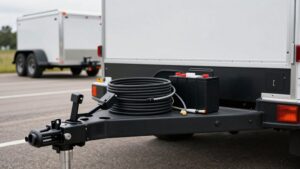
Electric vs Surge Trailer Brakes: Which Is Right for Your Trailer?
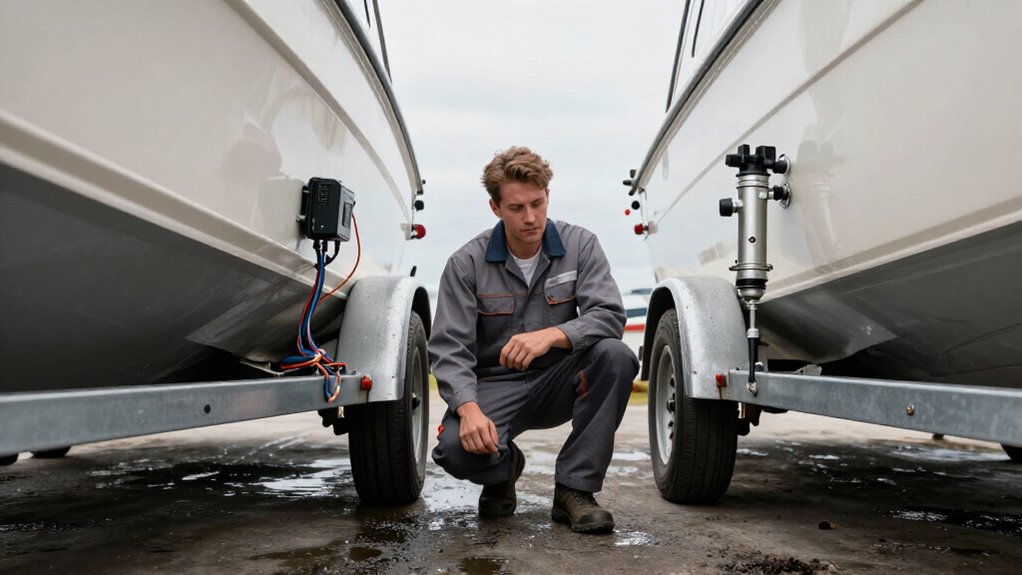
Choose electric brakes if you want direct, repeatable control, especially on steep grades; you’ll need an in-cab controller and wiring to the wheel magnets.
Surge brakes suit you if you prefer a self-contained hydraulic system: trailer momentum compresses the tongue actuator, so no controller is required.
For reversing, breakaway safety, and trailer weight ratings, compare each system’s limits.
The right setup depends on your tow vehicle and trailer use.
Key trade-offs are outlined below.
Quick Brake-Type Overview
Electric brakes rely on a tow-vehicle brake controller to send power to magnets in each wheel assembly when you press the brake pedal; a proportional controller helps match braking force to the tow vehicle’s deceleration, and you can activate the brakes manually if needed.
Surge systems need no tow-vehicle controller or brake wiring; they’re self-contained and commonly suit boat trailers. Compare the systems before towing, then verify the hardware fitted to your trailer.
| Check | Electric / Surge |
|---|---|
| Controller | Required / Not required |
| Wiring | Present / Not required |
| Hub clues | Magnets / Check tongue |
| Typical fit | General use / Boat trailers |
At a glance, electric hubs show magnets and wiring; surge trailers show a hydraulic actuator on the tongue.
Use this comparison to identify equipment and plan a careful safety check before every trip.
Actuation: Coupler vs. Controller
To see how each system applies braking force, compare what triggers it: a surge brake’s coupler actuator compresses when the trailer pushes forward, while an electric brake controller responds to your brake-pedal signal and sends current to the wheel magnets.
That difference matters: surge braking reacts to relative movement between your trailer and tow vehicle; electric braking follows your command through the controller. With a matched proportional controller, you can tune electric brake output gradually for the trailer’s load. Surge force instead depends on coupler and actuator dynamics as the trailer presses forward.
Neither setup removes the need to inspect components and confirm correct adjustment before towing. To identify the system, check the coupler for a hydraulic actuator; electric brakes require wiring to wheel magnets and a controller in the cab. Ensure electric wiring and controller settings match the trailer, and verify the surge actuator moves freely. A fault in either actuation path can compromise braking, so address damage before travel with your trailer.
Stopping Distance and Control
When stopping distance matters, electric brakes give you more direct control: a proportional controller increases braking smoothly with pedal input, while surge brakes engage as the trailer pushes the coupler forward. That response can make electric stopping more consistent and repeatable, especially on slopes or rough, hilly routes where predictable force matters.
- You can tune controller output to match trailer load and road conditions.
- You’ll feel less direct control with surge brakes; trailer momentum triggers their response.
- Below about 40 mph, surge drum and disc results are often comparable.
- Electric systems still let you refine braking through controller adjustments.
- You can manually apply electric brakes; surge systems offer no in-cab command.
Match your setup to conditions, and always maintain a safe following distance behind traffic.
Reversing on Inclines
Incline reversing shifts the focus from stopping distance to controlled, predictable braking. When you back up a slope, electric brakes can respond in proportion to your braking via your controller. This gives you steadier control than surge brakes, which engage only when the trailer compresses its hitch actuator.
While reversing, that pushing force can change, making surge braking weaker or inconsistent. On steep downhill reverses, electric brakes provide a more predictable response because the controller commands braking as you slow the tow vehicle. Set controller gain and proportional response so the trailer brakes engage smoothly without locking its wheels.
If you reverse on slopes, including boat ramps, you may prefer electric brakes for their command from the tow vehicle rather than hitch motion.
Tow Vehicle Wiring Requirements
Because electric trailer brakes rely on power and control signals from your tow vehicle, they require a compatible brake controller and wiring to the trailer.
- Check that your tow vehicle has a compatible controller installation option.
- Confirm its harness carries controller output and the trailer brake signal.
- Route and connect wiring from the controller to each brake assembly.
- Set controller gain for your trailer and test braking before travel.
- Budget for controller installation and wiring if your vehicle lacks them.
Surge brakes activate hydraulically in the coupler as the trailer pushes forward, so they need no in-cab controller or electrical hookup. With electric brakes, verify connections and settings before every tow; otherwise, magnets may not receive proper power and control, compromising stopping performance and safety.
Corrosion in Saltwater Use
Saltwater can corrode either brake system, but electric brakes have more vulnerable electrical components, including wiring, sensors, controllers, and magnets exposed to moisture. That exposure gives electric systems more corrosion-related failure points than surge brakes, which use a largely self-contained mechanical and hydraulic assembly on the trailer. Still, salt attacks shared hardware: drums or rotors, calipers, and fasteners.
Rinse your trailer after saltwater use, and choose properly coated parts; galvanized, zinc-coated Dacromet disc and hub hardware can limit corrosion. Surface rust on rotors may appear, but a few brake applications can wear it away. For surge drum-and-shoe brakes, maintain hydraulic function and follow fluid-service guidance, often about every three to seven years, depending on use. Check operation before towing; rinsing can’t verify safe braking.
Brake Repair Costs
A basic surge-hydraulic overhaul with an A60 master cylinder, brake lines, and servo cylinders typically costs about $200–$250 before major conversion work. Electric conversion often costs about the same or slightly more, depending on which existing parts remain serviceable.
Compare quotes by checking:
- Whether shoes, pads, magnets, and related hardware need replacement
- Whether actuators, wheel cylinders, or lines show wear
- Whether two loaded backing plates cost near two wheel cylinders
- Whether a package repair beats replacing parts piecemeal
- Whether labor and inspection are included in the estimate
If you’re replacing friction parts, budget for adjacent components too; isolated fixes may not restore balanced braking. Ask the shop to inspect both sides and verify operation before towing. Compare repair scope, not just the headline price.
Failsafe Behavior During Breakaway
If your trailer separates, an electric breakaway kit uses its battery to power the brake magnets when the pin pulls. Surge brakes depend on coupler and actuator behavior, so they may not apply consistently without a separate breakaway system.
In either setup, test and maintain the pin, switch, battery, and wiring to help ensure emergency braking works.
Breakaway Battery Activation
When a trailer separates from its tow vehicle, a breakaway system uses its dedicated battery to apply the brakes after the main signal or power is lost. With electric brakes, that battery directly energizes the brake magnets through the breakaway trigger. For surge brakes, you’ll need a compatible added kit if the system lacks battery backup.
- Confirm the pin pulls free during separation.
- Check battery charge before each trip.
- Inspect wiring and terminals for corrosion or loose connections.
- Verify regulated activation holds braking briefly, often minutes.
- Test the system as its manufacturer directs.
That energy gives electric brakes a failsafe; surge brakes have one only when equipped. A battery can leave your trailer without braking, so inspect and test the system.
Surge Coupler Limitations
Because a surge coupler needs forward trailer push to trigger hydraulic braking, it cannot provide its normal braking action after a full separation. In a breakaway, your trailer’s stopping ability depends on a separate actuator and brake system, not the coupler’s usual compression mechanism.
If your setup lacks a dedicated breakaway system, or its battery or trigger fails, the trailer may brake only when the tow vehicle pushes it. Once fully detached, that push disappears.
Unlike an electric controller that can command braking during separation, a surge coupler doesn’t sense separation and apply brakes by itself. As a result, your failsafe depends on a working breakaway actuator and correctly plumbed, adjusted hub brakes.
Pull the pin and confirm both sides apply and hold, not briefly.
Choosing Brakes by Trailer Weight
Check your trailer’s weight rating and loaded weight first, since trailers over about 3,000 pounds commonly need electric brakes. Electric brakes let you adjust stopping force with a controller, which helps manage variable loads and demanding grades; surge brakes apply force automatically and can suit lighter trailers or lower-speed towing.
Match brake capacity to your trailer’s weight and expected conditions, and keep all components in serviceable condition.
Trailer Weight Ratings
Choose trailer brakes by the trailer’s GVWR, not its empty weight, since heavier loads need greater braking capacity. Compare electric and surge components against the trailer’s rated weight and axle limits, then account for the load you actually tow. A system rated below those figures may feel weak or fade, even when it’s new. Local rules may require electric brakes above 3,000 pounds; confirm limits.
- For electric brakes, match per-axle assemblies and controller to weight and wheel count.
- For surge brakes, check actuator capacity and shoe or surface area against the rating.
- Check axle capacity when upgrading; don’t size from empty weight alone.
- Set the controller or actuator for your usual loaded weight.
- Keep adjustments correct, and bleed hydraulic lines; ratings can’t offset poor setup.
Braking Power Needs
When your trailer’s weight demands strong, consistent stopping—especially on slopes—electric brakes usually offer more control than surge brakes.
For heavier loads, an electric brake controller can scale stopping force to the load, giving you adjustable response as terrain or cargo changes. Surge brakes activate automatically when deceleration pushes the trailer against the hitch; they don’t let you set force independently. That difference matters on grades, where consistent, predictable braking helps you maintain control.
Below about 40 mph, some real-world reports find stopping roughly comparable with similar drum-and-disc setups, but electric control can adapt better when conditions vary. As a rule of thumb, you need trailer brakes above 3,000 pounds; then weigh the value of load-adjustable control against surge’s automatic activation. Choose your system.
Matching Brake Capacity
After comparing how each system responds, match brake capacity to the trailer’s GVWR and expected loaded weight. Your brakes must deliver enough force for the load without relying on the system label alone.
- For changing cargo, electric brakes let you adjust controller output to maintain suitable deceleration.
- As weight rises, electric setups, often used from about 3,000 pounds, can provide consistent braking authority.
- Surge actuators increase pressure as the trailer pushes forward, often matching typical loads automatically.
- Check drum or disc size and axle count; total working surface determines capacity.
- Don’t choose by brake type alone; verify assemblies suit GVWR and loaded weight.
Confirm your towing setup meets applicable braking requirements, then test under controlled conditions. Inadequate capacity can lengthen stops and compromise control.
Best Fit by Towing Setup
Your towing setup determines whether electric or surge brakes make more sense: electric brakes pair with an in-cab controller for adjustable, proportional braking and manual application, which can improve control on slopes or rough terrain. If you have a controller, electric brakes provide smooth starts and stops, adapt to loads, and allow manual application. Their proportional response helps maintain control on grades or rough terrain.
Without a controller, budget for wiring, installation, and brake hardware. Surge brakes suit plug-and-play towing: the trailer pushes the coupler to activate them, requiring no controller or extra vehicle wiring. Many boat owners choose surge systems because their self-contained actuator suits water exposure, though electric brakes work with maintenance. Choose electric for precise control; choose surge for simplicity and automatic operation.
Conclusion
Choose electric brakes if your tow vehicle has a compatible controller and wiring, and you want adjustable braking with predictable control. Choose surge brakes if you need a self-contained system that actuates through coupler compression, especially when wiring isn’t practical. Neither type eliminates maintenance or correct sizing.
Match brake capacity to loaded trailer weight, verify breakaway protection, and test operation before every trip. If you’re unsure, have a qualified technician inspect the complete towing setup.
Tongue Jack Rating Calculator
Estimate tongue weight from trailer weight and a cited 10-15% range, then check whether your tongue jack's rating covers it.
Flat Tow vs Tow Dolly Selector Quiz
Five-question quiz that routes you to flat towing, a tow dolly or a car trailer, with a weight check and owner's-manual check lists.
Trailer Tire Size Decoder & Wheel Fit Checker
Decode a trailer tire size, get its diameter, compare a replacement size and check rim size, lug count and bolt circle.