Trailer Towing Laws by State: Brakes, Chains, Mirrors and Speed Limits
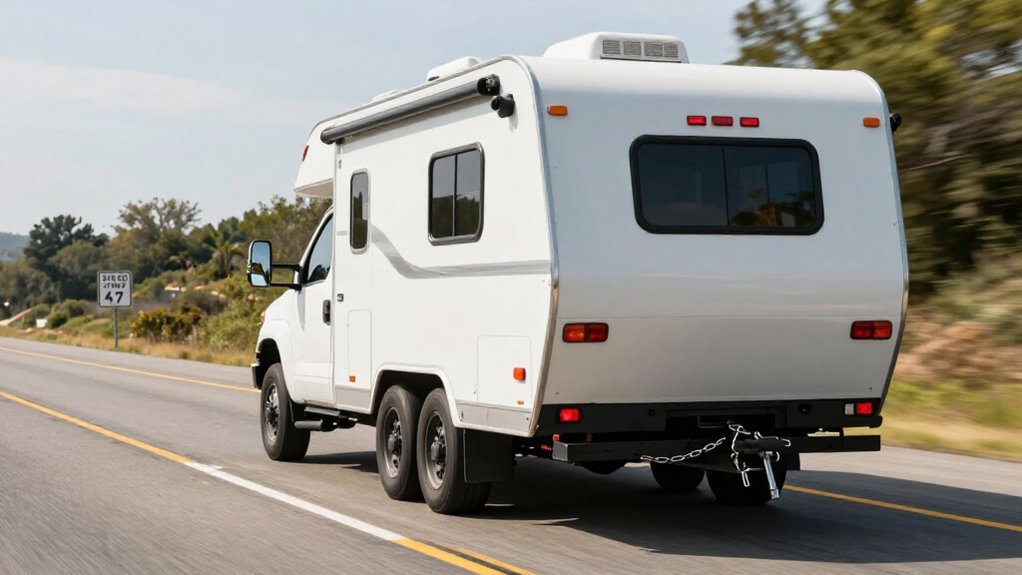
When towing across state lines, follow the laws of each state you enter; your home-state rules don’t control.
Check route-specific speed limits, brake weight thresholds, breakaway requirements, mirror visibility, lighting, and chain rules.
Keep your trailer within your tow vehicle’s GVWR and combined GCWR.
Use rated chain attachment points and cross chains beneath the coupler where required or recommended.
Test brakes and lamps, then confirm equipment rules for every jurisdiction on your route.
The sections ahead explain key checks.
Border-Crossing Law Checks
When you cross a state line, follow the laws of the state you’re entering, not just your home state’s rules.
Check that state’s hitch and safety-chain requirements before you travel. Secure chains to approved attachment points; cross them beneath the coupler when required or recommended to help retain the trailer if the coupler fails. Confirm that your trailer’s lighting and visibility equipment meets local rules, including tail lamps, brake lamps, turn signals, reflectors, and side markers.
Verify the towing speed limit in each state on your route. California sets a 55-mph limit for vehicles towing trailers; Colorado recommends traveling 5 to 10 mph below posted limits. Recheck mirror requirements if your trailer’s width or setup changes; the state may require towing mirrors or visibility equipment.
State-by-State Brake Weight Cutoffs
Because trailer-brake thresholds vary by state, check the rules for every state on your route; the weight cutoff can determine whether brakes are required on two wheels or all wheels, and whether a breakaway system is mandatory.
Use these cutoffs to plan; you’re responsible for compliance in each jurisdiction.
| State | Cutoff | Requirement |
|---|---|---|
| Colorado | Over 3,000 lb | All-wheel brakes; breakaway system |
| California, New York | Over 3,000 lb | Two-wheel brakes; over 10,000 lb: California air brakes, New York all-wheel brakes |
| Texas | 1,500–4,500 lb; over 4,500 lb | Two-wheel brakes; then all-wheel brakes |
Florida generally requires all-wheel brakes above 3,000 lb; smaller brake-free trailers need a hitch with a breakaway switch. California’s air-brake rule applies above 10,000 lb.
Verify current statutes before towing across state lines.
Gross Vehicle Weight Rating (GVWR)
Trailer-brake cutoffs address equipment requirements, but your vehicle’s ratings set the towing limit.
Your tow vehicle’s GVWR is its manufacturer-rated maximum allowable weight, including occupants and cargo. The hitch and trailer load must not push the vehicle above that limit. For combined towing, manufacturers specify a GCWR, the maximum permitted weight of the vehicle and loaded trailer together.
In Colorado, keep both ratings within their limits for legal towing. A payload that feels manageable doesn’t excuse an overload; exceeding GVWR can invite enforcement and strain your engine, brakes, and transmission. Verify the GVWR and GCWR on your compliance label or in your owner’s manual before choosing a trailer. Your GVWR helps determine the trailer’s rating and loaded weight you can tow, which may affect braking requirements.
Mirror Extension Requirements
Mirror requirements vary by state, so check your destination’s rules before towing across state lines. If your trailer is wider than your tow vehicle’s mirrors, or you can’t see the trailer’s full sides and the roadway behind you, fit securely mounted towing mirrors and adjust them before driving.
These extensions help you maintain required rearward visibility and avoid mirror-related violations.
State Mirror Requirements
When your trailer extends beyond your tow vehicle’s mirror coverage, some states require extended towing mirrors that let you see traffic lanes and the trailer’s outer edges.
State rules differ, so don’t assume one state’s equipment standard applies throughout a trip. Before towing across a border, check each state’s current statutes or official transportation guidance for the required mirror type, coverage, and any measurement threshold. Where the law requires extensions, install mirrors that remain securely attached and properly positioned; they must not loosen or fold during ordinary travel, including over bumps or on mountain grades.
You’re responsible for maintaining a clear view of adjacent traffic and the trailer’s edges. Even where extended mirrors aren’t expressly mandated, using them can reduce blind spots and support safer lane changes. Confirm applicable requirements before departure and keep compliant equipment in place while towing. Rules change; verify official sources, not informal summaries, before you travel.
When Extensions Are Needed
On the road, you’ll generally need extended towing mirrors if your trailer blocks your side mirrors’ view of traffic; the exact legal trigger varies by state. Some laws use “substantially obstructs,” so don’t assume one nationwide measurement applies. Your trailer’s width and position matter: a wider load or high-clearance setup may place its sides in your blind spots and trigger your state’s rule.
After hitching, check your view from the driver’s seat before departure; officers may assess mirror compliance during a stop, including visibility of adjacent lanes. A weight-distribution or anti-sway hitch may improve handling, but it doesn’t replace approved extensions when law requires them. Verify your state’s requirements before travel. Use extensions that meet applicable standards; inspect their fit and adjustment before each trip.
Required Rearward Visibility
Colorado requires extended towing mirrors when your trailer’s width reduces rearward visibility, so other drivers can clearly see the trailer’s sides as you change lanes. Your standard mirrors must provide a clear view behind and along the trailer; if its width blocks that view, you’ll need extensions that restore visibility. A trigger is a trailer extending beyond your tow vehicle’s mirrors, often at or beyond legal width of 8.5 feet (102 inches).
On roads with three or more lanes, stay in Colorado’s right or center lanes. Before departure, check mirror visibility rules in Colorado and every state on your route, because thresholds differ. If you fail to provide required rearward visibility, officers may cite you during roadside checks, even when your trailer’s lights and brakes comply.
Mirror Types and Placement
Choose towing mirrors that let you see the lane behind and along both sides of your trailer; if your trailer blocks that view in your standard mirrors, extend them with secure towing or spotter mirrors.
Use manually adjustable extensions or slip-on units that project far enough to show traffic beside and behind the trailer. Your mirrors must remain stable in use; a loose attachment or one that folds inward may fail to provide the required view.
Colorado and many states require adequate rearward visibility when a trailer extends beyond your vehicle’s mirrors, but the trigger and required extension differ by jurisdiction. Wider trailers, particularly those near or above the common 8.5-foot (102-inch) limit, may face additional mirror requirements.
Before towing across state lines, check each state’s DMV or DOT rules for applicable width thresholds and how far mirrors must extend. A trailer’s compliance in one state doesn’t establish compliance elsewhere. Confirm the required mirror setup before you begin each trip.
Avoiding Mirror Violations
If your trailer extends beyond your tow vehicle’s mirror coverage, Colorado requires towing mirrors that let you see clearly along both sides of the trailer while driving and changing lanes. Use mirrors that extend far enough to show the trailer’s full sides, not merely a partial view. Before departure, install or extend trailer-capable mirrors and confirm they remain secure under towing vibration; don’t rely on adjustable mirrors.
If your trailer’s overall width exceeds your vehicle’s mirror coverage, inadequate extension can result in a mirror or visibility citation, even when your trailer’s lights and brakes comply. Check the mirror-extension rules in every state on your route, because requirements may change at state borders. Recheck visibility regularly, and correct any blind spots before entering traffic.
Trailer Brake Safety Margins
To maintain a safe braking margin, check your state’s requirements rather than relying on the common rule of thumb that trailers over 3,000 pounds need brakes, often on all wheels.
State rules may set different thresholds, axle requirements, or exceptions; verify the law for your trailer. Match electric brakes with the correct controller; towing without one when brakes are required can violate state law.
Compare loaded weight with trailer GVWR and your vehicle’s GVWR and GCWR. Near-limit operation can reduce braking effectiveness and increase sway risk. On steep descents, use brakes suited to the load; added weight sharply increases stopping distance, even below tow rating.
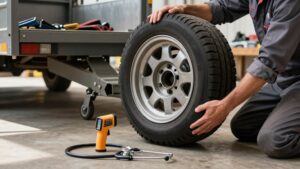
Allow extra space and test brakes before departure. Assess braking performance with the trailer fully loaded, not just empty.
Breakaway Switch Requirements
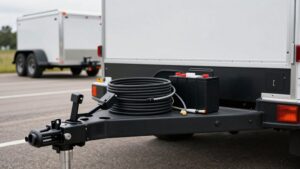
Brake compliance also requires a working breakaway system when Colorado law requires brakes for your trailer’s weight class, including trailers over 3,000 pounds. When your trailer falls within a class requiring brakes, you must equip it with a breakaway system; the 3,000-pound threshold makes this requirement especially relevant to heavier trailers.
The switch must automatically apply the trailer brakes if the trailer separates from your tow vehicle, helping prevent an uncontrolled runaway. Keep the actuator cable connected to the tow vehicle during travel so separation triggers braking immediately.
Test the system before towing; installation alone doesn’t establish compliance. A disconnected cable or failed activation can leave required equipment ineffective and expose you to a violation. Confirm the switch operates during inspection of your trailer.
Towing Speed Limit Differences
Towing speed limits vary by state, so check the rules wherever you travel. Don’t assume the limit for passenger vehicles applies when you’re towing; obey any lower posted limit. In California, you may not exceed 55 mph while towing a trailer. Florida generally applies a 55 mph towing limit unless signs set a different roadway limit.
Texas sets a 60 mph limit when you tow a heavy trailer, while other zones follow general highway rules. In New York, heavy-trailer towing is usually limited to 55 mph, but some zones require less.
Colorado generally has no separate towing speed limit, so follow the posted limit. Consider reducing speed by about 5–10 mph, especially when conditions warrant. Check rules; the strictest posted or legal limit governs.
Trailer Lighting Violations
Which trailer lights must work? Before you tow, verify every required lamp and reflector; a dark or failed circuit can make your trailer unlawful and invite an equipment citation. Requirements vary by state, but federal baseline rules commonly require:
- Working tail lights and brake lights.
- Functional left and right turn signals.
- Rear reflectors and, where required, an illuminated license-plate lamp.
- Side markers and reflectors when your trailer’s dimensions trigger them.
In Colorado, trailers over 3,000 pounds also need compliant braking signals. A faulty plug or partial wiring failure that disables a brake lamp or either turn signal may prompt a stop or citation.
Test each circuit before every trip, including both turns and brake lights; one working side doesn’t excuse the other under law.
Safety-Chain Attachment Points
At the hitch, attach safety chains to rated points on both the trailer and tow vehicle, not to a bumper or other weak mount.
Colorado requires safety chains when you tow a trailer. They must be strong enough to keep the trailer connected if the primary hitch fails. Before departure, verify the hitch, coupler, chains, and attachment hardware carry ratings suitable for your trailer’s gross trailer weight.
- Secure each chain at the designated, rated attachment point on the trailer and tow vehicle.
- Cross the chains in an “X” beneath the trailer tongue; this common safety practice can reduce slack and help support the tongue if coupling separates.
- Adjust chain length to allow turns and suspension movement without dragging excessively.
- Keep chains clear of snag hazards.
Conclusion
Before you tow across a state line, check each jurisdiction’s rules, not just your home state’s. Confirm your trailer’s weight against brake and breakaway thresholds, verify mirror coverage, lighting, and attached safety chains, and observe posted speed limits and any trailer-specific caps.
Don’t assume one state’s compliance satisfies another’s. When requirements differ, follow the stricter applicable standard until you confirm otherwise. Keep your equipment maintained and documentation accessible; you’re responsible for lawful operation throughout the trip.