Is a Trailer Breakaway Kit Required? Rules, Weights and How It Works
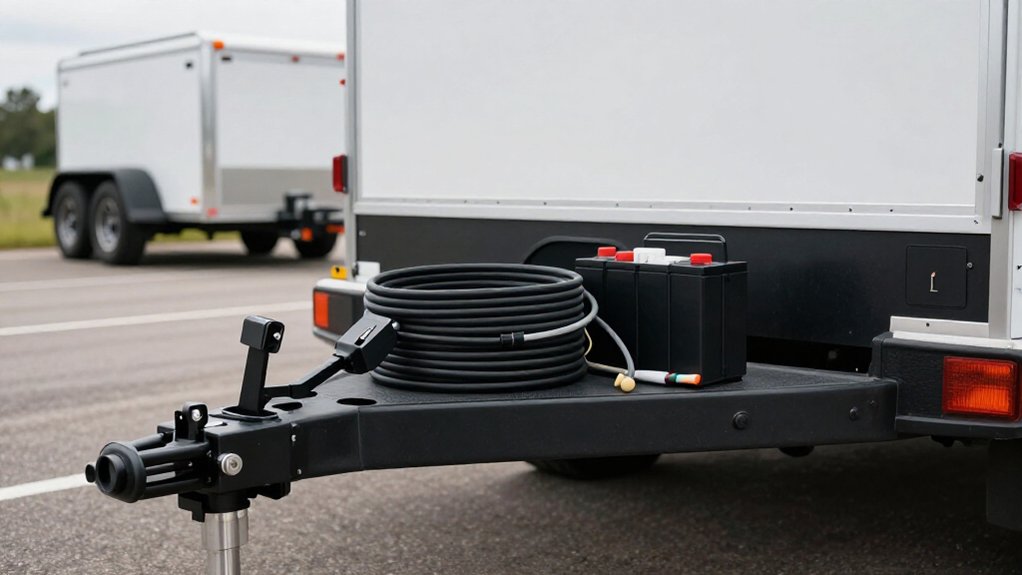
You may need a trailer breakaway kit when its weight or classification triggers your state’s rules; don’t assume one national cutoff. Check whether the law uses actual gross, registered, or another weight, and whether it requires service brakes.
If equipped, the dedicated 12-volt battery powers the electric brakes when separation pulls the switch pin.
Keep the battery charged, and inspect the cable and switch before towing.
Learn how thresholds, setup, and safe checks fit together.
State-by-State Breakaway Requirements
Because breakaway rules vary by state, don’t assume one weight cutoff applies everywhere. Check your state’s statutes and trailer classification before towing, because requirements often track whether your trailer must have service brakes. A commonly cited federal baseline calls for a breakaway kit on trailers with a gross weight of 3,000 pounds or more, but states may add rules or exceptions.
Don’t rely on your service-brake threshold alone: some states set a different cutoff for breakaway equipment. Your state may also require the brakes to hold for a specified period after activation, often cited as 15 minutes, though that standard isn’t uniform. Confirm how your trailer is classified and which state rules apply; Massachusetts, Ohio, and Oregon have classification-related requirements. Verify rules before departure.
Battery Backup Requirements
A breakaway kit needs its own dedicated 12-volt battery to apply the trailer brakes if the trailer separates from the tow vehicle; the lanyard only pulls the switch pin and can’t supply power.
Keep this battery dedicated to breakaway braking; it isn’t for accessories or the normal electric-brake circuit. Before towing, inspect its charge, terminals, wiring and case. A weak or uncharged battery can reduce braking effectiveness, even if the switch appears intact.
Follow the maker’s charging instructions and check applicable inspection rules. Test regularly using the prescribed procedure: confirm a full charge, then verify that the brakes apply and bring the trailer to a stop. If it won’t reach expected voltage during slow charging, or testing fails, service or replace it before towing.
Trailer Detachment Scenario
If the trailer separates from your tow vehicle, the lanyard pulls the breakaway switch pin, connecting its dedicated 12-volt battery to the electric brakes.
You’ll need to treat this as an emergency backup, not a substitute for sound coupling or safety chains. A coupler or hitch failure can leave your trailer detached; surge brakes may not respond if the coupler pops, because they need coupler pressure. Electric-brake trailers depend on the breakaway battery after separation. Check its charge and condition before travel: a weak or dead battery may provide little or no braking.
| Check | Why it matters |
|---|---|
| Coupling and chains | Prevent separation; remain essential |
| Breakaway battery | Supports emergency braking |
Plan a safe stop after separation. Many jurisdictions require breakaway systems when service brakes are required, often around 3,000 lb gross trailer weight. Rules and thresholds vary by state, so verify local requirements and your trailer’s ratings before towing.
How Breakaway Kits Activate
If your trailer separates, the tow vehicle’s attached lanyard pulls the breakaway switch’s pin. That action sends power from the kit’s dedicated 12-volt battery through the trailer brake circuit, engaging the electric brakes.
For reliable backup braking, keep the system correctly wired and its battery charged, as required by applicable regulations.
Breakaway Switch Trigger
When a trailer separates from the tow vehicle, its breakaway cable pulls a removable pin from the switch, completing a circuit that lets the dedicated 12-volt battery power the electric brakes.
During normal towing, you keep the lanyard attached and pin seated; the switch stays inactive, while your brake controller manages braking. The switch is an emergency trigger, not a power source; your battery must be charged to supply current.
Inspect the cable for damage, corrosion, and kinks before each trip; confirm the pin moves freely. Follow maker instructions and requirements for routing and securing the lanyard.
Don’t tow with damaged cable or assume brakes will engage after separation: a jammed pin or failed connection can prevent activation. Repair defects and verify the system before towing.
Pin Removal Activation
As the trailer separates, the properly connected breakaway lanyard tightens and pulls the switch’s removable pin, triggering the kit’s dedicated 12-volt battery to apply the electric brakes. During ordinary towing, keep the pin fully seated and the lanyard connected as specified by the kit manufacturer; your brake controller then operates the trailer brakes, while the breakaway battery remains inactive.
Pin removal is only the activation signal, not the power source: without a charged, properly wired dedicated battery, pulling the pin can’t supply braking current. Before each trip, confirm the lanyard attaches to the tow vehicle at an approved point, has enough slack for turns, and will pull free if the trailer detaches. Check the pin, wiring, battery condition, and applicable local requirements during inspection.
Emergency Brake Engagement
The breakaway pin signals emergency braking, but the dedicated battery supplies the power. If your trailer separates and pulls the cable, the pin leaves the switch. The switch then routes battery power through the trailer’s brake wiring to apply the electric brakes. This system doesn’t rely on your tow vehicle’s brake controller: that controller modulates braking while you’re towing, while the breakaway system responds to detachment using its own battery.
You can’t count on a switch alone to stop a separated trailer. A dead or weak battery, corroded connections, or miswired switch may prevent effective braking. Test the system according to the manufacturer’s instructions, and keep the battery charged and connections sound. Check applicable rules for your trailer; where breakaway equipment is required, a functioning battery-powered system, not just a switch, is essential.
Axle Count and Trailer Weight
Whether your trailer has one axle or multiple axles can affect which wheels must have service brakes as its weight increases. States set different brake thresholds—often near 3,000 pounds—and may define weight by actual gross, registered, or unladen weight.
Don’t assume axle count alone determines breakaway requirements; check your state’s exact threshold and braked-axle rules.
Single- vs. Multi-Axle Trailers
Because braking rules often depend on both gross weight and axle count, a breakaway kit must power every brake circuit required for your trailer’s configuration.
For a single-axle trailer, this may mean one axle’s electric brakes; a multi-axle setup may require braking on all wheels. Your jurisdiction determines which axles need service and emergency braking. Don’t assume every wheel must brake or that one braked axle suffices.
Connect the breakaway switch and battery to the required circuits so separation activates the correct magnets on every required axle. Inspect and test each brake and connection: a disconnected circuit, failed magnet, or discharged battery can undermine an emergency stop.
Check how your jurisdiction defines trailer weight; it may use loaded, registered, or unladen weight for compliance.
Weight Thresholds by State
Breakaway requirements vary by state, so the trailer’s weight and axle configuration can determine whether you need a system. There’s no national cutoff: states commonly use thresholds near 3,000 pounds, while others set limits at 1,500, 2,000, 4,000, 4,500, or 5,000 pounds.
Check the precise weight measure in your state’s law. It may mean gross, actual, registered, or empty weight; Ohio, for example, is commonly cited as using empty weight. Some rules also specify axle or wheel count and braking configuration, with coverage changing as weight increases.
Don’t assume a service-brake threshold is also the breakaway threshold. California and Nevada are commonly associated with brake requirements around 1,500 pounds, and Mississippi around 2,000.
Confirm current state rules for your trailer before towing; proper compliance helps ensure braking if it separates.
Axles Don’t Determine Requirements
Axle count alone doesn’t determine whether your trailer needs a breakaway kit; state law generally ties that requirement to the trailer’s braking classification, often based on weight. Many jurisdictions set a gross-weight threshold for required service brakes; when your trailer meets that threshold, an automatic breakaway activation requirement may apply.
Thresholds often sit near 3,000 pounds, but they vary by state. If your trailer falls below the applicable braking threshold, multiple axles alone won’t necessarily trigger a breakaway-kit mandate.
Check the statute’s exact weight measure: your state may use actual gross weight, registered weight, or unladen weight. These terms can place the same trailer in different legal categories. Don’t infer braking or breakaway requirements from axle count; verify which brake rules apply before towing.
Breakaway Kit Inspection Schedule
To keep the breakaway system ready for an emergency, inspect it at least once a year and whenever you service the brakes or maintain the trailer. Use each inspection to confirm:
| Check | What to verify |
|---|---|
| Battery and wiring | Battery’s fully charged and secure; wiring’s intact, clean, and firmly connected. |
| Cable and switch | Cable’s sound and correctly attached; pin releases and switch activates. |
Don’t rely on a click: test in a safe, controlled setting and confirm the trailer brakes engage and slow or stop it as expected.
Replace failing battery, switch, or cable components promptly; a charged battery and intact circuit must supply adequate brake power during separation. Follow local requirements; keep a record of checks and repairs, and repeat the inspection after brake or electrical work.
Breakaway Cable Snag Risks
A snag can pull the breakaway switch pin prematurely, applying the trailer brakes, or leave the cable partly tensioned so it may not pull the pin during a separation.
Route the cable to allow full trailer movement without excess slack or contact with the frame, road debris, or hitch components. A loose end or snag while backing can pull the pin, energizing the 12-volt battery circuit and applying the brakes unexpectedly. Partial tension may prevent full pin removal during separation, reducing emergency braking effectiveness.
Inspect cable and chain parts at least annually for wear, stretching, fraying, correct length, and free movement. With the trailer safely secured, test operation; confirm the brakes engage and check that the cable doesn’t rub afterward. Follow all applicable legal requirements.
Parking Brake Misuse
For parking, don’t use the breakaway cable as a stay-put control: the switch is designed to activate once when the trailer separates and the pin pulls, not to hold it in place. Repeatedly pulling the pin can energize your electric brakes long enough to overheat or wear components, while draining the dedicated breakaway battery.
- Use your trailer’s parking brake, if equipped, for a proper stationary hold.
- Add wheel chocks on suitable ground; don’t rely on electrical braking.
- Keep the lanyard and switch reserved for genuine emergency separation.
- The pin should pull only when the trailer actually disconnects.
- After misuse, check the battery and system before towing again.
Follow applicable rules: breakaway protection is emergency backup; a depleted battery may not stop a disconnected trailer.
Match the Kit to Your Coupler
Once the parking brake and wheel chocks secure the trailer, choose a breakaway kit that corresponds to your coupler, tongue, and brake type. Match switch style and mounting to your tongue; position the switch so its pin pulls without snagging. Confirm your kit’s coupler and charging setup.
If it uses a pin and cable, route the cable so it travels freely and pulls the switch completely when the trailer separates. Ensure it reaches the tow vehicle, but avoid excess slack, which can delay activation, and routing that rubs or catches.
For electric brakes, verify the kit uses a dedicated 12-volt breakaway battery to activate them. Check local rules and kit specifications. After installation, pull the switch to test brake application, then ensure the pin fully reseats in its coupler-side mount.
Conclusion
Before towing, confirm your state’s breakaway rules, weight thresholds, and battery requirements; regulations vary. Match the kit to your coupler and trailer, then test its operation and inspect the battery, wiring, switch, and cable regularly.
Route the cable so it won’t snag, and don’t use it as a parking brake. If your trailer detaches, the system should apply its brakes independently. A correctly installed, maintained kit can reduce risk, but it can’t replace safe hitching or routine checks.
Tongue Jack Rating Calculator
Estimate tongue weight from trailer weight and a cited 10-15% range, then check whether your tongue jack's rating covers it.
Flat Tow vs Tow Dolly Selector Quiz
Five-question quiz that routes you to flat towing, a tow dolly or a car trailer, with a weight check and owner's-manual check lists.
Trailer Axle Position & Axle Weight Calculator
Find an axle position for a target tongue weight, or calculate tongue and axle-group loads for an existing trailer layout.