Trailer Leaf Spring Size Chart: Length, Eye Type and Capacity
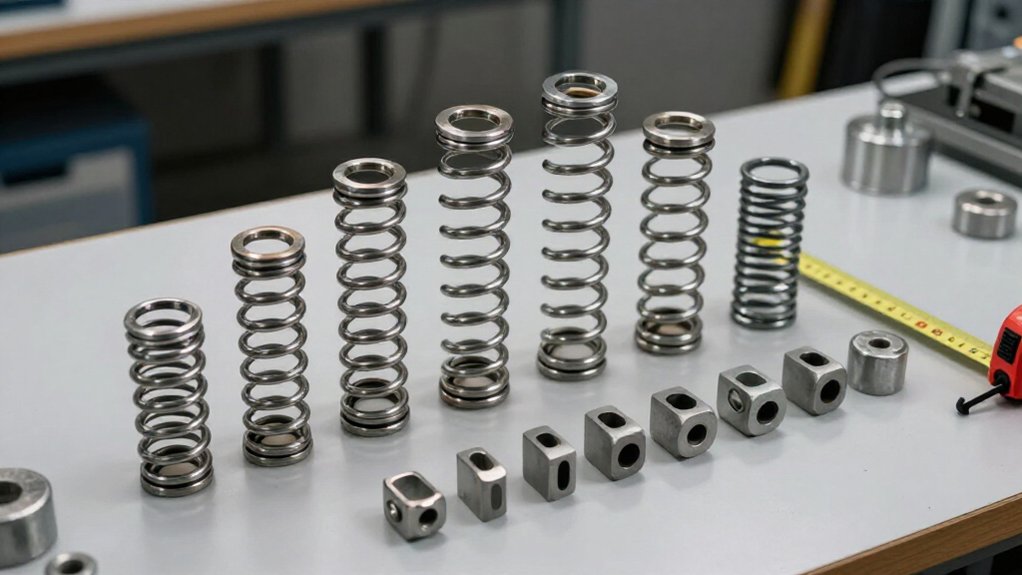
Choose a trailer leaf spring by matching its unloaded length, mounting style, and per-spring capacity—not by width alone. Measure double-eye springs center-to-center; measure slipper springs from the eye center to the contact point, identifying open-eye, hook, flat, or radius ends.
Support the frame and unload the spring before measuring. Confirm the spring’s rating meets the required load per spring and axle limits. Check arch, pack details, and clearance before ordering; the sections explain each fitment check.
Raising the Trailer Coupler
Raising the trailer coupler can change axle stance, spring angle, and ride stiffness, so don’t use longer shackles as a shortcut for a small lift: replacing common 2-5/8-inch shackles with 3-1/2-inch shackles leaves the hanger in place, makes the links sit more upright, and can create a stiffer ride and uneven lift.
For a modest raise, replace the hangers with units positioned about one inch deeper from the bolt-hole center to the hanger top. This keeps spring geometry closer to its intended working range. An over-under conversion can add roughly the axle diameter plus the spring seat, often exceeding a one-inch increase. Account for that change before choosing a method.
After adjusting coupler height, confirm the springs can flex freely under load. Support the trailer securely and use rated components. Don’t assume coupler adjustment alone corrects axle alignment or guarantees safe handling; inspect your setup before travel.
Leaf Spring Measurement Points
To measure a leaf spring accurately, unload it by supporting the trailer frame with a jack so the spring isn’t flattened. Keep the trailer stable on level ground, chock the wheels, and use rated stands; never rely on a jack alone. Measure free length in a straight line, choosing endpoints by spring style:
| Spring type | Start point | End point |
|---|---|---|
| Double-eye | Front eye bushing center | Rear eye bushing center |
| Open-eye slipper | Front eye bushing center | Open eye center |
| Hook-, flat-, or radius-end slipper | Front eye bushing center | Seating contact point |
Also measure width across the top leaf; 1-3/4 inches (1.75 inches) is common. Record axle location separately from spring length when matching a replacement.
Confirm measurements before ordering, since different end styles use different reference points.
Spring Arch and Camber
A leaf spring’s arch, or camber, is its built-in curve when unloaded; under vertical wheel load, the spring flattens and flexes to absorb bumps. When you compare spring condition or choose a replacement, check unloaded arch against specifications. As the axle moves, flattening changes spring length between the frame-fixed and moving ends, helping absorb shock and limit impact transfer.
The leaves resist compression progressively, with greater resistance as they approach flat.
If your springs look less arched than before, they’ve likely lost camber and ride height. Reduced arch lowers trailer height and leaves less travel before near-flat, which can make the ride harsher. Don’t assess camber by appearance; compare unloaded springs consistently with the trailer maker’s specifications. Replace sagging or damaged springs with rated parts.
Double-Eye Versus Slipper Springs
Double-eye springs mount through pivoting shackles at both ends, while slipper springs use one eye and one sliding contact end, changing how the axle moves as the spring flexes. These designs can produce different ride behavior and load ratings, so don’t assume springs with the same width are interchangeable.
Match your chart’s capacity and exact end configuration to your trailer’s mounts before installation.
Mounting Style Differences
Mounting style determines how a trailer leaf spring moves and how you measure it for fit.
Double-eye springs have two fixed mounting eyes, one at each end, and typically connect through shackle-style linkages. Measure their length from the center of one eye to the center of the other. Slipper springs have one fixed eye and one end that slides against a stationary surface.
Their length measurement runs from the eye center to the specified contact point; identify whether the end is open-eye, hook, flat, or radius style before using a chart. Since pivoting hardware and sliding interfaces aren’t interchangeable, match the exact spring and mounting style to preserve fit and alignment. For either design, verify the eye-bushing inside diameter—often 9/16 inch, sometimes 1/2 inch—and confirm it fits your hanger or shackle bolts. Don’t rely on length alone, either.
Axle Movement
As load increases, both spring types flatten and change effective length, but they manage that movement differently. With a double-eye spring, each end connects through a pivoting shackle. As the arc flattens, the spring grows in length, and the shackles swing to take up that growth.
The axle’s movement is governed by the links’ rotation and geometry.
A slipper spring uses a path: you secure one end in a frame hanger, while its open end slides against a support. That sliding interface accommodates spring length as the spring flattens; axle movement is fore-and-aft rather than hinge-based.
When you replace a spring, match its eye style and attachment mechanism, not by appearance alone. A pivot-type axle setup can’t use a slip-type spring. Verify fitment before towing.
Ride Characteristics
Because the two designs manage spring-length changes differently, they can feel different over bumps and under changing loads.
Double-eye springs connect through eyes, with pivoting shackle links at the mounted end. As your axle moves, the spring mainly flexes around these pivots rather than sliding against the frame. You may notice ride behavior shaped by shackle movement during bump travel.
Slipper springs use a sliding contact at one end to accommodate changes in effective spring length. As the spring flattens under vertical load, it can extend along this surface, reducing binding and helping maintain a consistent ride as conditions vary.
When replacing a spring, match its length and width, and verify the end style: double-eye, slipper, open-eye, hook-end, flat-end, or radius-end. Each style affects movement and ride, so confirm your mounts match before towing to avoid improper movement and unsafe operation.
Load Capacity
Choose a replacement by its per-spring “Lbs/ea” rating, not by whether it’s double-eye or slipper: either design must meet or exceed the load required for each spring.
Double-eye springs use fixed pivoting shackles at both ends; slipper springs use a sliding interface at one end. For either design, match the chart’s rating to the exact part, length, width, stack, and slipper end profile. Width alone won’t establish capacity: two 1.75-inch OpenEye parts rate 2,850 and 1,600 lbs/ea. Double-eye parts at that width also vary, from 27-203 at 3,500 lbs/ea to UNA-049 at 1,000 lbs/ea.
If your axle is rated 3,500 lb and uses two springs, the usual target is at least 1,750 lbs/ea. Check each replacement’s listed capacity against that requirement; don’t infer load rating from appearance or eye configuration. Verify ratings for both replacement springs before towing, and keep the axle’s stated limit as the controlling system constraint for safety.
Choosing Spring Type
Before selecting a replacement, match its spring type to the trailer’s suspension: double-eye springs attach through eyes at both ends, while slipper springs have one eye and a sliding end.
Measure a double-eye replacement from center-of-eye to center-of-eye, and confirm both bushing positions align with the hanger and equalizer. For a slipper spring, the fixed eye anchors one end; the other slides to accommodate spring-length changes under load. Don’t use double-eye measurement rules for this design.
For an open-eye slipper, measure from eye center to open-eye center and match that style. Hook-, flat-, and radius-end versions measure from eye center to the opposite-end contact point, so identify the end before measuring.
Then verify capacity by SKU: dimensions and spring type don’t establish rating. A 1.75-inch-wide double-eye 27-203, for example, is rated 3,500 pounds each.
Axle Load Capacity Limits
Match each replacement spring’s per-spring rating to the axle’s identified capacity: a 3,500-lb axle typically uses two springs rated at about 1,750 lb each. Use this rule, but verify rated limits carefully before ordering. Check the axle rating on the VIN trailer tag or axle tag before you order. Spring thickness, width, and leaf count alone don’t establish capacity.
Confirm the catalog lists “Lbs/ea” and select that per-spring value, not a combined pair rating. If you can’t locate a spring part number or capacity, use the axle’s rating and choose springs whose combined capacity meets or exceeds it. When tags are missing, bearing part numbers or axle diameter can help estimate capacity; 3,500-lb axles often measure about 2-3/8 inches in diameter. Don’t rely on estimates when you can verify the axle rating.
Reversed-Eye Spring Clearance
After confirming axle capacity, check clearance carefully if you’re considering a reversed-eye spring.
A reversed-eye, or reverse-arch, spring has its eye end rotated 180°, flipping the arch. This can change free length and clearance around the frame, hangers, and shackle.
Match the length measurement to your spring style: center of eye to center of eye for double-eye springs, or the relevant eye-to-contact point for slipper/open-eye styles. Confirm whether the end is a hook, flat, or radius type; contact geometry affects movement and clearance.
Check at full bump and full droop, not just at ride height. As the spring flattens, its length grows, so interference may occur at a travel extreme.
To restore clearance, measure from the frame mount or hanger to the spring’s endpoint. Compare replacement length, width, and per-spring capacity before installation.
Load Rating Identification Tags
To identify a leaf spring’s load rating, first look for a stamped or painted part number on the strap near the short leaf’s end or on the pack’s concave side. That identifier is your most reliable match to the correct capacity. If corrosion obscures it, check the trailer’s VIN tag or axle tag for the axle rating.
Select springs rated at about half that capacity per spring; for example, a 3,500-pound axle typically needs 1,750-pound springs. Confirm the chart lists pounds per individual spring (“lbs/ea”), since the pair must meet the axle’s required capacity. If tags are missing, bearing part numbers and axle diameter can help estimate capacity; 3,500-pound axles commonly measure about 2⅜ inches, though rare 3½-inch cases exist.
Don’t infer rating from leaf count or visible width; neither reliably predicts capacity. Verify identification before towing to avoid overload under your rated load.
Spring Pack Thickness
Once you’ve confirmed the spring’s load rating, check its stack height: the total thickness of the leaves at the stacked, clamped area, not the spring’s width.
Use this measurement to verify the pack build shown in the size chart. Even springs with the same width and similar leaf counts can have different stack heights. Match both stack height and capacity when the chart lists them; together they identify the correct replacement configuration.
Measure at the compressed stack, where the leaves meet the clamp; this is the chart’s reference point.
- Keep the spring unloaded and supported before measuring.
- Compare the listed stack height, not width alone.
- Treat mismatches as a reason to recheck fit and rating.
- Install a matched pack; incorrect thickness can compromise safe operation.
Spring Center-to-Center Distance
Spring center-to-center distance identifies a leaf spring’s length, but the measurement points depend on its end style.
Measure each spring unloaded to get its free length, and use the same definition when matching a chart.
- For a double-eye spring, measure from one eye-bushing center to the other.
- For an open-eye slipper, measure between the eye-bushing center and open-eye center, not the hook.
- For hook-, flat-, or radius-end slippers, measure from the eye-bushing center to the end’s seating contact point.
- Select chart length that matches both spring type and slipper end; definitions differ.
A mismatch can prompt an incompatible replacement, so verify before ordering. Don’t measure a loaded spring: load changes geometry and compromises comparison. Confirm capacity and fit separately against your trailer specifications and axle requirements before installation.
Conclusion
Use the correct trailer leaf spring size by matching its length, eye style, arch, pack thickness, and center-to-center spacing—not by appearance alone. Verify the spring’s rated capacity against the axle and trailer requirements, and account for coupler height and clearance, especially with reversed-eye designs.
Replace springs in axle pairs with compatible parts, then inspect fasteners and alignment. If measurements or ratings are uncertain, consult a qualified trailer technician before towing.
What Size Trailer Hitch Do I Need? Class Selector
Enter loaded trailer weight, tongue weight and your ratings to get the minimum hitch class (I–IV) and see which rating sets your limit.
Trailer Loading Ramp Length Calculator
Find the ramp length for a trailer deck height and angle, the angle an existing ramp gives, and whether a low vehicle will high-center.
Trailer Tire Size Decoder & Wheel Fit Checker
Decode a trailer tire size, get its diameter, compare a replacement size and check rim size, lug count and bolt circle.
Towing Capacity & Truck + Trailer Weight Calculator
Total your loaded trailer, estimate tongue weight and compare it with your tow rating, payload, GVWR, GCWR, rear GAWR and hitch limits.