How Heavy Can a Trailer Be Without Brakes? State-by-State Weight Limits
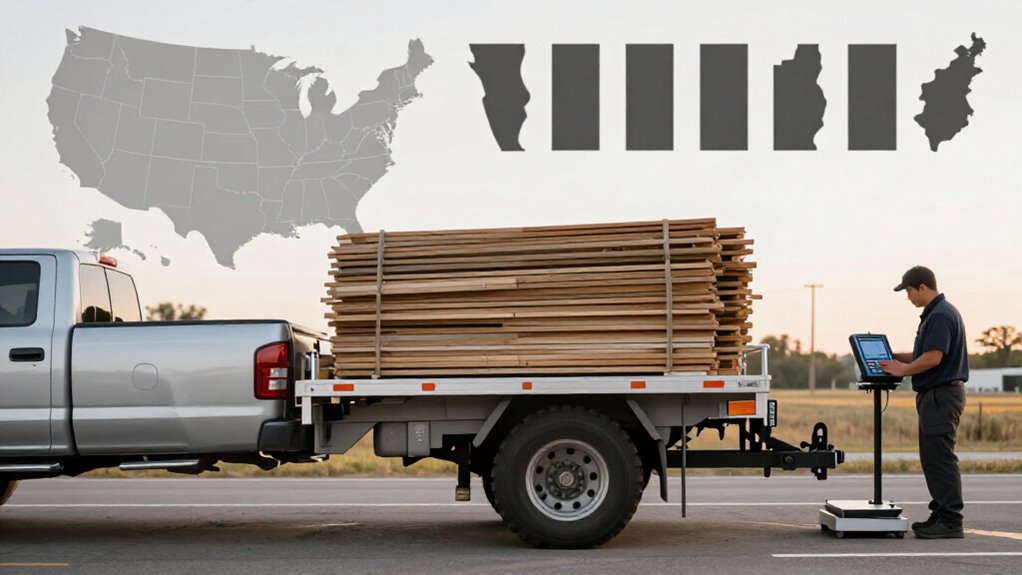
There’s no nationwide weight limit for towing a trailer without brakes; you must follow each state’s law.
Many states require brakes at about 3,000 pounds gross weight, while California and Nevada use 1,500 pounds gross, and Idaho uses 1,500 pounds unladen.
Don’t treat figures as universal: some states apply performance, ratio, or equipment rules.
Check weight definitions and breakaway requirements for each state on your route before towing; the details can help you verify them.
State-by-State Brake-Free Weight Limits
There’s no single nationwide weight limit for a trailer without brakes: many states require service brakes at about 3,000 pounds, while California and Nevada generally use a 1,500-pound gross-weight threshold and Idaho uses 1,500 pounds unladen. Your trailer’s legal status depends on the weight measure named in the statute, not simply its scale reading. A law may refer to gross, actual, registered, or unladen weight, and those terms aren’t interchangeable.
Some jurisdictions don’t set one universal cutoff; Kansas and Kentucky, for example, may require brakes according to stopping-performance standards. Montana generally uses a 3,000-pound gross-weight trigger, but conditions or weight ratios can affect certain lighter trailers. Before towing, verify the current rule for your route and compare the specified measure with your trailer’s weight.
Don’t treat a potential brake-free allowance as a safety target: braking distance, load, road grade, and tow-vehicle capacity still matter. Install and maintain suitable brakes whenever required, and consider them below the legal threshold when feasible.
State Brake-Weight Threshold Chart
Because states define trailer weight differently, use this chart as a starting point and check the rule for every state on your route.
A threshold may measure gross, registered, or empty weight, so confirm the statute’s wording before towing.
| State or rule | Brake trigger |
|---|---|
| Many states | About 3,000 lb gross |
| California, Nevada | About 1,500 lb gross |
| Idaho | About 1,500 lb unladen |
| Kansas, Missouri | Performance or equipment rules |
Don’t treat these figures as permission to tow without brakes; loaded weight and stopping ability matter. Many jurisdictions separately require breakaway equipment, often battery-powered and pin-activated, even when the service-brake threshold differs.
Check current state requirements and equipment before departure; if rules differ along your route, follow each jurisdiction. Keep documentation accessible, and verify that your trailer’s brakes and breakaway device function correctly; legal thresholds don’t replace safe stopping capacity under load or in traffic.
Axle-Count Brake Exemptions
Axle count can affect trailer-brake requirements, but it rarely creates a blanket exemption. States may escalate brake duties according to a trailer’s axle configuration, weight, or both. Spacing and configuration can matter even when the trailer is near a trigger.
Don’t assume that extra axles excuse required equipment. Some laws require brakes on all wheels for a covered trailer category; the number of axles can thus affect which wheels must be equipped. Axle-based load allowances don’t automatically waive braking duties. Before towing, compare your trailer’s axle arrangement with the state’s exact statutory terms, including whether they refer to gross weight, unladen weight, or braking performance.
If the rule is unclear, confirm with the responsible state agency and guarantee your setup can stop safely.
Brake-Exemption Weight Bands
You’ll commonly see brake exemptions end near 3,000 lb, but some states set lower thresholds around 1,500 lb or higher limits from 2,000 to 5,000 lb. Check whether your state measures gross, unladen, registered, or manufacturer weight, and whether its rules impose ratio, performance, or all-wheel braking conditions.
Before crossing state lines, verify each state’s exact threshold and confirm your trailer meets its requirements.
Common Exemption Thresholds
Brake-exemption limits often fall into weight bands, but the trigger depends on each state’s statute. In many jurisdictions, you’ll encounter a threshold near 3,000 pounds, while some require brakes at roughly 1,500 pounds. Others use a trigger near 2,000 pounds or measure a different weight entirely.
Don’t assume the number refers to the trailer’s loaded gross weight: a statute may specify actual gross weight, unladen weight, or empty weight. That distinction can change whether your trailer qualifies, especially when its load adds weight. A threshold also may not be the only test. Your state can require brakes based on stopping performance, axle count, or wheel-related provisions. Before towing, verify the statute’s wording and apply its measurement method. If uncertain, equip the trailer with brakes.
State Weight Bands
State brake-exemption bands vary, so don’t treat 3,000 pounds as a nationwide rule. Many states allow trailers below roughly 3,000 pounds to operate without electric service brakes but require them at or above that trigger. California and Nevada use a lower threshold of about 1,500 pounds. Idaho triggers requirements at an unladen weight of 1,500 pounds or more, while Ohio often ties the rule to empty weight.
Kentucky and Kansas may assess whether your trailer can stop safely rather than apply one fixed weight cutoff. Colorado requires brakes above 3,000 pounds and may also require them at or below that level when the trailer exceeds 40% of the towing vehicle’s gross weight. Check your state’s law before towing, and fit brakes when required.
Trailer Weight Definitions
Trailer weight definitions determine whether a brake exemption applies: most states require service brakes once a trailer’s gross weight reaches a threshold near 3,000 pounds, but the cutoff and measurement vary.
Check the statute’s defined measure before you compare your trailer with a limit. California and Nevada commonly set lower triggers, around 1,500 pounds. Idaho generally measures unladen, or empty, weight near that figure, not loaded gross weight.
Montana generally requires brakes when gross weight exceeds 3,000 pounds, while some lighter trailers face a weight-ratio test. Kansas doesn’t rely solely on one cutoff; required stopping performance and the trailer’s weight relative to the tow vehicle can determine whether brakes are necessary. These distinctions matter: gross, unladen, manufacturer-rated, and registered weights aren’t interchangeable.
Use the definition your state applies, then assess the trailer using that measure. A mistaken comparison can put you outside the exemption and compromise safe, controlled stopping during sudden or emergency maneuvers.
Exceptions And Conditions
Although many states exempt trailers from service-brake requirements below a specified weight, that exemption is conditional, not universal.
Many states set exemption bands around 1,500–3,000 pounds, but you must identify the statute’s measure. It may use gross weight, registered gross weight, or unladen weight; these figures aren’t interchangeable.
California and Nevada use thresholds near 1,500 pounds, while Idaho’s trigger concerns unladen weight. Don’t assume a trailer qualifies based only on its loaded reading.
Some laws add equipment or ratio conditions. A brake requirement may apply at a threshold only when the trailer has brakes on all wheels. Other rules require brakes when a trailer weighing 3,000 pounds or less exceeds 40% of the tow vehicle’s gross weight.
Check the definitions and conditions before towing. The wrong weight yardstick can invalidate an exemption and leave you operating unlawfully or unsafely.
Multi-State Compliance
When you cross state lines, don’t assume one brake-exemption weight band applies everywhere: many states use a service-brake trigger near 3,000 pounds GVW, while others use thresholds such as 1,500 pounds, 2,000 pounds, or unladen weight.
Identify whether each statute measures gross weight or empty/unladen weight. A trailer below one state’s gross-weight trigger may exceed another’s unladen-weight limit.
Check additional conditions: Colorado applies a 40% of tow-vehicle GVW test to certain trailers at or below 3,000 pounds, while Kentucky, Kansas, Missouri, and Montana may rely on stopping performance or the trailer-to-tow-vehicle relationship.
Don’t treat a weight band as a universal exemption. Confirm the rule and its measurement method for each state, and verify breakaway requirements; meeting a service-brake exemption doesn’t automatically exempt breakaway equipment.
Verify Brakes Across State Lines
If you cross state lines, check each state’s brake rules because a trailer that’s legal in one may require brakes in another. Before you leave, identify each state on your route and read its statute; don’t assume one weight limit applies everywhere. Many states set thresholds near 3,000 pounds, while others use limits below that.
Nevada requires brakes on all wheels at 1,500 pounds gross weight; Idaho commonly requires them at 1,500 pounds unladen weight. These terms aren’t interchangeable, so compare your trailer’s weight with each statute’s definition. Some states use stopping-performance or trailer-to-tow-vehicle ratio rules instead of a threshold.
Kentucky emphasizes performance, and Kansas requires the combination to meet stopping standards. Check whether each rule covers service brakes, breakaway systems, or both, and meet the strictest requirement.
Mountain Descent Brake Risks
On a long mountain descent, a trailer that falls below a state’s brake threshold can still exceed safe stopping performance in real conditions. Grade, wind, heat, and added speed can increase stopping distance and reduce control.
Many states require service brakes at about 3,000 pounds gross weight, while others set lower limits, use unladen weight or trailer type, or apply stopping-performance and tow-vehicle weight-ratio tests.
Check the rule that applies to your trailer and route; a trailer that feels light on level ground may push or sway downhill.
Without trailer service brakes, your tow vehicle handles the full braking load, risking brake fade. Engine braking may not control speed adequately. Confirm coupling and safety-chain integrity, and avoid extreme descents when you can’t legally or practically brake the trailer.
Boat Trailer Launch Scenario
Before towing a boat trailer to the launch, check brake rules for every state on your route. A service-brake trigger is about 3,000 pounds gross trailer weight, but states differ. Some use lower limits, such as 1,500 or 2,000 pounds; others measure unladen weight rather than loaded gross weight.
A few base the requirement on trailer-to-tow-vehicle weight ratios or performance tests, so the same boat and trailer may be treated differently behind another vehicle.
Check each state’s rules for your route and its maximum weight without supplemental brakes. Confirm how the law defines weight and whether the trailer meets required thresholds. You must secure the coupling and safety chains. Breakaway brakes, when required, apply only if the trailer separates; they don’t replace service brakes.
Brake Controller Troubleshooting
Once you’ve confirmed your route’s brake-weight rules, check that the controller matches the trailer’s actual gross or unladen weight, as the state defines it.
Many states require brakes above thresholds near 3,000 pounds; Nevada or Idaho may set lower limits around 1,500 pounds, depending on the statutory weight basis. Confirm your controller’s setting reflects that gross or unladen measure.
- Verify power at the controller: battery feed and ground must be sound.
- Confirm the correct harness routes the trailer-brake circuit; inspect output wiring for proper gauge, loose connectors, or shorts.
- Check brake magnet polarity where applicable and inspect breakaway battery, switch pin, and lanyard for faults.
Test manual activation only in a controlled setting where the wheels can be safely braked. If braking feels weak, adjust output gain for the trailer’s weight; low gain can mimic failure. Don’t tow until you’ve confirmed reliable operation and repaired all identified faults.
Boat Trailer Launch Scenario
A boat trailer can meet your tow vehicle’s capacity and still violate the launch state’s brake rules.
Before you tow, verify the trailer’s actual gross weight and apply the law where you’ll launch. Many states require brakes around 3,000 pounds, but thresholds differ; statutory terms may also differ.
- Nevada commonly requires brakes at 1,500 pounds gross.
- Idaho commonly uses 1,500 pounds unladen weight.
- Check maximum towing limits too; they may not match the federal 80,000-pound GVW baseline.
If your trailer exceeds the no-brakes threshold, install properly operating service brakes; safety chains aren’t a substitute. Check whether the state requires a properly set breakaway electric system.
For interstate trips, don’t assume your tow vehicle’s capacity—or another state’s rule—authorizes an unequipped trailer at your launch.
Conclusion
Before you tow, confirm the brake requirements for every state on your route; rules may depend on trailer weight, axle count, and vehicle class. Don’t rely on a single threshold or assume an exemption travels across state lines.
Equip and maintain brakes that meet applicable law, and test them before departure. If you’re unsure, verify requirements with the relevant motor vehicle agency. A compliant braking system protects you, your cargo, and everyone sharing the road.
Tongue Jack Rating Calculator
Estimate tongue weight from trailer weight and a cited 10-15% range, then check whether your tongue jack's rating covers it.
Fifth Wheel / Gooseneck Pin Weight & Payload Checker
Estimate fifth wheel or gooseneck pin weight and check it, plus hitch, people and cargo, against your truck's door-jamb payload sticker.
Flat Tow vs Tow Dolly Selector Quiz
Five-question quiz that routes you to flat towing, a tow dolly or a car trailer, with a weight check and owner's-manual check lists.
Trailer Tire Size Decoder & Wheel Fit Checker
Decode a trailer tire size, get its diameter, compare a replacement size and check rim size, lug count and bolt circle.
Towing Capacity & Truck + Trailer Weight Calculator
Total your loaded trailer, estimate tongue weight and compare it with your tow rating, payload, GVWR, GCWR, rear GAWR and hitch limits.
Trailer Axle Position & Axle Weight Calculator
Find an axle position for a target tongue weight, or calculate tongue and axle-group loads for an existing trailer layout.