Boat Trailer Winch Size Guide: Capacity by Boat Weight and Ramp Angle
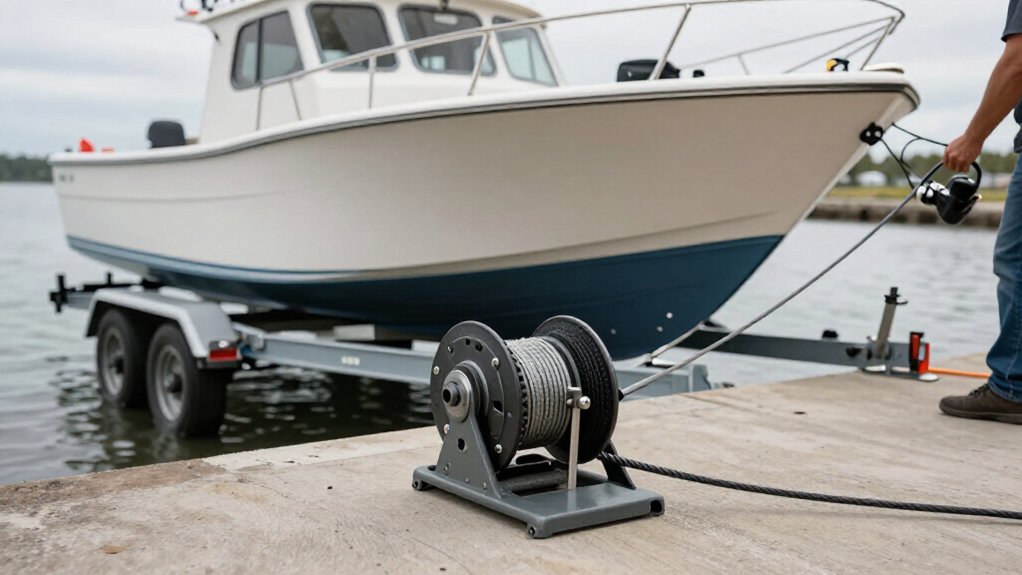
Size your trailer winch for your boat’s loaded weight, including engine, fuel, water, gear, and safety equipment—not dry hull weight.
Estimate ramp pull by adding bunk friction and incline; a rough starting point is 25% friction plus 7% slope, or about 320 pounds for a 1,000-pound boat.
Choose a single-line-rated winch around 1.5–2 times loaded weight for margin.
Steeper ramps, dry bunks, or hull drag can raise demand.
The sections below refine your estimate.
Ramp Angle Load Adjustments
On a ramp, account for slope resistance as well as bunk friction when sizing your winch. If you’re pulling against both bunk friction and an upward grade, combine their effects instead of sizing for friction alone.
Add roughly 7% of the load for slope resistance to your base friction estimate; for example, 25% friction plus 7% slope equals about 32% total resistance. A 1,000-pound boat creates 320 pounds of pull (0.32 × 1,000), which you can use in winch and handle-force calculations.
Don’t treat that estimate as a guaranteed maximum. Choose a winch with a safety margin where the ramp gets steeper. Include heavier fuel and gear and the steepest ramp in your worst-case estimate, so conditions don’t erase your margin.
Boat-Weight Winch Capacity
Size your winch for the boat’s loaded weight—the hull, engine, fuel, water, and gear—not its dry hull weight. Allow for ramp resistance by choosing capacity at least 1.5–2 times loaded weight; this margin helps manage incline and friction, but it doesn’t replace sound rigging or safe operation.
| Loaded weight | Suggested capacity |
|---|---|
| 1,000 kg | 1,500–2,000 kg |
| Worked estimate | 1,800 kg (~4,000 lb) |
For the example, applying 1.5× incline and 1.2× carpet-friction factors gives 1,800 kg, or roughly 4,000 lb. Rated capacity and line pull aren’t interchangeable: slope and bunk friction determine resistance, while gearing affects handle effort. A 1,000 lb boat may create about 320 lb of line resistance; a 15:1 gear ratio reduces crank force to roughly 21 lb.
Keep clear during loading.
Boat Weight Measurement Methods
For boat weight measurement, start with the manufacturer’s dry hull weight, then add the engine, fuel, water, gear, and safety equipment to estimate the total weight you’ll pull. That figure is only a baseline; it doesn’t include the load your winch must move.
Check the engine’s actual weight, then estimate fuel at about 6 lb per gallon and water at 8 lb or more per gallon. Add electronics, tools, PFDs, and other carried items; these count because you’re pulling the complete loaded boat, not its bare hull.
Convert every figure to pounds or kilograms before totaling; 1,000 lb is about 454 kg. If weights are uncertain, use a conservative loaded-weight estimate so ramp-force calculations don’t understate the pull and protect your winch and crew.
Winch Capacity by Boat Length
Boat length offers only a rough weight estimate; hull type and onboard gear can change your loaded boat’s weight substantially. Choose a winch rated about 1.5–2 times that weight to account for ramp slope and friction, rather than relying on length-based ranges alone.
Verify your boat’s actual loaded weight and your ramp conditions before selecting capacity.
Length And Weight
Although boat length offers a rough starting point, choose a winch based on your boat’s total loaded weight—boat, engine, fuel, and gear. Length can help you estimate a likely range, but boats of the same length can carry different loads. Weigh the rig or verify the combined boat, engine, fuel, and gear weight before selecting capacity.
For many setups, choose a winch rated about 1.5 to 2 times that loaded weight to allow for ramp resistance, which rises as conditions become demanding. For example, a 1,000-pound loaded boat may call for roughly 1,500 to 2,000 pounds of capacity, depending on bunk friction and ramp angle. Don’t size by length alone; a heavier-than-average boat or steeper, resistant ramp can leave an undersized winch struggling. Check whether the rating is for single-line pull. A snatch block changes effective pull, so size and rig it accordingly.
Hull Type Effects
Because hull shape and length affect how the boat meets the ramp, two boats with the same loaded weight may need different winch capacities.
A deep-V, flat-bottom, displacement, or planing hull changes how the bow contacts the ramp and how much drag you must overcome.
Longer boats present more wetted surface, increasing resistance at equal weight. Beam, ride height, and hull form can make a boat catch as it *shifts*; peak load may occur just before the bow reaches the stop.
Rough finishes or shapes that trap water can add unpredictable resistance. When you assess your setup, consider hull length and ramp severity together, not weight alone. Choose a winch with a safety margin, and keep everyone clear of the cable and boat path.
Typical Capacity Ranges
Capacity ranges are useful starting points, but size the winch for the boat’s total loaded weight and the resistance your ramp creates. For smaller trailer boats, manual winches commonly top out around 4,000 lb (about 1,800 kg).
As boat length and hull weight increase, you’ll generally need a higher-rated winch to overcome added pull resistance. Use boat length to identify a preliminary capacity band, then check the actual loaded weight, including fuel, gear, and onboard equipment. A practical rule is to choose a winch rated at 1.5 to 2 times that total.
Ramp angle also matters: allow about 1.5 times capacity on a 10 to 20° incline and up to 2 times above 20°. For example, a 1,000 kg boat on a 15° ramp with carpeted bunks may call for roughly 1,800 kg (4,000 lb).
Length-Based Sizing Limits
When using boat length to shortlist a winch, treat it only as a coarse check: longer boats often weigh more, but your required rating depends on the boat’s loaded weight and ramp angle. Use length charts to screen categories, not to select a final capacity: typical manual trailer winches span smaller utility ratings through about 4,000 lb (1,800 kg).
That range can flag an undersized choice, but it doesn’t guarantee safe retrieval. For longer, heavier boats, consider that an electric winch may be appropriate, especially above roughly 2,500 kg.
Compare single-line pull ratings; many capacity figures assume a single line, and alternate rigging can change the effective pull. Before buying, estimate resistance from boat friction plus ramp-slope load, then choose a winch whose rating exceeds that demand with a margin. Don’t let a length chart override ramp conditions or the manufacturer’s limits.
Verify Actual Boat Weight
Before choosing a winch by boat length, verify the weight of the complete, loaded boat—not just the hull. Your pulling weight includes the dry hull plus engine, fuel, water, gear, and safety equipment. Confirm the figure matches the boat you actually launch with, including onboard items.
If you know only length, use a weight guide for that model or length, then check manufacturer specifications when available. Don’t treat an estimate as a verified load.
Fuel can change the calculation: one gallon of gasoline weighs about six pounds. Add your fuel and equipment before selecting capacity.
When weight remains uncertain, build in a safety margin and choose a winch rated for 1.5–2× your total loaded weight. Underestimating can overload the winch and damage its strap or cable. A capacity rating matters only against the ramp load.
Estimating Hull Drag
Hull drag adds resistance beyond basic friction, especially when the boat sits deep, the ramp is steep, or the bow meets the water before the hull settles onto the bunks.
Estimate it as added pull, not as boat weight alone. On an easy setup, you might allow about 25% of boat weight for lubed-bunk friction and 7% for ramp slope, or roughly 32% total resistance.
Increase that allowance when the ramp is steeper, the hull rides deep, or bunks are dry; rough surfaces can raise friction above 25%.
Expect the greatest load as the boat gets into the process of moving from floating to bunk contact, sliding over changing water pressure and waterline. Since drag is difficult to measure, include it in your working-load estimate, then select a winch rated for at least 1.5–2 times load.
Don’t size from dry weight alone; stay controlled. Use higher estimates when conditions vary; keep people clear of the loaded line.
Cold-Weather Winch Performance
In cold weather, slick bunks and reduced ramp traction can raise pulling resistance, so use a higher friction estimate, closer to dry, rough conditions, and add margin for ice or freezing hardware beyond the usual incline allowance. Don’t rely on incline math alone.
Cold thickens lubricant and stiffens seals, making a manual crank harder even though its rating hasn’t changed. Electric units may run slower and draw more current from cold batteries; allow extra time and use a fully charged, winter-capable 12V battery.
For winter launches, choose generous capacity: apply the 1.5–2× rule to loaded weight, since friction and drag can exceed estimates. Before pulling, inspect the strap and mounts, keep clear of the line, and stop if the trailer shifts or the winch strains.
Heavy-Boat Shoreline Recovery
When recovering a heavy boat from shore, estimate the pull by adding friction—often about 25% of boat weight on lubricated bunks, more on dry bunks—to ramp resistance, using roughly 7% of the boat’s weight as a starting point for the slope.
A 1,000-pound boat may need about 320 pounds of effective line pull: 25% for bunk friction plus 7% for slope. Treat that figure as an estimate, not a guarantee; dry bunks, uneven ground, or a steeper ramp can raise resistance. With roughly 15:1 total gearing, 320 pounds at the line takes about 21 pounds of force at the crank. If that effort climbs, a two-speed winch can shift to a higher-advantage setting, such as 45:1, for difficult pulls.
For uncertain shoreline conditions, choose capacity conservatively at 1.5 to 2 times the total loaded weight, including fuel and gear. Keep the trailer aligned, inspect the strap or cable, and stop if components strain or the winch overheats before continuing; reassess the load and setup safely.
Misreading Winch Capacity Labels
A winch’s capacity label usually describes its maximum straight-line pull on a single line, not how easily it will retrieve your loaded boat up a ramp.
Don’t match it to dry weight alone; add fuel and gear, then account for ramp resistance. For example, friction near 25% plus a 7% slope can demand pull around 32% of loaded boat weight.
- A 320-pound pull need doesn’t mean a 320-pound-rated winch suffices; a common sizing range is 1.5–2 times loaded weight.
- Check whether the rating assumes cable or strap; damage or altered double-line rigging changes conditions.
- Compare gear ratios: 15:1 eases cranking more than 5:1, though labels may match.
Inspect the strap and hook before loading, and never exceed rated limits; secure the boat during transport.
Ramp-Side Capacity Log
Since capacity labels don’t capture every ramp condition, keep a ramp-side log to refine your estimate.
Record the ramp angle and select an incline factor: 0 to 10° uses about 1.2, 10 to 20° about 1.5, and above 20° about 2.0. Log bunk type at each launch so you account for changing resistance:
- Rollers: 1.0; carpeted bunks: 1.2; rubber bunks: 1.5.
- Estimate pull as (friction percentage + slope percentage) × boat weight; 25% friction plus 7% slope means roughly 32% of boat weight.
- Divide required pull by about 15 for approximate handle force, then choose a winch rated around 1.5 to 2 times total loaded boat weight.
Keep entries consistent and note wetness or unusual loading. Use the higher capacity when conditions may worsen; never treat the estimate as permission to exceed trailer, strap, or winch limits. Inspect connections before pulling. Maintain a clear, controlled pull throughout.
Conclusion
Choose a trailer winch for the boat’s measured, loaded weight—not length alone—and account for hull drag, ramp angle, and cold-weather losses. Check the manufacturer’s capacity label and keep a ramp-side capacity log so you can verify your setup before each launch.
If shoreline recovery or a steep ramp pushes the load beyond the winch’s rated capacity, don’t improvise: use properly rated equipment or get assistance. Keep people clear of the cable path, and never exceed the winch’s working limit.
Tongue Jack Rating Calculator
Estimate tongue weight from trailer weight and a cited 10-15% range, then check whether your tongue jack's rating covers it.
Boat Trailer Parts Selector & Rating Checker
Enter your boat plus gear weight and the rating printed on each trailer part to see which parts are rated below your loaded weight.
Trailer Loading Ramp Length Calculator
Find the ramp length for a trailer deck height and angle, the angle an existing ramp gives, and whether a low vehicle will high-center.
Towing Capacity & Truck + Trailer Weight Calculator
Total your loaded trailer, estimate tongue weight and compare it with your tow rating, payload, GVWR, GCWR, rear GAWR and hitch limits.
Trailer Axle Position & Axle Weight Calculator
Find an axle position for a target tongue weight, or calculate tongue and axle-group loads for an existing trailer layout.