Do I Need a Slider 5th Wheel Hitch? Short-Bed Cab Clearance Explained
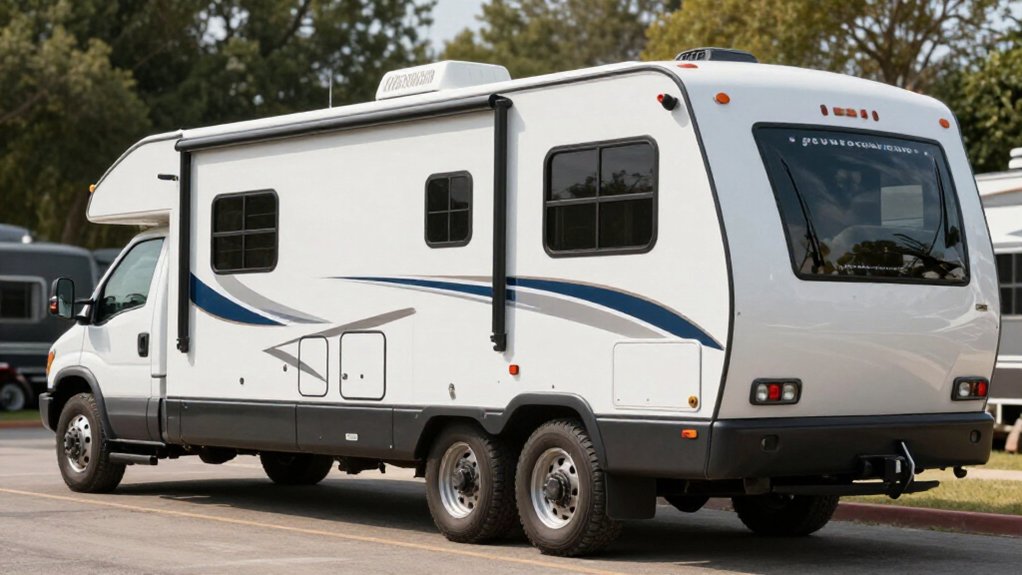
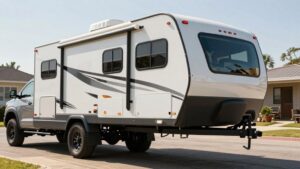
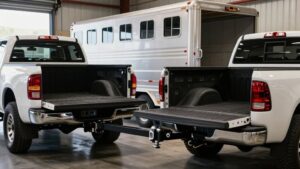
If your truck has a short bed (about 6.5 feet or less), you’ll need a sliding fifth-wheel hitch to keep the trailer’s front from striking the cab during tight turns or backing. A fixed hitch may work only if pin-box geometry leaves enough room, but straight-line clearance doesn’t prove you’re safe.
Test slowly in a controlled area, checking both cab and tailgate gaps. The details below explain how to confirm fit and choose a setup.
Short-Bed Cab Clearance
With a short-bed truck, commonly one with a bed around 6.5 feet or less, the trailer’s front can approach the cab during tight turns, so you may need a sliding 5th wheel hitch to create clearance. Your actual margin depends on the truck’s exact bed length and the pin box’s shape; some MORRyde designs, for example, can leave less room near the tailgate.
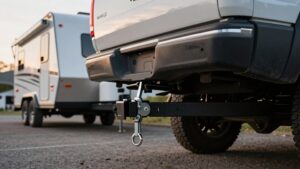
Sliding the hitch rearward usually moves the trailer away from the cab, but it also brings the pin box closer to the tailgate. Don’t assume a setup clears just because it looks close on paper. Hitch up with your truck and trailer configured as you’ll tow them, set the hitch where you intend to use it, then move slowly while checking for contact.
If clearance is tight, lower or remove the tailgate for verification, and follow the hitch and trailer manufacturers’ instructions. Check both cab-side and tailgate-side gaps at the hitch position you’ll actually use before towing.
Turn Clearance Needs
Short-bed trucks, often with beds around 6.5 feet or shorter, usually need a sliding 5th wheel hitch because tight turns can bring the trailer’s front dangerously close to the cab. With a fixed hitch, clearance depends largely on the distance between the pin box and cab. Sliding the hitch aft can increase cab room, but it reduces tailgate clearance; the pin box may push the trailer rearward at certain angles.
You may have ample space on ordinary roads yet risk contact during sharp turns or backing, when the trailer swings closest to the cab. Don’t assume a slider’s rearward position solves every clearance issue. Hook up your rig as you’ll tow it, move the hitch to your intended setting, then maneuver slowly through tight turns and backing angles.
Check both cab and tailgate clearance, and stop before either can touch. Test gradually, since clearance changes as the trailer pivots around the hitch during maneuvers.
Factory Puck System Compatibility
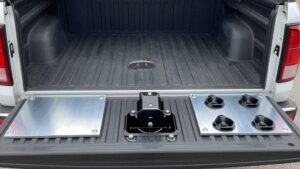
Once you’ve assessed turning clearance, check how the hitch mounts to your truck. With Ram factory pucks, typically three or five mounting holes, you can fit a puck-compatible hitch, including a slider, without base rails. But don’t assume every puck pattern matches every hitch: Lippert lists compatible options for brands including Ram, and your truck’s year and bed layout matter.
| Bed setup | Mounting view | What you’ll need |
|---|---|---|
| Factory pucks | Flush bed openings | Matching puck-fit hitch |
| No OEM pucks | Added rail footprint | Aftermarket mount |
Before buying, compare your puck layout with the hitch’s stated fitment and included hardware. Without OEM pucks, you’ll generally need an aftermarket mount, often permanent base rails. That mounting choice differs from selecting fixed or slider for cab clearance.
Pucks alone don’t guarantee turning room; the slider’s fore-aft range and your trailer’s pin box geometry determine how much cab and tail clearance you’ll gain.
Slider Hitch Types
You can choose a manual slider, which you reposition yourself, or an automatic model that shifts the trailer pivot as you turn. Removable slider bases offer another option when you want to take the slider out between trips.
Check the hitch’s travel positions and limits to balance cab clearance with tailgate clearance.
Manual Sliding Hitches
For a short-bed truck, a manual sliding hitch lets you move the trailer head rearward to gain cab clearance during tight turns. You’ll typically need this option with a bed 6.5 feet or shorter if a fixed hitch can’t keep the trailer overhang clear of the cab or fender.
Before a tight turn or backing maneuver, you must stop and reposition the hitch according to its instructions. Sliding it rearward increases cab clearance, but may reduce space between the pin box and tailgate. That tradeoff makes fitment dependent on your truck, trailer, and hitch combination.
Check your hitch model’s travel and geometry, along with your pin box and kingpin height. To confirm whether you need a slider, hook up and test its full travel. At low speed, check for contact during turning and jack-knife maneuvers.
Automatic Sliding Hitches
When tight turns demand more cab clearance, an automatic slider moves the pin box rearward without requiring you to stop and operate a manual lever. Power-cam systems, including Lippert’s automatically sliding style, shift the trailer rearward during turns to help keep its front cap clear of your cab. You needn’t release a manual latch, though the hitch follows a designed path.
Rearward travel trades cab clearance for tailgate space. Truck-bed geometry and pin-box designs, including MORryde models, affect where contact risk occurs. An automatic slider may still let the trailer hit the tailgate during sharp turns or backing.
Before relying on tailgate-up clearance, hook up as you’ll tow and maneuver slowly in a controlled area. Let the slider engage, then check clearances throughout each full turn.
Removable Slider Bases
If you tow with a short bed, a removable slider base lets you add rearward hitch movement for turns, then remove the base when you’re not towing. This setup suits trucks with beds around 6.5 feet or shorter, where cab clearance can limit tight turns.
Choose a base designed for your truck’s mounting system; OEM puck or rail setups aren’t interchangeable by assumption. Although the slider can improve cab-to-trailer clearance by shifting the hitch rearward, that movement may create a different clearance concern at the tailgate.
Before towing, connect your exact hitch and pin-box combination, then maneuver slowly with the base slid back and check for contact. Confirming this fit matters because truck, hitch, and trailer geometry vary. Never rely on bed length alone.
Slider Hitch Travel Positions
A sliding fifth-wheel hitch typically has a forward position for road travel and a rearward position that adds cab clearance on short-bed turns. Keep the hitch forward for normal towing; move it rearward only when you need room between the trailer and cab. That added room can leave less space at the tailgate, especially as the trailer swings sharply.
Don’t assume every slider offers a continuously adjustable range: some lock into specific stops. Check your hitch’s instructions, then test each stop with your trailer attached. Maneuver slowly through the turns and backing angles you expect to encounter, watching both the cab and tailgate. Use only a position that preserves safe clearance throughout the maneuver, and return the hitch to its road-travel position before towing.
Bed Length and Maneuverability
If your truck bed measures 6.5 feet or less, the trailer pivots closer to the cab, limiting sharp turns sooner than it would with an 8-foot bed. A slider moves the pin box rearward to increase clearance during tight turns and backing.
Check your bed measurement and turning limits to reduce the risk of cab contact.
Short-Bed Cab Clearance
Because a roughly 6.5-foot bed leaves less room between the trailer overhang and your cab, a fixed hitch can limit tight turns.
A sliding hitch lets you move the trailer rearward when maneuvering, creating more space between its overhang and your cab. That extra clearance can matter when backing or positioning your rig, but it doesn’t eliminate the need to check the setup. Sliding the hitch back also brings the trailer closer to your tailgate, so confirm rear clearance as well as cab clearance.
Hitch height and the distance from the kingpin to the pin-box front affect where contact could occur. Before traveling, test the combination in a safe area, with the hitch in the position you plan to use. Check clearances as the trailer moves, and follow the hitch and trailer manufacturers’ setup guidance.
Turning Radius Limits
During tight turns and backing, a short bed can limit how far the trailer’s front swings before it approaches the cab.
A bed of about 6.5 feet or less leaves less cab-to-trailer room, so a fixed hitch may bring the kingpin closer to the cab as the trailer tracks through a turn. Sharp steering angles can create the tightest clearance, especially when you’re backing slowly and maneuvering into a site. Don’t judge clearance only with the truck and trailer straight; the front corner follows a different path as the combination bends.
Maintain a margin for uneven ground, suspension movement, and small differences in your approach angle. A spotter can help you watch the cab gap, but move slowly and stop if it narrows unexpectedly.
Slider Travel Benefits
On a short bed of 6.5 feet or less, slider travel moves the hitch rearward to improve cab-to-trailer clearance during tight turns and backing. That movement gives your trailer’s front more room to swing as you maneuver, when a setup leaves little turning space. You’ll usually need the extra travel only at sharper angles; straight towing doesn’t show the same clearance demand.
Bed length and your route matter, because sliding the hitch rearward can reduce space at the tailgate. Plan each maneuver with both ends of the trailer in mind, rather than assuming more rearward travel solves every clearance constraint.
To verify your setup, connect the truck and trailer and slowly jack-knife in a controlled area. Watch how clearance changes through the turn, and note the angle where slider travel is needed.
Cab Contact Risks
Slider travel can improve cab clearance, but it doesn’t guarantee the trailer nose will clear your truck. On a short-bed truck, tight turns can swing trailer overhang toward cab and shrink your clearance. The risk rises when you back or jack-knife, because the trailer pivots through tighter arcs.
Moving a sliding hitch rearward usually gives the nose more room, but it can leave less space between trailer and your tailgate. That tradeoff means you should check both ends, not assume the cab is safe because the hitch slides. Hook up, set the hitch position you plan to use, and slowly turn to the limit. Physical testing is the reliable way to confirm your truck, trailer, and maneuver geometry won’t make contact. Repeat with your actual trailer load.
Pin Box Height Compatibility
Pin box height affects whether a slider or fixed hitch can clear your truck’s cab and tailgate, because the pin box’s position and shape influence how closely it swings to them during a turn. Compare the installed pin-box height with your truck’s bed and tailgate area. A higher pin box, or a taller, wider profile, can shrink clearance even when hitch height is correct.
MORryde pin boxes may have bulk that makes tail clearance tighter than bed length suggests.
Sliding changes more than fore-aft position: it shifts the pin box’s effective rotation point and can alter the margin its height leaves around the cab or tailgate. Hook up at your towing height, adjust as needed, and verify clearance before tight turns or backing.
Grease Point Access
Because a slider moves the kingpin closer to or farther from the bed bulkhead, it can change how easily you can reach the hitch’s grease zerks from behind the truck. A fixed hitch gives you consistent access, but a slider changes the clearance window whenever you move it.
Many lubrication points, including the pin box pivot and jaw area, are easiest to reach when the hitch is in its most open position. Before greasing, choose a position that lets you place the gun squarely on every zerk.
If you tow with a short bed, check access after moving the slider for cab clearance, not just in its normal position. When a fitting is hard to reach, use a longer needle or nozzle, or reposition the slider for access. Don’t force the gun at an angle.
Slider Release Mechanism Reliability
Although a slider’s release mechanism is designed for controlled operation, its reliability depends on clean hardware and full re-engagement.
You should operate the pinned or latched handle only with the hitch unloaded or during a controlled hookup. Keep the track and latch free of grit, old grease, and corrosion; buildup can make release and locking sticky.
- Follow the maker’s procedure and travel limits; don’t force a latch that may be misaligned.
- Test the release and relock during setup, before you travel.
- After sliding, return the handle fully to its locked position.
- Check visible pins or indicator marks for engagement; don’t trust sound alone.
- If the latch won’t seat cleanly, stop and correct the alignment before towing. This check helps prevent engagement failures before towing.
Warranty and Replacement Parts
Once the slider is locked and checked, protect your warranty by confirming the hitch model and mounting hardware match the manufacturer’s requirements and are installed to the specified torque. Before ordering parts, record your hitch’s SKU and serial number; slider brands use kits for base rails or adapters, handle and latch assemblies, pins, and locks.
- Check puck or rail compatibility; mismatched bases can misalign the hitch and create unusual loads.
- Keep receipts for hardware and adapters to support warranty claims.
- Lubricate and inspect bushings, wedges, and slide rails on schedule; neglected wear may weaken coverage.
- If you change pin boxes, including MORryde, or alter height, recheck clearance; added contact can accelerate wear and fall outside normal use.
- Ask the manufacturer before adjustments.
Conclusion
You don’t automatically need a slider 5th-wheel hitch for a short-bed truck. Check your trailer’s cab clearance, pin box, bed length, and hitch compatibility before deciding. If your setup allows safe turns without contact, a fixed hitch may work; otherwise, choose a reliable slider and confirm you can release it easily.
Keep grease points accessible, and check warranty and replacement-part support. When clearance remains uncertain, have a qualified installer verify your measurements before you tow.
Fifth Wheel / Gooseneck Pin Weight & Payload Checker
Estimate fifth wheel or gooseneck pin weight and check it, plus hitch, people and cargo, against your truck's door-jamb payload sticker.
Hitch Bike Rack Load & Fit Checker
Check your e-bikes and hitch bike rack against your receiver's tongue-weight rating and the rack's own capacity, in lb or kg.