Flat Towing vs Tow Dolly: Cost, Setup and Which Cars Work
Choose flat towing or a dolly only after your owner’s manual approves the exact car and drivetrain.
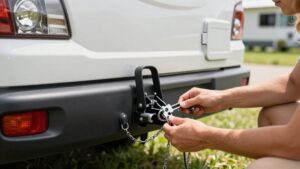
Flat towing uses a baseplate, A-frame bar, and supplemental brake; parts run about $700–$2,000, plus $500–$1,000 installation.
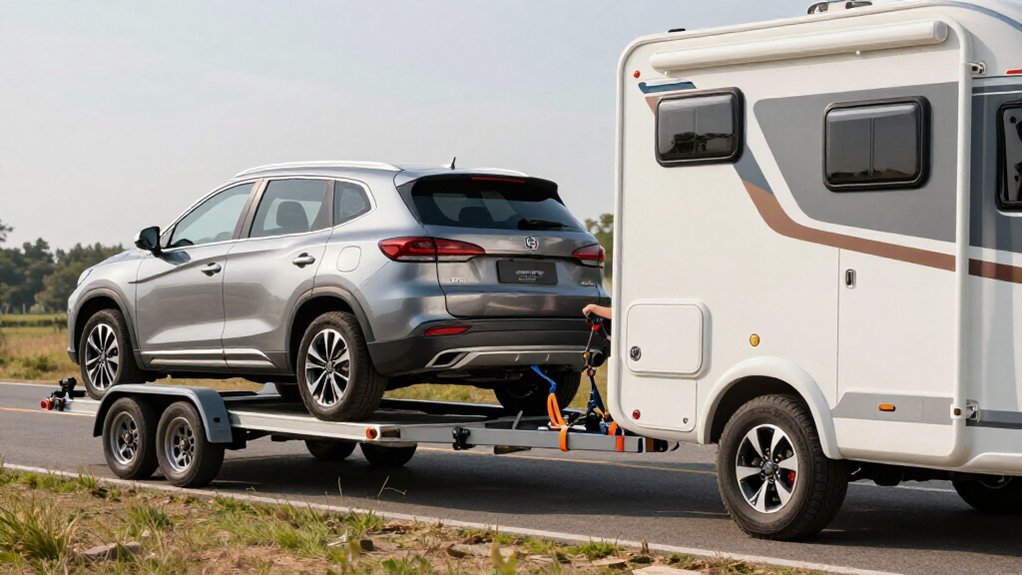
A dolly carries the front wheels and needs secure loading, tie-downs, and brake, tire, and bearing checks.
AWD cars generally aren’t dolly-compatible.
Your turning, campsite space, and setup time matter; details below help you match methods, costs, and safety steps.
How Each Method Connects
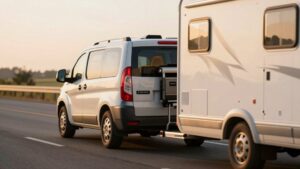
Flat towing connects your car directly to the RV with an A-frame tow bar and vehicle-specific baseplate hardware; a tow dolly connects to the RV’s hitch and carries the car’s front wheels.
With flat towing, you keep all four tires on the road, so confirm your owner’s manual permits the procedure and follow its tow-mode steps. A dolly lifts the front axle, often suiting front-wheel-drive cars; verify drivetrain compatibility before loading. Secure straps and check clearances before travel.
| Method | Road contact |
|---|---|
| Flat tow | Four tires |
| Tow dolly | Front wheels raised |
| Check manual | Tow mode, axle |
Choose the connection your vehicle allows, then recheck every latch, strap, and tire position at each stop during travel, too.
What the Setup Includes
Once your vehicle’s approved connection method is clear, compare the hardware and work each setup requires: flat towing typically needs an A-frame tow bar, a vehicle-specific baseplate, and a dedicated braking system, while a dolly carries the car on its front wheels and requires secure loading and tie-downs.
Budget about $700–$2,000 for flat-tow parts, plus roughly $500–$1,000 for shop installation; your braking system must match the vehicle and RV requirements. A dolly is more DIY-friendly once you own it, but you must center the car, follow its loading procedure, and tighten every restraint before travel. Expect about 30 minutes to load it the first time, around 10 with practice, and four to five minutes to unload.
Flat-tow departure can take one to two minutes once latches release freely. Store the dolly separately when parked; many tow-bar setups remain attached to the RV. Before each trip, inspect pins, safety cables, electrical connections, brake operation, tire pressure, and straps. Confirm the car’s manual permits the chosen method, and never exceed dolly or RV ratings listed.
Turning Radius and Tracking
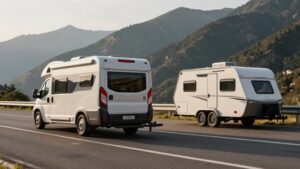
How does a dolly change your turning path? A tow dolly tracks behind your RV, but its wheels cut inside the path of the RV’s rear wheels. So you generally need a wider turning arc than you would when flat towing four-down.
The dolly’s position and tracking geometry create this different cut-in.
The added length also matters. Your rig extends beyond the car by the dolly and its neck, making tight campground turns and parking-lot corners harder to judge. Since you can’t reverse with a car on a dolly, you can’t back up to correct a missed line once committed.
Before entering a narrow turn, slow down, check clearance, and use your spotter. Practice low-speed turns first; watch for curbs, posts, or campsite edges.
Dolly Storage at Campsites
Storing a tow dolly at camp often takes less room than you might expect: you can usually park it beside the RV, sometimes sideways, though a longer coach or narrow site may limit the fit.
Check your site’s width and length, then choose a safe position that won’t block neighboring vehicles, walkways, hookups, or emergency access.
- A roughly 36-foot coach may still fit with the dolly turned sideways.
- Measure before relying on that arrangement; campsite dimensions vary.
- Keep the dolly clear of traffic lanes and shared access.
- When space is tight, some users slide it under the RV’s rear about 80%.
- Don’t obstruct access or leave it unstable on uneven ground.
Unlike a trailer, you can store it separately from your RV at your campsite.
Manufacturer-Approved Towing Procedures
Campsite storage is only one part of the decision; your vehicle must also be approved for the towing method. Check your exact model and drivetrain in the owner’s manual for a listed recreational-towing procedure, often indexed under “R” or “T.” Approval depends on both the method and the steps.
For flat towing, follow the specified tow-mode sequence; it may require transmission or transfer-case neutral and leaving the ignition on briefly or throughout the trip to keep steering released. Don’t assume generic neutral is enough.
AWD vehicles generally aren’t approved for dollies because all four wheels drive; use only a manufacturer-approved arrangement. Many 4WD models also risk serious damage with two wheels down, so use the manual’s allowed method.
If you can’t find it, get the manufacturer’s online manual and verify setup before towing. Confirm the procedure matches your vehicle’s year, trim, and drivetrain.
Tow Dolly Upkeep Costs
Though a tow dolly may cost less to maintain than a trailer, budget for recurring upkeep: brake service, tire checks and replacements, bearing inspections, strap and ratchet adjustments, and worn tie-down hardware. Your model determines whether you’ll service hydraulic disc calipers or replace pads and rotors.
- Check dolly tires often; concentrated load can accelerate wear and replacement.
- Inspect bearings routinely, and adjust straps and ratchets before each trip.
- Replace damaged tie-down hardware; secure wheels before towing.
- Clean and re-grease moving parts; inspect coupler and frame for corrosion.
- Test lights and brake-signal actuation; replace faulty bulbs or connectors promptly.
Schedule service by your dolly maker’s intervals, and keep receipts; neglected brakes, loose connections, or rust can cause failures on road, towing delays, and compliance problems.
Tire Wear and Drivetrain Strain
Flat towing usually promotes more even tire wear because all four tires roll, while a tow dolly can wear the free axle’s tires unevenly. Because the other axle stays lifted, those rotating tires do more work; inspect tread depth and pressure before and after each trip. Flat towing often creates little tire wear, but it isn’t automatically safe for your drivetrain.
A dolly adds handling and loading stress each time you drive the car onto it and secure it. More importantly, match the method to your vehicle’s design. Many AWD cars need all four wheels off the ground, so dolly towing can damage them. Flat-tow only when your owner’s manual specifies an approved tow mode.
Automatic RWD cars and some other configurations may suffer poor transmission lubrication or overheating with the engine off. Confirm the exact procedure before moving. Never assume a familiar setup applies to your car.
Pros and Cons of Brake Systems
When flat towing, you’ll typically need a supplemental brake system, adding hardware and installation costs but providing braking support for the towed vehicle. A dolly may avoid that device in some setups, though you’ll still need to load and unload the car.
Check your owner’s manual and compatibility chart to confirm required equipment and procedures.
Brake System Benefits
Because the towed vehicle adds weight behind your RV, a supplemental braking system helps control stops and reduces reliance on the RV’s brakes.
Flat towing typically needs dedicated braking, while many modern dollies provide braking hardware. Use these checks to match the system to your route and vehicle:
- A flat-tow unit such as CURT’s RVibrake applies braking at the towed car, helping you manage combined weight safely.
- A braked dolly can contribute stopping force, easing demand on your RV’s brakes.
- Match braking equipment to your setup before departure; confirm compatibility in both vehicle manuals.
- Set the car’s tow mode and steering as specified so the system works as intended.
- With a dolly, connect it correctly and verify the parking brake is off before towing.
Brake System Drawbacks
That added braking control comes with a cost: flat towing requires a dedicated supplemental brake, plus setup and maintenance for its components, wiring, and controller. The equipment can add $700–$2,000 for the tow bar and baseplate, plus about $500–$1,000 in installation labor; budget separately for the supplemental brake. Your car’s brakes must actuate reliably, so test wiring, controller settings, and any breakaway switch before travel; incorrect setup can leave you with reduced braking.
With a dolly, verify RV and dolly requirements: some rely on RV braking, while others include brakes. The mechanism may shift setup and upkeep away from your car. If you tow often, you may accept flat towing’s added cost and adjustments for convenience; don’t skip safety checks. Inspect the system regularly before every trip.
Initial Equipment Cost
A tow dolly typically costs $3,000 to $5,000 new, though a used unit may lower your upfront price. Flat towing often runs $3,000 to $4,000 after you add a tow bar, vehicle-specific baseplate, supplemental braking system, and installation.
Compare the full one-time setup cost, and confirm your car’s approved towing method before buying.
Tow Dolly Purchase Price
Tow dolly prices range from about $800 for a used model to $3,000-$5,000 for newer, heavier-duty setups. Your price depends on age, capacity, brakes, and vehicle fit. Before buying, confirm the dolly lifts your car’s drive wheels; many models suit front-wheel-drive cars with the front wheels aboard. Confirm your car-and-dolly fit before purchase.
- Used, roughly four-year-old dollies have sold near $800.
- Newer, heavier-duty configurations can cost $3,000-$5,000.
- Hydraulic disc brakes may raise price while improving control.
- Check load height for low-profile cars; Acme markets models for MINIs.
- Match capacity and tie-down hardware to your vehicle’s specifications.
You may also avoid installation labor often needed for flat-tow setups, helping offset the dolly’s upfront cost. Check brakes, tires, and lights; follow the maker’s loaded limits.
Flat Towing Equipment Costs
Compared with a dolly’s purchase price, flat towing spreads its initial cost across several components: an A-frame tow bar and vehicle-specific baseplate typically run $700–$2,000, before installation.
A dedicated braking system, such as CURT RVibrake, adds substantial expense; it isn’t optional for safe, controlled stopping. Budget for that hardware rather than comparing tow-bar prices alone.
With the bar, baseplate, braking system, and typical installation, a realistic initial total often reaches $3,000–$4,000. That total exceeds the bar-and-baseplate figure because braking equipment and vehicle-specific parts contribute materially; don’t treat the tow bar as a complete, road-ready system alone.
Your figure depends on vehicle and component choices, so confirm compatibility and get a complete quote before buying. Verify braking requirements for your motorhome and towed vehicle.
One-Time Setup Expenses
Although the initial prices can look similar, flat towing typically costs $3,000–$4,000 once you include the tow bar, vehicle-specific baseplate, supplemental braking system, and often $500–$1,000 in shop installation; a tow dolly generally runs $3,000–$5,000, though costs vary with duty level and setup. Your actual bill depends on compatibility and what you can install safely.
- Budget $700–$2,000 for a tow bar and vehicle-specific baseplate.
- Add shop labor, often $500–$1,000, if you need professional fitting.
- Include a supplemental brake, such as CURT’s RVibrake, in flat-tow planning.
- A used dolly may cut upfront spending; one four-year-old unit cost about $800.
- Check your manual: flat towing needs compatible drivetrains; dollies usually suit front-wheel-drive cars, while some AWD makers prohibit dolly use. Loading adds handling steps and safety checks.
Solo-Travel Convenience
If you travel solo, flat towing is usually quicker at the campsite: once you’ve practiced, hooking up or disconnecting often takes about 1–2 minutes, with no car to load onto equipment.
With a dolly, you must position it, secure it, load the TOAD, then unload and detach the dolly at arrival. Those steps are manageable after practice, but they take longer, especially on your first trip. Flat towing is closer to “hook up and drive,” and you won’t need to remove and correctly reattach a dolly before departure. Check every connection, safety cable, lighting plug, and braking-system indicator before moving; speed doesn’t replace a walk-around.
A dolly may fit sideways beside some coaches, but it’s still less grab-and-go than a tow bar left ready. Flat towing can cost roughly $3,000–$4,000 initially, including a braking system and possible installation, but you may value that expense if repeated solo loading cycles strain your time or effort routinely.
Conclusion
Choose your towing method only after checking your vehicle’s owner’s manual and manufacturer-approved procedures. Flat towing can simplify campsite stops, but only if your car is approved and properly equipped.
A dolly may suit more vehicles, yet adds storage, setup, and turning considerations. Compare total equipment costs, brake requirements, tire wear, and drivetrain limits. Before each trip, verify every connection and brake function. If you’re unsure, ask a qualified installer; the right setup protects your car and keeps you safer on the road.