GVWR vs GCWR: Towing Weight Ratings Explained in Plain English
GVWR limits your loaded tow vehicle: curb weight, passengers, cargo, and tongue or pin weight must stay within it.
GCWR limits the complete combination: your loaded vehicle plus your loaded trailer. Passing one check doesn’t guarantee you pass the other.
Weigh the setup, then compare vehicle weight with GVWR and combined weight with GCWR; don’t rely on brochure estimates.
Check axle and tire ratings too.
The sections ahead explain how to verify limits before you tow.
GVWR and GCWR Limits
For safe towing, check both the vehicle’s GVWR and the full rig’s GCWR. Your GVWR is the vehicle-only ceiling: curb weight plus everyone and everything you carry. Tongue weight presses onto the vehicle and counts toward that limit, so account for it with passengers and cargo.
GCWR sets the maximum for the complete combination. You can stay below GVWR and still exceed GCWR, so passing one check doesn’t prove your setup is safe. Find both ratings on the manufacturer’s label or in the owner’s manual; if GCWR isn’t listed there, consult the manufacturer’s towing guide. Keep each load within its rating before you travel.
| Rating | What it limits |
|---|---|
| GVWR | Towing vehicle alone |
| Included | Vehicle, occupants, cargo |
| Excluded | Trailer’s total weight |
| GCWR | Vehicle and attached trailer |
Trailer Weight in GCWR
To check GCWR, add the towing vehicle’s actual weight—with occupants and cargo—to the trailer’s actual weight; the total must not exceed the rating. Use scale readings, not brochure estimates: GCWR governs the complete combination, while the trailer’s published weight alone doesn’t tell you whether the combination is compliant.
Distinguish trailer weight from the load carried at each point. The trailer’s axles support one portion; tongue weight transfers another portion to the tow vehicle. That tongue weight, along with other load supported at the hitch, counts toward the vehicle’s GVWR, even though the trailer’s full weight doesn’t.
As a result, meeting GCWR alone isn’t enough: verify the separate ratings that apply to the tow vehicle and trailer. Weigh the loaded vehicle and trailer in your towing configuration, then compare their combined weight with GCWR. Check axle and hitch limits too; compliance with GCWR doesn’t override them.
Payload and Passenger Impact
As passengers and cargo add weight, your vehicle moves closer to its GVWR, leaving less payload capacity for anything else the vehicle must carry. Payload isn’t GVWR: it’s the amount you can carry, calculated as GVWR minus curb weight. Your occupants and gear consume that allowance, so check the loaded vehicle against its rating, not an empty-vehicle estimate.
- Count occupants and cargo: each pound reduces remaining payload.
- Compare loaded vehicle weight with GVWR; staying below it doesn’t guarantee you meet GCWR.
- Include tongue weight in vehicle-side loading; passengers and cargo leave less GCWR margin for the trailer.
GCWR also covers vehicle and trailer together, so assess both limits after loading. Trailer brakes can’t offset an overloaded vehicle or combined weight above its rating.
Fifth-Wheel Hitch Setup
Although the fifth-wheel rides behind the truck, its kingpin weight counts as vehicle load and reduces the truck’s remaining GVWR capacity for passengers and cargo.
When you hitch up, include that pin weight in the truck’s loaded road weight; shifting belongings between cab and bed doesn’t change the total. Your truck’s actual curb or base weight, occupants, cargo, hitch, and kingpin load must remain within GVWR.
GCWR sets a separate ceiling for the loaded truck and trailer combined. So account for the trailer’s actual gross weight as well as its kingpin load when checking the combination limit. Don’t assume a published maximum tow figure overrides either rating. Verify with actual weights for the truck, occupants, cargo, hitch, kingpin load, and trailer before you tow.
Axle Rating Compatibility
GVWR and GCWR don’t guarantee that each axle is within its rating: a forward- or rearward-heavy load, including trailer tongue weight, can overload one axle even when the totals are under their limits. Your loaded tow vehicle’s weight includes occupants, cargo, and tongue weight; tongue load shifts axle distribution, so a heavier hitch load may exceed one axle’s rating without exceeding GVWR.
- Check the door-jamb label or owner’s manual for published front- and rear-axle ratings.
- Estimate each axle’s load with your actual cargo, hitch, and trailer setup.
- Weigh the loaded vehicle on a scale, measuring each axle or individual wheels, then compare readings with corresponding ratings.
A safe total alone doesn’t excuse an overloaded axle. Stay below every axle limit, plus GVWR and GCWR.
Transmission Heat Under Load
Even when each axle stays within its rating, towing near your vehicle’s GVWR or GCWR can make the transmission run hot.
Transmission fluid transfers power and maintain gear ratios; under heavy load it works harder, so temperatures can climb quickly. Hot fluid loses viscosity and can accelerate wear. Staying within your vehicle’s GVWR and GCWR limits reduces overheating risk.
Repeated downshifting and gear hunting add torque converter and clutch friction heat. Select a lower gear when needed, then hold a steady throttle to limit heat buildup.
Your vehicle’s transmission cooler can manage normal demands, but a heavy trailer may overwhelm it on steep grades. If engagement becomes delayed, the transmission slips, or its temperature keeps rising, stop and let it cool before continuing.
Tire Pressure and Load
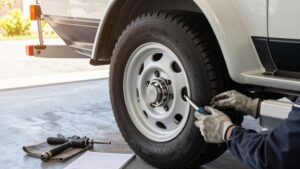
Your tires must support the actual load on each axle, so check their load capacity when your vehicle’s fully loaded—not just its GVWR or the combined weight at the GCWR limit.
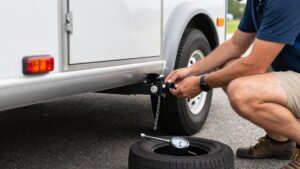
Set pressure to the tire placard or owner’s manual value for your load; don’t inflate by guesswork. If listed, follow the “tire pressure for GVWR” or “for trailer towing” guidance. Towing increases effective tire loading and can raise temperatures, while underinflation can’t make a near-limit vehicle safe. Before departure, and after any significant load change, check cold pressures before every trip and inspect for damage.
- Compare each tire’s load capacity with the measured load on its axle when fully loaded; axle distribution matters.
- Keep every axle within its tires’ rated capacity, especially as combined weight approaches GCWR.
- Recheck pressures if heavy-load driving leads to pressure loss; a paper GVWR or GCWR calculation doesn’t reveal an unsafe tire condition.
Towing a Gooseneck Trailer
A gooseneck hitch transfers substantial kingpin weight to your truck, and that load counts against its GVWR.
Check your loaded truck’s actual weight against GVWR and the combined truck-and-trailer weight against GCWR; either limit can be exceeded first. Use the lower rating-derived towing limit, and don’t exceed the manufacturer’s gooseneck tow rating.
Gooseneck Hitch Basics
With a gooseneck hitch, the trailer’s pin weight transfers to the tow vehicle and counts against its GVWR along with occupants and cargo.
A gooseneck couples over the rear axle, but that placement doesn’t make pin load disappear. Your loaded truck includes curb weight, people, cargo, and the pin load; GVWR caps that vehicle total. GCWR instead caps the truck-and-trailer combination, including trailer cargo.
- Treat pin weight as transferred payload, not trailer weight alone.
- Your payload room may run out before the trailer reaches its full loaded weight.
- Both ratings matter; whichever ceiling restricts first limits the combination.
A correctly installed, vehicle-approved hitch and secured coupler are essential; never assume a gooseneck’s frame or axle placement increases your truck’s rated capacity.
Check Weight Ratings
Check both weight ratings before towing: GVWR limits the loaded truck—including passengers, cargo, and gooseneck tongue weight—while GCWR limits the combined weight of the truck and trailer. Count passengers and cargo in your truck’s weight, then add the gooseneck’s tongue load; that total must stay within GVWR.
Separately, add the truck’s actual weight to the loaded trailer’s actual weight and keep the combination within GCWR. Your safe trailer limit is whichever is lower: the capacity allowed by remaining GVWR payload for tongue weight or by GCWR towing capacity. Don’t know your GCWR? Check the manufacturer’s towing chart or owner’s manual for your specific gooseneck setup. Before departure, verify measured truck, trailer, and tongue weights. Ratings are limits, not estimates; exceeding either can compromise control, braking, or component safety.
Choosing Ratings for Real Trips
Match GVWR to your tow vehicle’s curb weight, passengers, cargo, and trailer tongue weight; match GCWR to the actual combined weight of the vehicle and loaded trailer. Count every passenger and item, then compare real scale weights, not brochure estimates, with both ratings.
Keep a safety margin below the limits, and use your owner’s manual or manufacturer towing guide if you don’t know the GCWR.
Match Ratings to Loads
Before choosing a trailer, compare your actual trip weights with both ratings: GVWR limits the loaded tow vehicle, while GCWR limits the vehicle and trailer combined. Use this sequence to identify the binding limit before you hitch:
- Check vehicle weight against GVWR; the difference between GVWR and curb weight is your available payload, and your loaded vehicle must remain within it.
- Then add the tow vehicle’s actual weight to the trailer’s actual weight and compare that combined figure with GCWR.
- Use the manufacturer’s towing guide if GCWR isn’t clear; don’t exceed the lower result from these checks or the advertised maximum tow rating.
A trailer may fit rating yet breach GVWR; carefully verify both limits with weights before travel to protect braking and control.
Count Passengers and Cargo
Count every passenger and every item of cargo when estimating your loaded vehicle’s weight: they use payload, which is GVWR minus curb weight. Before you hitch up, add the people and gear in the tow vehicle to its curb weight; don’t treat the full GVWR as available payload. Then account for trailer tongue weight, which presses on the vehicle and counts toward its GVWR. Your vehicle occupants, vehicle cargo, and tongue weight together must stay within that rating.
For the combination, compare your vehicle’s loaded weight plus the trailer’s actual total weight, including anything carried inside it, with the manufacturer’s GCWR. Count every seat, not just front-row passengers, and include items added for this specific trip. Use scale weights when estimates leave uncertainty, and follow the vehicle and trailer specifications. Use the lower applicable limit for your trip; meeting GCWR alone doesn’t prove the vehicle meets GVWR.
Leave a Safety Margin
Even when your loaded vehicle and combination stay within GVWR and GCWR, leave room below both limits for uncertain weights, shifting cargo, and route demands. Treat GVWR as the tow vehicle’s limit: curb weight, occupants, and cargo count, but the trailer doesn’t. Recheck payload when you add people or gear; payload equals GVWR minus curb weight.
- Compare your combined weight—vehicle, occupants, cargo, and trailer—with GCWR; don’t treat the published limit as a target.
- Use the lower of your calculated maximum tow and the manufacturer’s rating, then reduce it for scale uncertainty and load distribution.
- Check tongue weight’s effect on payload, and preserve cushion for grades, braking, and conditions; if the numbers leave little reserve, lighten the load or choose a smaller trailer.
Smog Test Requirements
Smog test requirements are separate from GVWR and GCWR: emissions checks usually depend on your vehicle’s model year, fuel type, and sometimes ZIP code, not its towing capacity. Still, a street-legal vehicle may need to pass an emissions inspection before you can renew its registration. Don’t assume a truck’s towing ratings determine whether it needs testing.
Check your local DMV or air-quality agency for the rules that apply to your vehicle. Confirm the test deadline, required documents, and whether you need an initial inspection, a renewal test, or a retest after repairs. If your vehicle fails, you may need to fix the emissions problem and return within a locally specified window.
Some programs offer waivers based on income, vehicle age, or repair costs; local rules set eligibility. Meet deadlines to keep your registration current.
Conclusion
When you compare GVWR and GCWR, check every limit—not just the truck’s advertised tow rating. Count passengers, cargo, hitch weight, and the loaded trailer; then verify axle and tire ratings, too. Set tire pressures to the vehicle or tire maker’s load-specific guidance, and confirm fifth-wheel or gooseneck hardware is properly rated and installed.
Choose a setup that stays within all ratings on real trips, with a safety margin. Meet applicable smog-test requirements before towing, and never exceed a stated limit.