Proportional vs Time-Delay Brake Controller: Which Stops Smoother?
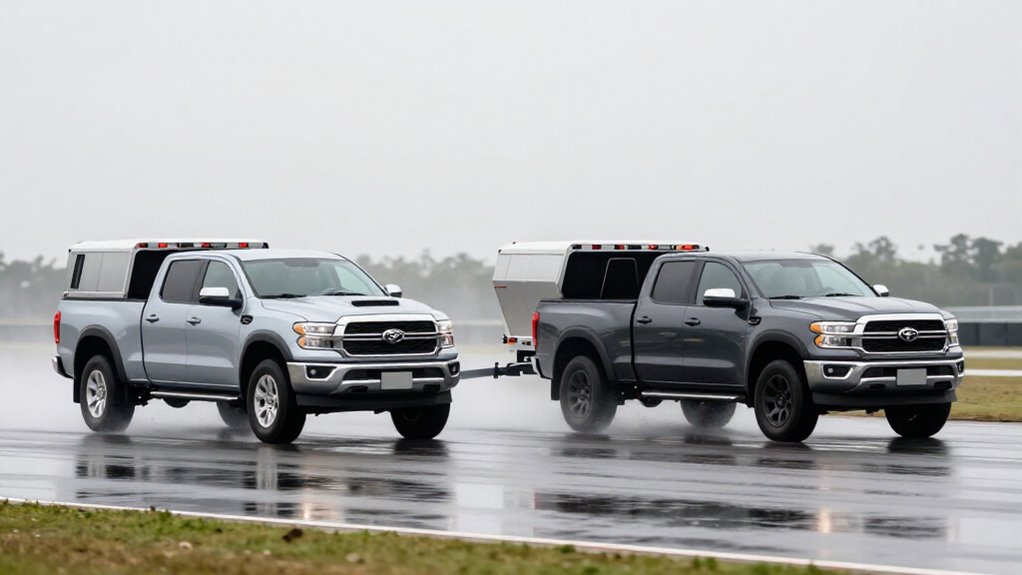
A proportional brake controller usually gives you smoother stops because it senses your tow vehicle’s deceleration and adjusts trailer braking to match.
A time-delay controller follows a preset ramp, often taking one to two seconds to reach its set output, so braking may feel late or uneven.
Neither design guarantees a shorter stop; incorrect gain can cause wheel lock or poor braking.
You’ll also need to check setup, wiring, and load conditions to choose and tune the right controller.
Stopping Smoothness Snapshot
Proportional brake controllers generally provide smoother stops because an accelerometer or inertia sensor adjusts trailer braking to match the truck’s actual deceleration. With a proportional system, you get a small, gradual trailer-braking current during gentle stops and higher power during hard stops. This response can reduce trailer push and jerk, supporting steadier control.
| Stop type | Proportional response | Time-delay response |
|---|---|---|
| Gentle stop | Gradual, low current | Preset ramp |
| Hard stop | Quickly increases power | Same preset pattern |
| Changing loads | Adapts to deceleration | Less adaptive |
| Feel | Less push and jerk | May feel uneven |
For you, proportional control generally offers the smoother feel across varied loads and terrain. Confirm proper installation and adjustment, and test braking safely before towing. Smoothness doesn’t replace adequate stopping distance or routine inspection and maintenance.
Brake Signal Timing Differences
Brake signal timing determines how closely the trailer’s braking matches the tow vehicle’s deceleration. With a time-delay controller, you set Sync/Delay and Maximum Power, and the unit applies braking through a fixed ramp, typically about one to two seconds. It doesn’t begin in step with the truck’s braking, so the truck may slow before the trailer’s brakes build.
A proportional controller uses inertia or accelerometer sensing to detect deceleration and actuates the trailer brakes as the truck begins slowing. It adjusts brake force to the measured deceleration: greater deceleration prompts more trailer current. This links onset and intensity to the event rather than a preset ramp. With time-delay control, the same pedal input can produce different timing and smoothness in routine and sudden braking.
Real-World Stopping Distances
Timing affects how predictably your rig slows in real-world stops. A proportional controller uses an internal accelerometer to match trailer braking to your tow vehicle’s deceleration, increasing output as you slow rapidly. This response reduces the trailer’s push against your vehicle and supports more repeatable stopping distances.
A time-delay controller waits through a preset interval, commonly one to two seconds, then ramps toward its set maximum. When your brake application changes, that fixed timing can leave the trailer briefly under-braked or over-braked, making stops less consistent. Conditions such as downhill grades or trailer load also affect stopping.
Proportional output adapts to each stop’s deceleration, while delay behavior changes less. Neither design guarantees a shorter stop: low gain may limit braking, while excessive gain can lock trailer wheels. Maintain safe following distance and brake smoothly.
Setup Time and Calibration
For setup, a time-delay controller is usually quicker: set its maximum power for the trailer’s weight and adjust the ramp or sync time, typically about one to two seconds.
A proportional controller needs more attention because you must mount and orient it within the manufacturer’s leveling range, often within about 70° of level, so its accelerometer reads deceleration correctly. Newer proportional models can make setup nearly as simple as this, but correct mounting remains the calibration variable.
Once mounted, adjust gain and assess braking in a controlled area, following the manufacturer’s instructions. The unit matches output to your deceleration: hard stops call for higher output promptly, while gentle braking calls for less.
With a time-delay model, poorly tuned ramp and maximum power can create a delay or mismatch at initial braking, making the trailer feel jerky and contributing to uneven brake wear. Confirm stable, balanced braking before travel; don’t compensate for unsuitable setup by relying on abrupt stops.
Trailer Wiring and Plug Fit
Before either controller can deliver smooth braking, the trailer must connect through a brake-capable 7-way plug. A basic 4-pin flat connector typically lacks the brake-control wire needed for electric trailer brakes. A 7-pin carries the dedicated brake signal and 12V auxiliary power. If your truck has only a 4-pin, an adapter alone may not add the missing brake-signal conductor; verify the wiring path carefully first.
Your controller connects under the dash to the brake-light circuit, detects when you brake, then sends braking voltage through the 7-way to the trailer’s brake magnets. Check connector type and fit before towing. A mismatched 4-flat and 7-round or 7-flat plug can prevent connection or hide a wiring gap. Confirm the signal reaches the electric brake assemblies.
Warranty and Replacement Parts
Because proportional controllers use accelerometers, their replacement costs may differ from simpler time-delay units. That added electronics can affect warranty service and parts pricing on models such as the Tekonsha P3 or REDARC Tow-Pro. Time-delay units, including the CURT Discovery NEXT #51126 and Venturer NEXT #51116, generally contain fewer internal components, which may simplify service or parts replacement.
Check your model’s warranty before buying, especially if you tow often or operate in harsh conditions. Coverage differs by brand and model. If the controller fails, you’ll typically replace the module rather than an individual sensor, so compare module cost and availability. Keep your model and part number on hand when planning spares.
For phone-linked controllers such as CURT Echo #51180 or #51190, confirm replacement availability for the unit. Don’t continue towing with a failed controller; restore braking function before travel.
Controller Compatibility Issues
Warranty and parts availability matter, but compatibility determines whether a brake controller can work correctly in your vehicle.
A proportional controller uses an inertia sensor, so you must mount it within its specified level range, often about 70 degrees, and calibrate it as directed. Incorrect orientation can cause poor brake response.
A time-delay controller reads the brake-light signal and generally tolerates more mounting angles, which can help when under-dash space is limited.
Check your truck’s wiring before installation. Trailer brakes need a compatible connection, commonly a 7-pin plug with a brake-control signal wire; a 4-pin harness won’t supply it. Don’t assume a factory tow package includes or enables a controller. Verify the option and vehicle compatibility. Match controller behavior to your electric-brake trailer: proportional output follows deceleration, while a fixed delay ramp may not sync well with every trailer. Test braking safely.
Build Quality and Durability
When you compare component quality, consider how each controller’s design handles repeated braking demands.
Proportional units use more internal electronics and typically cost more, while time-delay units use a simpler ramp-based design. For long-term reliability, check the manufacturer’s installation and operating requirements, since correct mounting helps protect performance and braking safety.
Component Quality
Although proportional controllers can deliver smoother braking, their accelerometers and added circuitry make build quality and correct mounting more important for long-term reliability. Inside a proportional unit, an inertia sensor measures deceleration, and electronics translate that signal into trailer-brake output. Those extra components can support a stop, but they also make manufacturing quality, secure connections, and assembly consequential.
Long-Term Reliability
Long-term reliability depends on build quality and correct installation. Proportional controllers use an accelerometer to measure deceleration, adding sensor and control circuitry. This complexity can raise manufacturing and maintenance costs and creates more potential failure modes than a time-delay design. However, a well-made proportional unit can still provide reliable service over many years.
Time-delay controllers typically trigger a timed voltage ramp from the brake-switch signal. Their simpler internal design can support durable operation, and many models mount at any angle without calibration. That flexibility may reduce installation-related problems.
For a proportional controller, follow the manufacturer’s level and angle requirements. Incorrect orientation can affect sensing, braking consistency, and long-term performance. Whichever type you choose, inspect connections, wiring, and mounting periodically. Replace or service a controller that behaves unpredictably; dependable trailer braking requires both sound equipment and installation that meets specifications.
Trailer Weight and Terrain
Match your controller to trailer weight: proportional control adjusts braking to your deceleration, while time-delay output follows a fixed ramp. Set gain for the current load, especially when cargo or passengers change.
On steep descents, allow for stronger braking demands and check that the trailer brakes respond smoothly without locking.
Match Controller to Weight
A proportional controller is usually the smoother choice when trailer weight or terrain varies, because its accelerometer adjusts braking output to the tow vehicle’s deceleration on each stop. For changing loads, choose proportional braking: it raises output for heavier or rapid stops and reduces it for lighter loads and varying grades.
This event-by-event response helps keep the trailer from pushing the tow vehicle, especially on descents. A time-delay controller can suit a consistently light trailer on similar terrain. It applies a preset ramp after you press the brake, with maximum power and ramp time set manually, typically across one to two seconds. Because its output pattern stays largely constant between stops, changing weight or terrain can make its braking feel less matched.
Select a controller suited to your trailer’s electric-brake requirements; under-driving can lengthen stops, while excess braking can lock wheels and reduce control. Assess your typical loads and routes before choosing.
Adjust Gain for Loads
Even with a proportional controller, set the gain for your trailer’s weight and road grade. Gain sets maximum braking power; tune it so the trailer slows without locking its electric drums or causing a skid or hard, jerky stop. Your controller’s accelerometer responds to braking demand, but gain still needs adjustment for the load you’re towing.
- With a heavier trailer, raise gain gradually; greater inertia requires more current at the brake magnets to match deceleration smoothly.
- With a light or empty trailer, lower gain. Excess force can make it surge or ride abruptly during gentle stops.
- Recheck the setting when your load or route changes. On a downhill grade, you may need more gain, but stay within the no-lock limit and confirm smooth braking.
Account for Steep Terrain
On steep grades, a proportional controller uses an accelerometer to adjust trailer braking to the tow vehicle’s deceleration, helping it stay synchronized as terrain and load demands change. When you descend with a heavy trailer, inertia raises braking demand; climbing can make the load feel lighter. The controller responds to deceleration, increasing or reducing output with each stop.
On rolling hills, it can provide more braking as you slow into an uphill grade, then ease output as conditions change near a crest. Set gain carefully so the trailer contributes without locking its wheels. A time-delay unit instead ramps output over a fixed window, often one to two seconds after you press the pedal.
It won’t adjust that ramp for changing grades or trailer weight, so your trailer may push on a long descent or lock if maximum power is excessive. Check braking response at safe speed before steep travel and allow space.
Manual Override Confidence
How confidently can you judge trailer response with the manual override? A proportional controller applies trailer braking immediately, matching deceleration and inertia, so response typically feels synchronized and predictable. A time-delay controller follows its preset ramp, often about one to two seconds; braking may feel late even when you expect an instant response.
- During parking-lot checks, proportional activation reduces the wait-then-lurch effect, especially in light or moderate stops.
- With time-delay control, account for the fixed ramp before judging braking strength; hard stops may feel different.
- Verify gain and maximum power with either type: the trailer should slow without locking its wheels.
Use a safe, controlled test area, keep speed low, and adjust settings incrementally; don’t rely on override feel alone to confirm proper braking.
Conclusion
Choose a proportional controller if you want braking that responds to your tow vehicle’s deceleration, typically producing smoother stops across changing conditions. A time-delay unit can work reliably, but its preset output may feel less natural and require careful adjustment.
Neither controller guarantees a shorter stopping distance; trailer weight, road conditions, wiring, and calibration matter. Match the controller to your vehicle and trailer, verify plug compatibility, and test the brakes safely before towing. Use the manual override only when needed.