What Is a Pintle Hitch? How Lunette-Ring Towing Works
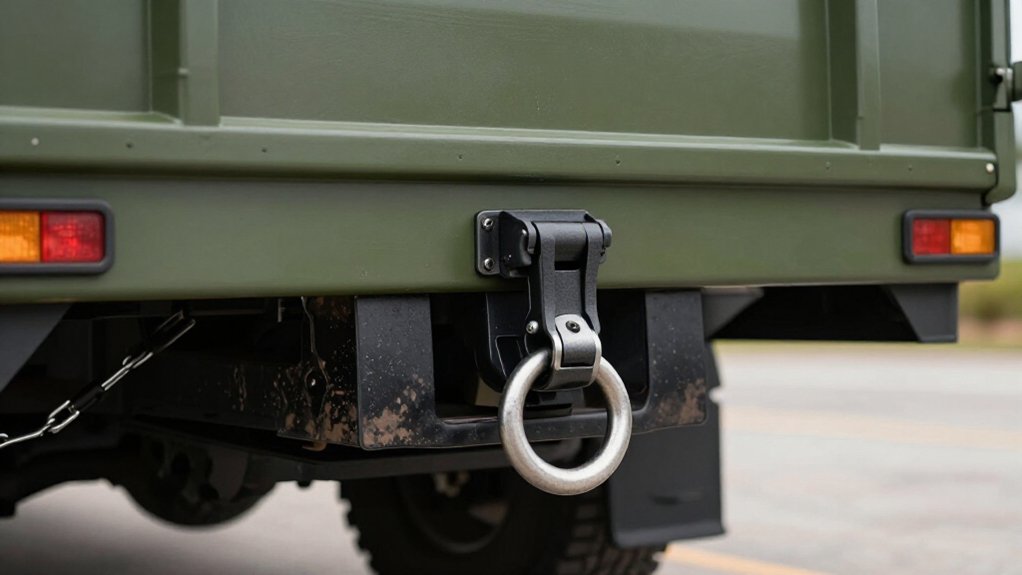
A pintle hitch connects your tow vehicle to a trailer’s lunette ring using a hinged hook with a locking jaw.
The ring mounts to the trailer tongue and drops over the open hook as you position the vehicle.
Lower the tongue fully onto the hook, close the latch, and install its safety pin.
This pivoting joint allows vertical and horizontal movement on rough terrain.
Check fit, ratings, and wear before each trip; more safety checks follow.
Lunette-Ring Towing Basics
When you tow with a pintle hitch, a trailer-mounted lunette ring fits over the towing vehicle’s pintle hook. The ring, or eye, sits on the trailer tongue, while the hook is mounted to your towing vehicle and designed to mate with it. To couple, open the hook jaw, then back up until the hook aligns beneath the ring.
Lower the tongue so the ring drops fully over the hook; don’t tow until it’s seated. Close the hook and secure its latch with the safety pin or lock to prevent accidental opening or release. Before travel, verify that both components’ gross trailer weight (GTW) and tongue weight (TW) ratings meet or exceed the trailer’s loaded weight and tongue load, as shown on both rating plates.
Lunette-Ring Articulation on Rough Terrain
Once the lunette ring is seated and locked on the pintle hook, the coupling can pivot as the trailer crosses uneven ground. The ring can rotate and shift vertically and horizontally around the hook, helping you maintain alignment as your trailer moves through ruts, dips, and jobsite terrain.
Unlike a ball-and-socket connection, whose range and play are more limited, hook-and-ring geometry gives you greater pivot and float. This motion lets the trailer tongue respond to bumps instead of forcing it along a straight-line path. Under load, the pivot can reduce binding and side-loading forces that may stress less-flexible couplers.
Articulation doesn’t make the connection immune to overload. Check that both the lunette ring and pintle hook carry ratings adequate for your trailer’s gross weight (GTW).
Lunette Ring Coupling Steps
To couple a lunette ring, park the trailer with its tongue ring aligned to the pintle hook, then open the hook jaw and back the tow vehicle until the hook sits directly beneath the ring.
Keep people clear and secure the trailer against movement as you carefully position it. Use the tongue jack to lower the trailer until the lunette ring drops fully over the hook; don’t force the connection if alignment is off.
Close the jaw around the ring, then engage the built-in latch and install the safety pin or clip. Confirm both retainers are seated before moving the tow vehicle.
To uncouple, secure the trailer, remove the pin or clip, open the jaw, and raise the tongue until the ring lifts clear.
Pintle Hook and Lunette Ring
Your vehicle-side pintle hook uses a locking jaw to capture the trailer tongue’s lunette ring. The ring pivots within the hook, allowing more vertical and horizontal movement than a ball coupler on uneven terrain.
Match both components’ ratings to your trailer’s loaded weight, and secure the closed jaw with its safety pin or lock.
Pintle Hook Design
A pintle hitch connects a vehicle-side pintle hook to a trailer-side lunette ring, forming a heavy-duty coupling that allows more movement than a rigid ball coupler. The hook uses hinged jaws that open as you back the trailer into position. Once the ring enters, the jaws close around it to create an interlocked connection.
You must confirm that the locking arm or latch engages fully, then secure it with a safety pin or clip; this helps prevent opening or detachment. Pintle hooks suit heavy-duty service, but ratings vary. An aftermarket model may carry 12,000 lb of tongue weight and 60,000 lb of gross trailer weight.
You’ll need a lunette ring rated to meet or exceed your trailer’s requirements, and every component must remain within its marked limits.
Lunette Ring Function
Beyond the hook’s latch and safety pin, the lunette ring completes the pintle coupling: it bolts to the trailer tongue and drops over the hook jaws as you lower the tongue after backing the vehicle into alignment.
Unlike a ball-and-socket coupler, you use a ring designed for a pivoting hitch arrangement that allows greater vertical and horizontal movement while towing. This articulation helps accommodate terrain, but it doesn’t remove the need for setup and capacity checks.
Choose a lunette ring rated to match your loaded trailer’s weight, and confirm the pintle hitch’s applicable gross trailer weight and tongue weight limits. If either component lacks sufficient capacity, you risk overloading the coupling and compromising towing control. Inspect the ring for secure mounting and damage before trips.
Hook-and-Ring Connection
When you couple a pintle hitch, the vehicle-side hook interlocks with the trailer-side lunette ring, also called a lunette eye.
To connect it, open or raise the pintle hook’s jaw. Back your vehicle until the hook aligns beneath the ring, then lower the trailer tongue so the ring drops over the hook. Once seated, close the jaw and engage a locking arm or latch.
Add a safety pin or locking clip to prevent accidental opening. As you tow, the hook provides a pivot point, allowing the ring vertical and horizontal movement beyond that of ball couplers. Check clearance and attachment before travel.
Match the hook and ring to your trailer’s loaded gross trailer weight (GTW) and tongue weight (TW); don’t rely on your vehicle’s hitch rating alone.
Weather and Road Conditions
On wet or slippery roads, reduce speed and allow extra stopping distance; crosswinds can also push your trailer off line. The pintle-and-lunette joint allows movement over rough terrain, but mud, snow, or ice can still foul the locking arm and safety pin, so keep them clean and verify full engagement.
Before towing, confirm every hitch component’s rating meets your loaded trailer weight.
Wet and Slippery Roads
Wet or icy roads and loose debris can make pintle-hitch alignment more difficult, so make sure the lunette ring drops fully over the hook jaws before closing and pinning the latch. Rain and grit can leave the ring partially seated. After coupling, visually confirm the jaw’s closed and the ring’s fully captured position, then secure the safety pin or lock before moving.
Road spray accelerates corrosion, which can cause binding or interfere with locking. Choose weather-resistant coatings, such as powder coat or chrome, and clean and dry contact surfaces to limit corrosion. Inspect the jaw and latch for grit, rust, wear, and smooth operation. If seating or latch movement isn’t smooth, correct the problem before towing.
Wind and Crosswinds
Crosswinds can push your trailer sideways because its broad side catches the wind, placing lateral force on the pintle-and-lunette connection. The hook-and-ring design allows movement over uneven ground, but sudden gusts can produce sharper trailer reactions. Reduce speed and avoid abrupt steering or braking.
Gusts pose risk when you back or align the trailer imperfectly, because the pivot may amplify sideward drift. Before travel, set the hitch at the correct height and confirm the pintle lock fully engages so the lunette ring stays seated. On exposed highways, leave extra space around other vehicles; wind combined with a road crown can trigger momentary yaw. If control becomes difficult, slow down safely and stop at a sheltered location rather than continuing into stronger gusts.
Mud, Snow, and Ice
When mud and snow make the ground uneven, a pintle hook’s greater vertical and horizontal movement helps the trailer stay aligned, reducing the risk of binding that can occur with a ball coupler. In terrain, you can benefit from this articulation, but it doesn’t replace safe speed, tire choice, or secure coupling.
Ice can prevent the jaw from closing fully. Confirm the locking arm engages and insert the safety pin or clip; slick metal doesn’t confirm seating. Clear slush and grit from the hook and lunette ring, then inspect surfaces for wear; abrasive grime can impair hookup and retention.
Choose corrosion-resistant coatings for wet service. After driving a short distance, recheck seating and pin insertion, since trapped moisture and freeze-thaw changes can affect the latch.
Agricultural Equipment Hauling
For hauling tractors, implements, and other farm machinery over rough terrain, a pintle hitch provides a heavy-duty connection that allows more vertical and horizontal movement than a typical ball coupler. The trailer tongue carries a steel lunette ring. To connect it, back your vehicle until the pintle hook sits beneath the ring, close the jaws, then secure the latch with its safety pin.
This pivoting joint helps you maneuver uneven farm loads across ruts. Use components rated for the load: the hook, mount, and lunette ring must each meet the required capacity. Pintle ratings can exceed typical ball-mount ratings; one example supports 60,000 pounds gross trailer weight and 12,000 pounds tongue weight.
Don’t assume weight-distribution compatibility. Inspect the connection before each trip and routinely.
Tow Vehicle Compatibility
Before coupling a trailer, confirm that your tow vehicle’s pintle hook matches the lunette ring size and mounting height so the jaws engage correctly.
Plate-mounted pintle hooks usually bolt into your receiver opening, so check the receiver class and the combined ratings of the hook, hitch pin, receiver tube, and mounting plate. Your setup must also meet the trailer’s loaded tongue weight (TW) and gross trailer weight (GTW); the lowest-rated component sets the limit.
A standard ball receiver alone won’t provide a hook-and-ring connection. You’ll need a compatible pintle hook, combination unit, or receiver-mount pintle setup. If your trailer uses electric brakes, check brake-controller compatibility separately.
Electric-over-hydraulic brakes may require an aftermarket controller, even when the hitch fits mechanically. Verify ratings and connection before towing.
Lunette Ring Wear Signs
Inspect the lunette ring and pintle hook regularly, since flattened or rounded contact edges can prevent the jaws from engaging securely. Check the trailer tongue around the ring’s mount for cracks, rust scale, or pitting; corrosion weakens the attachment and can accelerate failure. After latching, compare movement with what you normally observe.
Noticeably increased play may point to worn contact or pivot surfaces, or a deformed ring.
- Look for uneven, polished wear on one side; misalignment can speed pintle-jaw wear.
- Watch for rust-colored dust or metal shavings, which signal surface abrasion.
- If you spot damage or abnormal play, stop and inspect both components before towing again.
Replace damaged parts promptly, and don’t resume use until the ring and hook move and latch correctly together.
Verify Towing Capacity
To verify towing capacity, check that both the pintle hook and lunette ring are rated for your trailer’s actual loaded gross trailer weight (GTW) and tongue weight (TW).
Check both ratings against your trailer’s loaded weight and measured tongue weight; neither may fall below its corresponding load.
Inspect the load path: hook, receiver, mounting plate or adapter, and hardware. The lowest-rated part sets the system limit; each must meet required GTW and TW. Its receiver or plate must also carry those loads.
A 10,000-pound bolt-on hook caps capacity at 10,000 pounds, regardless of stronger receiver hardware. With a CURT hook rated for 12,000 pounds TW and 60,000 pounds GTW, keep loaded tongue and trailer weights within those limits.
Conclusion
When you tow with a pintle hook and lunette ring, you gain the articulation needed for uneven ground, but you must keep the connection secure. Inspect the ring and hook for wear, confirm the latch locks, and match the trailer to your vehicle’s rated towing capacity.
Adjust your speed for weather, road conditions, and the load. Before each trip, verify every connection. Safe hauling depends on compatible equipment, careful checks, and steady driving.