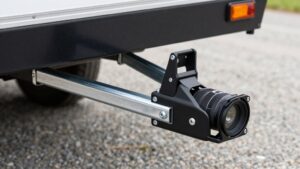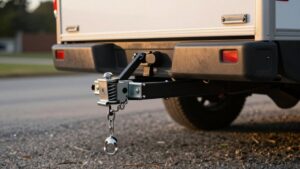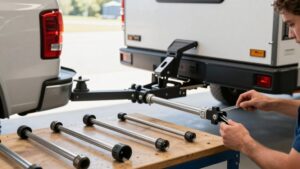
What Drop Hitch Do I Need for a Lifted Truck? Find Your Exact Drop
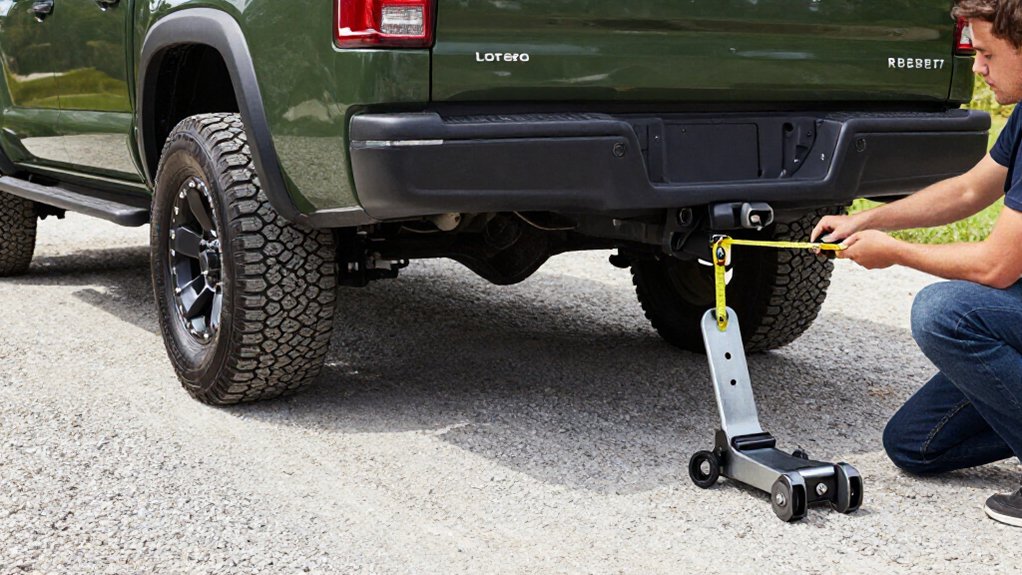
To find your exact drop, park on level ground and measure from the receiver’s top inside edge to the ground.
Measure from the ground to the bottom of your fully loaded, level trailer’s coupler. Subtract coupler height from receiver height; a positive result is drop, while a negative result means rise.
Check tongue-weight and gross-weight ratings, coupler ball size, and shank fit.
Maintain at least 11 inches of ground clearance.
Continue for checks that confirm safe fitment.
Measure Receiver-to-Coupler Height
To determine the drop hitch you need, park your truck and trailer on level ground and level the truck before measuring.
Measure the receiver height from the ground to the receiver’s top inside edge, using that same reference point throughout. This consistency keeps your calculation accurate. Measure your trailer coupler’s bottom height from the ground, then subtract it from the receiver height: receiver top height minus coupler bottom height equals required drop. A positive result indicates drop; a negative result indicates rise.
Lifted trucks often place the receiver higher than stock: a stock setup may measure about 19–21 inches, while a lifted setup can reach roughly 27 inches or more. Don’t estimate from typical figures. Measure your specific truck and trailer in their actual towing configuration; even a small height difference can affect trailer stability and brake engagement. Choose your hitch only after confirming these measurements.
Check Tongue-Weight Rating
Once you’ve calculated the drop or rise, check that the hitch’s tongue-weight rating exceeds your trailer’s maximum tongue weight. Don’t choose by drop size alone; an undersized rating can compromise control.
Measure with the trailer loaded. Park it on level ground, level the trailer with its tongue jack, and confirm coupler height.
Cargo affects tongue weight, which changes truck squat and the ball height you’ll need.
Match the hitch and ball mount ratings to your measured tongue weight and the coupler’s stamped ball size: 1-7/8, 2, or 2-5/16 inches. A lifted setup can increase strain on the rear suspension and hitch system, so verify capacity.
If you don’t know the tongue weight, weigh it or use a scale, then compare the result with the hitch’s rating before ordering.
Ground Clearance Underneath the Receiver
Even if your trailer sits level, the receiver or shank may hang low enough to scrape. Don’t size your drop hitch by drop amount alone: measure from the pavement to the hitch’s lowest point. Keep at least 11 inches of clearance as a safety guideline; less clearance raises impact risk at driveways and speed bumps.
| Receiver height | Example drop | Clearance concern |
|---|---|---|
| 32 inches | 12 inches | Higher receiver may allow |
| 19 inches | About 9 inches | Ground contact likely |
Your truck’s receiver position determines whether the shank clears; trailer leveling doesn’t guarantee safe clearance.
Before you buy, measure receiver height and the hitch’s lowest point with your actual loaded trailer height. Recheck that the lowest point remains at least 11 inches above pavement.
Dual-Ball Mount Configurations
A dual-ball mount lets you switch between common 2-inch and 2-5/16-inch balls to match your trailer’s stamped coupler size without removing the hitch. Before towing, confirm the selected ball and mount meet or exceed the trailer’s loaded tongue and gross weight ratings.
Secure each ball position with rated locking hardware, and use the adjustable drop to keep the coupler level.
Ball Size Options
Which ball size fits your trailer coupler? Read the size stamped on the coupler: common options are 1-7/8 inches, 2 inches, and 2-5/16 inches. Your hitch’s dual-ball setup must provide the matching size; don’t assume a ball will seat securely because it looks close.
If the marking is missing or unclear, measure the coupler’s ball-seat diameter before towing. An incorrect size can prevent proper seating and compromise the connection.
Many adjustable dual-ball mounts pair a 2-inch ball with a 2-5/16-inch ball for utility, camper, or equipment trailers. If you’re towing trailers with different coupler sizes, this arrangement lets you retain one mount and its drop. Select the correct ball before fine-tuning drop or rise; coupler geometry and tongue set can change the required height.
Switching Between Balls
With a dual-ball mount, you can switch between common 2-inch and 2-5/16-inch couplers without carrying separate fixed mounts. Check the size stamped on each coupler before connecting: 2-inch balls fit utility boats and light campers, while 2-5/16-inch balls fit larger campers and equipment trailers. A dual-ball configuration keeps both options in your receiver, replacing separate mounts and letting you reconfigure.
Before towing, position the mount for the required ball, then secure it with the locking pin. Stainless-steel pins resist corrosion and can reduce movement or hitch slop. After switching ball sizes, recheck the drop and level height with the trailer loaded.
This alignment supports sway resistance and consistent surge-brake behavior. Never assume the previous setup remains correct.
Weight Rating Limits
Check the rating for your exact dual-ball hitch configuration before towing: switching between 2-inch and 2-5/16-inch balls changes the load path and may change capacity. Verify the marked capacity for the ball and shank you’ll use; don’t assume one rating covers both balls. Your receiver size—commonly 2, 2.5, or 3 inches—and the mount’s pin position can affect the limit.
Check the hitch’s maximum gross trailer weight, tongue weight, receiver rating, and pin or hardware rating, then stay within the lowest applicable value. A lifted truck still needs those limits respected; choosing enough drop for level towing doesn’t increase capacity. If the mount adjusts or inverts, confirm its rating for your exact setting. Install the specified stainless-steel locking pins. Replace damaged parts before loading.
Matching Trailer Couplers
After confirming the mount’s ratings, match its ball to the size stamped on the trailer coupler; a dual-ball mount lets you switch between common 2-inch and 2-5/16-inch couplers without replacing the hitch. Before ordering, verify the coupler’s stamped size; never assume a trailer uses the ball currently installed.
To set drop or rise, level the trailer on its tongue jack and measure from the ground to the coupler’s bottom. Subtract that height from your receiver height, then select the mount position that keeps the trailer level.
Repeat this check whenever you change couplers or ball sizes: different coupler geometries can shift the required height by inches, even when your truck’s lift hasn’t changed. Secure the correct ball and hitch pins, and use a mount with a dedicated anti-rattle, tight receiver fit. That limits movement that could disturb alignment.
Recheck level and connections before towing each trailer. Confirm the ball is fully seated and locked before coupling.
35–37-Inch Tire Fitments
With 35–37-inch tires and a roughly 6-inch lift, your receiver may sit 8–10 inches above stock, often requiring an 8–11-inch drop, but measure rather than rely on estimates.
Level your truck and trailer, measure receiver and coupler heights, then account for loaded trailer squat to keep the trailer level and reduce sway. Before choosing the drop, confirm the lowest hitch point retains about 11 inches of ground clearance to limit scraping.
35-Inch Tire Clearance
A lifted truck on 35-inch tires, and some 37-inch setups, can place the receiver about 8–10 inches above stock, often requiring an 8–11-inch drop hitch. Measure receiver height before choosing the ball mount: record ground-to-top-of-receiver and ground-to-bottom-of-coupler on level ground, then subtract coupler height from receiver height.
For example, a receiver near 27 inches and a loaded coupler bottom near 17 inches produce a 10-inch difference; add 2 inches for trailer squat when setting a loaded rig, targeting a level stance. That adjustment can reduce sway and improve brake feel, but verify loaded geometry instead of relying on tire size or an estimate. Check the lowest hitch point’s ground clearance. A drop can still scrape on steep driveways, so approach junctions and reassess clearance with the trailer connected.
37-Inch Tire Clearance
On 37-inch tires, a 6-inch lift can raise your receiver about 8–10 inches over stock, often calling for an 8–11-inch drop hitch. With 37-inch fitments, tire size often signals a taller-than-expected receiver, especially when lift geometry adds height.
Treat the 8–11-inch range as a starting point, not a specification: your truck’s receiver and trailer coupler heights determine the actual drop. Use level, loaded towing conditions when establishing those heights; tongue weight can make a heavier trailer squat. For added accuracy, account for roughly 2 inches of drop for that squat, but don’t automatically select a deeper hitch.
A low hitch can scrape on driveways, ramps, or uneven ground. Keep 11 inches between ground and hitch’s lowest point, and verify the trailer stays level before towing.
Measure Coupler Height
Before choosing a drop hitch for 35–37-inch tires, measure from level ground to the bottom of the coupler with your trailer fully loaded and level. Park on level ground, then use the tongue jack to bring the trailer frame and connection point level. Measure from ground to the coupler’s bottom; record this value.
Also measure receiver height at the top inside edge of its opening. Subtract coupler height from receiver height to find required drop. For example, a 27-inch receiver and 17-inch coupler call for 10-inch drop. Add about 2 inches to account for loaded trailer squat, which can lower the hitch under towing weight.
Confirm the measurement reflects your actual load, including propane, water, and gear; changes in coupler height alter required drop even with 35–37-inch tires. Follow hitch and trailer manufacturers’ ratings and instructions.
Check Hitch Ground Clearance
With 37-inch tires on a 6-inch lift, don’t rely on drop measurements alone: check that the hitch’s lowest point sits at least 11 inches above the pavement. Use receiver-height/coupler-height math to choose your drop, but verify clearance separately. Measure from pavement to the lowest point on your hitch with your truck on level ground.
Even when your trailer sits level, the receiver or shank may scrape on steep driveways and approaches. Risk depends on your receiver height and how far the shank hangs below it, not solely on the drop. For example, a receiver near 32 inches may accommodate about a 12-inch drop, while a 19-inch receiver may reach its limit around 9 inches. Treat these figures as guidance, not guarantees; inspect clearance before towing.
Shank and Pin Clearance
Shank and pin clearance matter as much as drop: with the trailer hitched and level, measure from the ground to the hitch’s lowest point and keep at least 11 inches of clearance to help prevent scraping. Match your receiver opening—2″, 2.5″, or 3″—to the shank; a reducer sleeve adds a joint that can complicate fit, pin alignment, and clearance.
On a 6-inch lifted truck, receiver height may sit 8–10 inches higher, so use this ground-to-lowest-point check. Confirm each hitch pin passes fully through the aligned holes and install its locking clip. Partial engagement can let the hitch shift over bumps, reducing clearance. Recheck with your trailer loaded and level: tongue weight can make the truck squat and lower the receiver, cutting shank-to-ground clearance.
Corrosion-Resistant Finish Options
Because a drop hitch faces road spray, salt, and moisture, choose a corrosion-resistant powder coat or plated or treated steel, especially if you drive in winter-salted areas. Match the finish to your climate, and inspect it regularly for chips or exposed metal.
For moving contact points, prioritize protected ball, hinge, and pin surfaces; rust can increase wear and contribute to wobble or slop. Proven Industries’ Hyper Hitches M355 uses dual 5/8-inch solid stainless steel pins, which resist corrosion better than mild-steel hardware.
Also consider 100% robotically welded construction: fewer crevice areas can limit places where corrosion starts and spreads during long-haul use. Protecting the hitch’s finish and hardware helps preserve its anti-rattle fit and quiet performance. Replace damaged components before corrosion compromises secure attachment.
Ignoring Loaded Trailer Squat
Account for loaded trailer squat before choosing your drop hitch: tongue weight settles the truck’s suspension, lowering the coupler from its unhitched height. Measurements taken with an empty trailer can underestimate the drop you need because loading adds tongue weight and changes ride height.
Load cargo, water, and gear as you actually tow; use the tongue jack to level the trailer frame, then remeasure the coupler and truck heights. The guide recommends adding about 2 inches to your calculated drop to account for squat, but confirm against your loaded measurements.
- If you ignore squat, your trailer may run nose-high or nose-low at highway speed, reducing stability.
- Poor leveling can worsen sway during crosswinds and lane changes.
- Correct height supports smooth, consistent surge-brake engagement.
Verify Coupler Size Compatibility
Before ordering, check the ball size stamped on your trailer coupler, commonly 1-7/8, 2, or 2-5/16 inches, and match it to the hitch ball. Don’t infer size from trailer category; couplers on similar trailers can differ. Read the marking directly, then confirm the adjustable mount includes that exact ball before you order.
- A 1-7/8-inch ball won’t seat correctly in a 2-inch coupler; mismatch can compromise retention and stability.
- Check included ball size(s), not just the mount’s drop range, before purchase.
- If you switch trailers, a dual-ball mount can cover 2- and 2-5/16-inch couplers.
Your drop measurement only solves height; it can’t correct an incompatible ball. After matching sizes, verify the ball locks fully into the coupler and follows its manufacturer’s setup instructions before towing each trip.
Conclusion
To find the right drop hitch, measure from your truck’s receiver to the trailer coupler with both loaded, then account for suspension squat. Choose a mount that levels the trailer while meeting your receiver’s tongue-weight rating. Confirm ground, tire, shank, and pin clearance; match the coupler to the correct ball size.
If you tow different trailers, consider a rated dual-ball mount. Select a corrosion-resistant finish, and recheck fit and secure pin engagement before every trip.
What Size Trailer Hitch Do I Need? Class Selector
Enter loaded trailer weight, tongue weight and your ratings to get the minimum hitch class (I–IV) and see which rating sets your limit.
Hitch Bike Rack Load & Fit Checker
Check your e-bikes and hitch bike rack against your receiver's tongue-weight rating and the rack's own capacity, in lb or kg.
Hitch Step Fit Checker
Check if a hitch step fits your receiver: shank vs opening, step load rating vs the heaviest user, and approximate platform height.
Ball Mount Drop and Rise Calculator
Enter receiver and coupler heights to calculate the required ball mount drop or rise in inches and millimeters.