Do I Need a Weight Distribution Hitch? The Weight Thresholds That Decide It
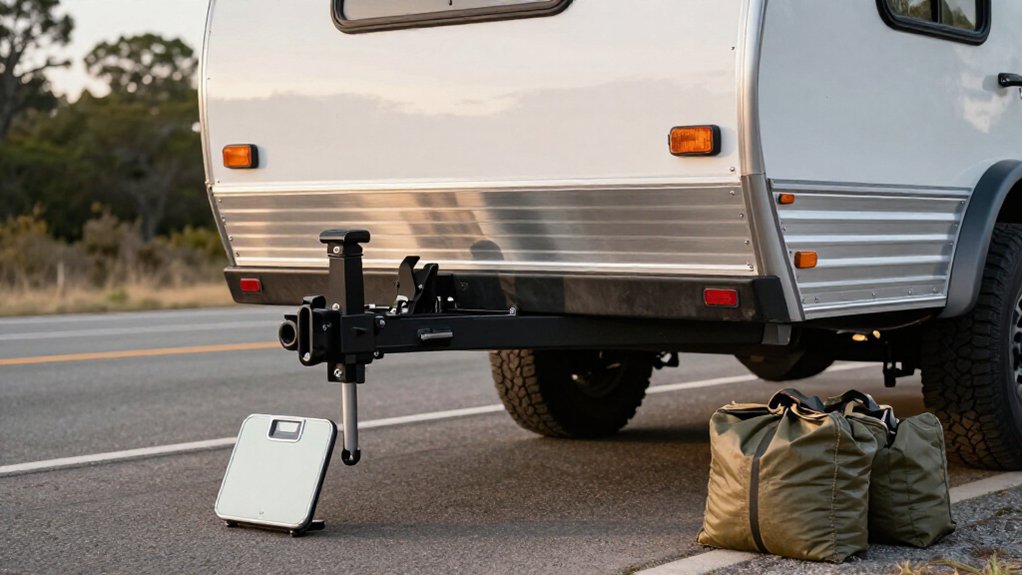
Consider a weight distribution hitch when your loaded trailer is around 5,000 pounds or more, but treat that threshold as a prompt, not a rule. Rear sag or light steering also signal that you should assess the setup.
Match the hitch to measured loaded tongue weight, typically 10–15% of trailer weight, and verify every vehicle, receiver, trailer, and kit rating.
A WDH can improve balance, but won’t raise capacity.
The checks below help confirm fit.
Weight Threshold Quick Guide
A weight distribution hitch is worth considering once your loaded trailer exceeds about 5,000 lb, especially if the truck’s rear sags or its steering feels light. Treat that threshold as a prompt, not a rule: your truck, receiver, or trailer maker may require weight distribution at a different limit. Check each manual before towing, and don’t ignore front-end lift or highway sway; either can signal that the setup needs attention.
Match the hitch to tongue weight, not the trailer’s dry weight, and choose a spring-bar range that closely fits your loaded setup. A 4,000-lb trailer commonly calls for 400–600 lb of tongue weight; at 6,000 lb, expect 600–900 lb; at 8,000 lb, 800–1,200 lb. A tongue weight near a hitch’s minimum may still work, but closer range matching is preferable.
If handling remains poor, stop and correct the setup before continuing. Use these figures as screening guides, and prioritize stable, controlled steering.
Weigh Your Loaded Trailer
Weigh your loaded trailer before choosing a weight distribution hitch; tongue weight typically should be 10% to 15% of the trailer’s loaded weight. Don’t rely on dry-weight figures: pack the trailer as you’ll travel, then measure at the coupler with a tongue weight scale, such as etrailer #e99044. Cargo placement changes the reading, so include items behind the rear axle; moving them can shift tongue weight.
Use the result to select a hitch whose tongue-weight range covers your actual load. As a quick minimum check, calculate 10% of loaded trailer weight to see whether you’re nearing the range’s lower end. For example, 4,000 pounds suggests about 400 to 600 pounds of tongue weight; 6,000 pounds, 600 to 900; and 8,000 pounds, 800 to 1,200. Recheck after loading changes for accurate hitch selection.
Tongue Weight vs. Tow Rating
Don’t confuse tongue-weight limits with tow rating: a weight distribution hitch can help level the rig and improve handling, but it won’t increase your vehicle’s towing capacity, payload, or axle ratings.
Choose your hitch by loaded tongue weight, not dry trailer weight. Tongue weight typically runs 10–15% of loaded trailer weight; a 7,000-pound trailer may impose about 700 pounds. Check that measured load falls inside the hitch’s rated range, then verify every vehicle and hitch limit.
| Measure | What it determines |
|---|---|
| Loaded tongue weight | Hitch size |
| Tow rating | Maximum trailer load |
Use a WD hitch when tongue load causes squat or front-axle lift, even within tow rating. It improves balance, but can’t legalize overloads. Weigh the rig and compare axle loads with vehicle limits.
Spring Bars vs. Chain Systems
Spring-bar systems use tensioned bars to transfer load, but they need careful setup and can be heavy. Chain systems use chains and friction components, which may simplify adjustment and sway control.
Whichever design you choose, match its rating to your measured loaded tongue weight—typically 10–15% of the trailer’s loaded weight.
Spring Bar Basics
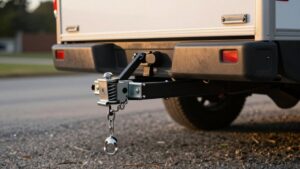
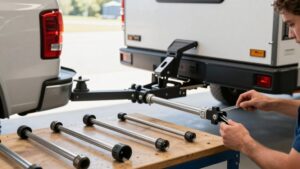
Traditional weight-distribution hitches use tensioned spring bars to lift the coupling point and transfer load to the tow vehicle’s front axle and the trailer axles. You’ll find round or trunnion bars; both work by applying leverage against the trailer frame. This helps reduce excess load on the hitch ball and restores balance across the rig.
You’ll need to set bar tension and angle according to your hitch’s instructions, then check that the tow vehicle sits level and handles predictably. Don’t assume a hitch’s rating alone guarantees a proper setup: match it to your trailer’s actual loaded tongue weight, commonly about 10–15% of its loaded weight. Too little or too much bar tension can affect handling and component stress. Recheck the setup after loading changes, and follow the manufacturer’s limits.
Chain System Basics
Spring bars aren’t the only way to distribute tongue weight: chain-based systems use chain tension and friction components to help restore front-axle load and reduce rear squat.
At the coupling, friction resistance helps redistribute load and restore weight to your tow vehicle’s front axle. This can reduce rear sag and support steadier steering. You manage tension through the chain and friction setup; follow the manufacturer’s instructions, then check stance and handling.
Easier fine-tuning doesn’t replace correct sizing. Match the hitch’s tongue-weight range to your loaded tongue weight, not the trailer’s dry figure. Tongue weight commonly falls around 10–15% of loaded trailer weight. Weigh the actual load after packing, and confirm you’re within vehicle and hitch limits before towing, and recheck whenever cargo changes notably.
Key Design Differences
Although both designs redistribute tongue load, they do it differently: spring-bar hitches use rigid steel bars tensioned between the hitch and trailer frame, while chain systems use chains and friction components to transfer load and help damp sway. With spring bars, you adjust angle and bar tension to lift the coupling and counter tongue pressure. Some setups weigh about 100 pounds and may need separate sway hardware, such as friction bars or dual-cam components.
Chain systems use friction for sway damping and may have fewer contact points.
Both require correct sizing: match the hitch to loaded tongue weight, typically 10–15% of loaded trailer weight, and adjust it to restore a level, stable tow. Check ratings, then follow the manufacturer’s setup instructions; poor adjustment can compromise handling.
Choosing the Right System
Choose between spring bars and a chain system based on how you prefer to adjust the hitch and manage sway. Spring-bar models use tensioned round or trunnion bars to transfer load from the coupling point to your vehicle’s front axle and the trailer axles, helping restore level stance and control. You may need to adjust head angle, brackets, and bar tension to get the setup right. Many include friction or cam-style sway control.
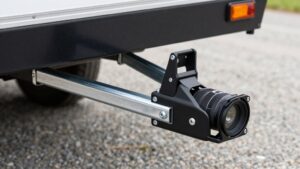
Chain systems use chains and friction components to distribute tongue load and resist trailer yaw. They typically rely on a repeatable friction setting and careful alignment, with fewer traditional bar contact points to maintain. Before choosing either design, measure your loaded tongue weight; it’s typically 10–15% of loaded trailer weight. Match the hitch’s rated range to that weight for proper leveling.
Frequent Mountain Towing
Steep mountain grades add strain, while descents demand steady steering and braking control. Match your weight-distribution hitch to the trailer’s loaded tongue weight, and verify it with a scale.
Check your vehicle, receiver, and trailer ratings before towing.
Steep Grades Add Strain
On mountain grades, tongue weight can push down on your truck’s rear axle and lighten the front, reducing steering authority when you need control most. Sustained climbs can make the imbalance more noticeable, especially as you accelerate.
A weight distribution hitch transfers some tongue load toward the front axle and trailer axles, helping restore steering response and stability. If you tow a heavier trailer—often around 5,000 pounds or more—and notice rear sag or front-end lift, check your tongue weight. It should typically fall near 10–15% of the trailer’s weight when loaded.
Choose a hitch rated for your tongue load, and follow your truck, receiver, trailer, and hitch-maker requirements. Don’t assume a weight threshold overrides those limits; verify your setup before mountain towing.
Descents Demand Control
During long mountain descents, frequent towing can make rear sag and front-end lightness more noticeable, dulling steering and braking feel.
When your truck squats after you connect the trailer on hills, tongue-weight transfer shifts load away from the front axle. A weight distribution hitch uses spring bars to lift the hitch and coupler point, redistributing load more evenly and helping restore front-axle load. That can make steering and braking responses feel more controlled as grades steepen.
If you tow often at highway speeds, better balance may also reduce sway risk; some systems add friction or dual-cam sway control. A WDH is commonly recommended for heavier trailers, often around or above 5,000 pounds, because their tongue weight can meaningfully alter axle balance. Stay alert downhill.
Match Hitch To Load
To keep your truck balanced on frequent mountain trips, match the weight-distribution hitch to your trailer’s loaded tongue weight, not its dry rating. Measure tongue weight with the trailer packed for travel; it’s typically about 10–15% of loaded trailer weight. Choose a hitch whose specified tongue-weight range includes that measurement, ideally near its middle for effective bar tension and load transfer.
For example, a 10K Equal-i-zer #EQ37100ET covers 600–1,000 pounds, while the 12K #EQ37120ET covers 800–1,200 pounds. A 7,000-pound loaded trailer may have roughly 700 pounds on the tongue; a 7,600-pound trailer could approach 760 pounds. On mountain grades, rear sag, light steering, or an unsettled truck-trailer feel can signal poor balance. Don’t select by trailer weight alone; match the hitch to measured tongue load.
Check Vehicle Ratings
Before choosing a weight-distribution hitch for frequent mountain towing, check your truck’s axle ratings and your receiver’s tongue-weight limits; a WDH improves load balance but doesn’t increase any rating or your towing capacity.
When a loaded trailer causes rear sag or lifts the front axle, you need a WDH if your vehicle or receiver manufacturer requires one. Loads often cross WDH thresholds above about 5,000 pounds, and mountain grades magnify steering and braking changes.
Estimate tongue weight at 10–15% of loaded trailer weight; cargo placement can shift it. Confirm the measurement fits the WDH’s tongue-weight range. After loading, use a tongue-weight scale, such as a coupler scale, and check each component’s rating. Don’t rely on a level-looking truck; appearance can’t confirm axle loads or safe limits.
Trailer Frame Clearance
Check trailer-frame clearance before choosing a weight distribution hitch: the frame must let you secure the spring-bar brackets and position the hitch head and bars at the specified angles. Check the front of your trailer for obstructions. Propane tanks, battery boxes, or the tongue jack can interfere with bar placement or prevent proper bracket and hitch-head angles.
Confirm the frame’s width and attachment points let the supplied brackets and shank sit at the required height without contacting nearby components. Your tongue jack must also lift and support the tongue enough to unload or tension the hitch during setup, and hitch hardware mustn’t block the jack. Don’t accept approximate angles if the frame or nearby equipment prevents the specified setup. You may need a different hitch model to achieve a secure, correctly positioned installation. Verify clearances before purchase.
Weight Hitch Compatibility
Even if your trailer needs weight distribution, use a WD hitch only if your tow vehicle’s receiver and labels explicitly approve it. Check the receiver and hitch labels before buying or installing a system; a standard receiver may not be rated for weight distribution. You’ll need a compatible WD-rated receiver and shank setup mounted in the rear receiver.
A manufacturer’s WD requirement, often triggered above about 5,000 pounds, doesn’t override compatibility. Don’t use a WD hitch with a 5th-wheel or gooseneck trailer; these setups generally aren’t compatible. A WD hitch also won’t raise your towing capacity or axle ratings. Keep the entire combination within the lowest rating among your vehicle, receiver, trailer, and WD kit. If your receiver or labels don’t approve weight distribution, don’t use the hitch; contact the vehicle or receiver manufacturer for an approved solution.
Verify Your Vehicle’s Payload
To verify your vehicle’s payload, use the door-jamb label and owner’s manual, then subtract passengers, cargo, and added equipment to find what remains for the hitch load.
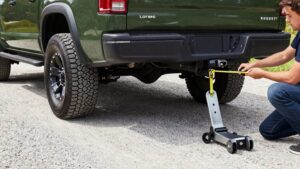
Next, measure your actual tongue weight with a tongue scale: place it at the coupler and record the reading. This load counts directly against your truck’s payload. Typically, a properly loaded trailer puts about 10–15% of its total weight on the tongue; confirm your reading falls within that range.
Apply these three checks:
- Compare tongue weight and remaining payload with receiver and vehicle ratings; the lowest-rated component sets your limit.
- If your trailer nears or exceeds payload or axle limits, weight distribution becomes more important.
- It can restore more load to the front axle and reduce rear sag.
Check Receiver Shank Length
Start by confirming the shank places the hitch head where it needs to be to restore the correct front-axle load. Measure from your receiver opening to the trailer coupler’s required attachment point; an unsuitable length can limit spring-bar tension and proper load transfer.
- Follow the manufacturer’s shank guidance for your receiver class and drop or rise; the system’s operating height matters.
- Check clearance around the jack handle, crossmembers, propane or battery hardware, and tongue brackets so bars can move freely.
- After installation, confirm the front axle load is restored and rear sag is reduced; stop and adjust if indicators fall outside guidance.
Correct shank length supports safe handling and lets the hitch work within its intended tongue-weight range; don’t judge fit by appearance alone.
Conclusion
Before you tow, weigh your loaded trailer and confirm its tongue weight, your vehicle’s payload, and every hitch and receiver rating. Use a weight distribution hitch when your vehicle or trailer maker requires one, or when your setup exceeds the relevant thresholds.
Check frame clearance, shank length, and hitch compatibility; choose spring bars or chains suited to your trailer. If you’re unsure, consult your owner’s manual or a qualified hitch installer. Never tow beyond any rated limit.