How to Choose a Weight Distribution Hitch: Bar Rating, Sway Control and Fit
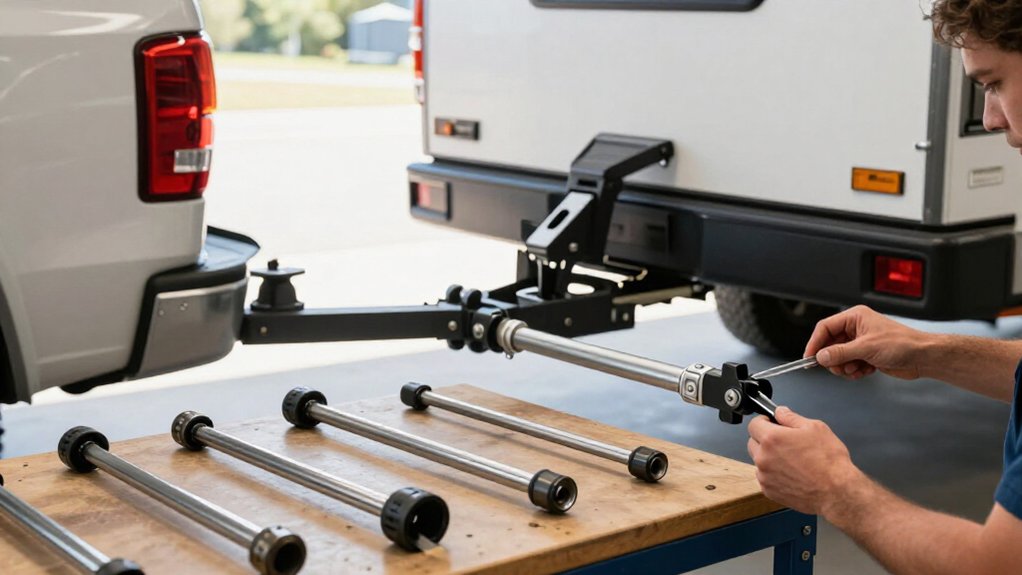
Choose a weight distribution hitch by measuring loaded tongue weight, not dry trailer weight.
Select spring bars whose rated range includes that load, and verify your receiver, vehicle, and every hitch component stay within their limits.
Confirm sway control compatibility, then check bar clearance during travel.
Check frame space and replacement parts for your model.
Adjust tension gradually until the rig sits level, and retune after cargo changes.
More checks can help you confirm the setup.
Bar Rating and Fit Choices
Choose a weight distribution hitch by your trailer’s loaded tongue weight, not its dry weight; tongue weight typically runs about 10–15% of the loaded trailer’s gross weight. Select spring bars whose rated range includes your tongue load. For example, the 10K Equal-i-zer #EQ37100ET covers 600–1,000 lb, while the 12K #EQ37120ET covers 800–1,200 lb.
If your estimate sits near a range’s lower limit, choose a system whose minimum you meet or exceed; undersized bars can distribute weight poorly. Before purchase, confirm your trailer frame accepts the brackets and attachment points. Check that the shank’s drop or rise positions the bars for your setup geometry. Keep the tongue load within the hitch’s rated window after cargo changes, and adjust bar tension according to the manufacturer’s instructions.
Measure Loaded Tongue Weight
Before matching spring bars to a rating, measure your trailer’s loaded tongue weight.
Load the trailer; dry weight can mislead. Use 10–15% of loaded trailer weight as an estimate. Confirm the actual value with a tongue-weight scale at the coupler, such as etrailer’s Tongue Weight Scale # e99044. Lift the tongue with the jack to remove pressure from the scale and stabilize the reading.
Account for cargo placement: cargo behind your truck’s rear axle contributes to loaded tongue weight once you’re hitched and configured for travel.
Choose a hitch whose tongue-weight range includes your measured value. For example, Equal-i-zer # EQ37100ET covers 600–1,000 pounds. If your reading falls below a hitch’s lower limit, reload or select another range. Never use one rated below your tongue weight.
Vehicle Receiver Weight Limits
Check your vehicle’s receiver rating before selecting a weight distribution hitch: adding weight distribution does not increase the receiver’s or vehicle’s maximum capacities.
Verify that the receiver is explicitly rated for WD use; its label or manual may list separate tongue-weight and gross-trailer-weight limits. Base your hitch rating on loaded tongue weight, typically 10–15% of loaded trailer weight, but check receiver limits against tongue load and required load transfer.
| Check | What to verify | Why it matters |
|---|---|---|
| Receiver | WD-approved | Compatibility |
| Limits | Tongue and GTW | Capacity |
| System | Lowest-rated part | Sets ceiling |
A bar range’s lower edge doesn’t excuse exceeding WD limits. Compare receiver, ball mount or coupler, hitch head, and frame attachments; the lowest-rated component governs. Stay within every published limit for your setup.
Round-Bar vs. Trunnion-Bar Designs
Round-bar hitches use cylindrical bars, while trunnion-bar hitches use square-ended bars positioned differently at the hitch head, which can affect ground clearance. Choose a system rated for your loaded tongue weight—typically 10–15% of loaded trailer weight—and verify it can handle your actual load, especially near the rating’s lower limit.
Install and adjust bar tension and head and bracket positions to restore proper leveling and stability, and confirm separately that the hitch includes the sway control you need.
Bar Shape and Position
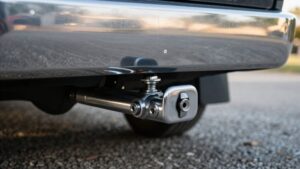
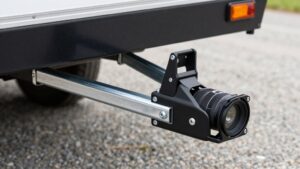
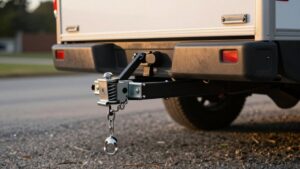
Often, the right choice comes down to fit and rated tongue-weight range, not bar shape. Round-bar hitches use cylindrical spring bars that pivot under tension from the hitch head. Trunnion-bar designs use squared bars mounted to the head face, changing how they sit and transfer load.
For either style, match the spring-bar rating to your measured or estimated loaded tongue weight; a 7,000-pound trailer may carry about 700 pounds at the tongue.
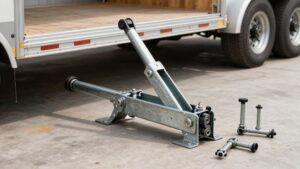
Both designs use bar tension to restore load transfer, helping lift your truck’s rear and add load to your front axle. Position the bar ends and frame brackets according to the manufacturer’s geometry. Check that the bars move through their intended arc without binding. Then adjust tension and verify axle loading before towing.
Ground Clearance Differences
Bar shape also affects ground clearance: round-bar assemblies typically hang lower beneath the hitch head, while trunnion bars mount to its face and generally sit higher.
That difference can matter at steep driveways or on rough roads, where a low bar or attached component may strike pavement. Before you buy or install either design, compare your trailer’s actual hookup height with the lowest point of each bar assembly. Check the full travel path, not just level parking clearance.
After installation, hitch your trailer with its usual load and inspect clearance again. Cargo shifts can change tongue weight, and bar angle or tension may slightly alter the hitch’s vertical position. Recheck after loading changes, and confirm bars remain clear through turns and uneven ground regularly.
Weight Rating Considerations
Although round-bar and trunnion-bar hitches attach differently, either design can distribute weight correctly when its spring bars match your loaded tongue weight. Choose by loaded tongue weight, not trailer’s dry rating: aim for 10–15% of loaded trailer weight, then select a bar range that includes your measured tongue weight.
A 10K Equal-i-zer #EQ37100ET covers 600–1,000 lb; if you’re near its lower limit, the 12K #EQ37120ET, rated 800–1,200 lb, may be a safer match. These ratings describe usable tongue-weight ranges.
Cargo behind the rear axle can change tongue weight, so measure the coupler with a tongue-weight scale, such as etrailer #e99044. A correctly rated system transfers load more effectively, reducing rear sag and front lift to support stable handling. Either design requires this match.
Installation and Adjustment
Once the spring bars match your loaded tongue weight, set their tension to level the tow vehicle and trailer. Choose round-bar or trunnion-bar design by how you want bars to apply tension: round bars project from the hitch head, while square trunnion bars attach to its face.
Measure tongue weight with the trailer loaded; it typically equals 10–15% of loaded trailer weight. Don’t use dry weight to select bar rating. Attach the bars to the frame brackets and receiver head, then increase tension in small increments. Stop when the rig levels; over-tightening can create a harsh ride.
After moving cargo, recheck tongue weight and retune tension. Confirm a level stance, smoother braking, and reduced sway. After a test drive, recheck bolts, pins, and safety clips.
Best for Frequent Hitching
If you hitch and unhitch often, choose a weight distribution hitch with easy bar attachment and minimal daily adjustments. Match its rating to your loaded tongue weight, ideally near the middle of the range, and use a tongue-weight scale to set it accurately.
Integrated sway control can improve highway stability while letting you reconnect and disconnect quickly.
Fast Hitching Setup
For frequent hitching, choose a weight-distribution system with clear settings, quick-connect hardware, and sway control that re-engages consistently, such as an integrated dual-cam or friction-style design.
Before buying, match the spring-bar rating to your loaded tongue weight; typically, that equals 10–15% of the trailer’s loaded weight. Keep the measured value within the bar’s stated range; frequent use won’t correct a mismatch.
Use a coupler-mounted tongue-weight scale, and recheck after cargo changes. Load behind the rear axle can increase tongue weight and push it outside the proper range.
Choose clear markings and straightforward settings, so you won’t need repeated bracket or angle adjustments. Confirm receiver height and shank drop, then check trailer-frame bracket locations for propane tanks, batteries, and tongue-jack swing. These fit checks help keep each hookup repeatable without altering components.
Before travel, confirm sway control has engaged as designed and inspect for binding or loose hardware.
Easy Bar Attachment
Clear settings make repeat hookups more consistent, but easy bar attachment also matters when you hitch often. Choose a weight distribution hitch with tool-light spring-bar connections so you can reconnect without wrestling heavy bars or avoiding a complicated hookup sequence.
Before selecting bar rating, match it to your loaded tongue weight, not the trailer’s dry figure. Tongue weight typically falls near 10–15% of loaded trailer weight, but cargo can shift it.
Verify the hitch’s rated tongue-weight range covers your measured or estimated load; for example, EQ37100ET suits roughly 600–1,000 lb. If cargo varies, measure at the coupler with a tongue scale before setting bar tension. Correctly matched bars let you establish the intended tension and repeat a secure, predictable connection safely, trip after trip.
Minimal Daily Adjustments
Frequent hitching takes less adjustment when your hitch’s spring-bar range covers your loaded tongue weight. Choose a rating slightly above your expected load, but confirm its range includes measured tongue weight. A 700–800 lb target fits the 600–1,000 lb range of the 10K Equal-i-zer #EQ37100ET; the 12K #EQ37120ET covers 800–1,200 lb if you’re near the upper band.
Loaded tongue weight is typically 10–15% of trailer weight. After loading changes, use a coupler-mounted scale, such as etrailer #e99044, to verify the bar range remains appropriate.
Set the head angle and brackets, then maintain consistent spring-bar tension. When cargo stays similarly located, hookup mainly needs connection and securing components. If cargo shifts behind the rear axle, recheck tongue weight because it changes required bar tension.
Quick Trailer Disconnect
If you hitch and unhitch often, choose a weight distribution hitch with a quick-disconnect system that lets you leave the spring bars and brackets set. Before relying on it, confirm the hitch handles your loaded tongue weight, typically 10–15% of loaded trailer weight, and that disconnecting doesn’t alter bar tension or matching. After each re-hook, measure tongue weight at the coupler with a tongue-weight scale.
Keep the reading within your hitch’s rated range and target its sweet-spot window; many midweight setups fall near 700–760 lb. If readings drift, make small bar or tension adjustments, then measure again. Before towing, inspect every pin and lock for correct engagement. A quick disconnect saves time, but never trade verified setup and secure connections for convenience alone.
Trailer Frame Clearance
Before choosing a weight distribution hitch (WDH), measure the trailer-frame clearance around the hitch attachment points, especially near the propane tank, battery box, and tongue jack.
You need room for spring bars and brackets to swing and seat without interference. Check vertical clearance under tension: bars must contact the frame safely, because loading changes hitch geometry and a static fit can mislead. Inspect horizontal space beneath the trailer and around crossmembers.
Bar ends and brackets must avoid wiring, hoses, jacks, and members during setup and towing.
If your frame is narrow or wide, verify the brackets and shank suit it; otherwise, consider spacers or another hitch style. Dry-fit level, position and tighten bars to specification, and measure tongue weight on a scale tuning tension.
Replacement Parts Availability
Once the hitch fits your trailer frame, check that its critical replacement parts are still available. Confirm the manufacturer still produces components for your exact model and rating; a 10K system may not accept parts from a 12K system. Check spring-bar length and rated tongue-weight range, and match that range to 10 to 15% of your trailer’s loaded weight.
Verify you can buy head or lever components, shanks, brackets, bolts, and mounting hardware. Missing fasteners can prevent a safe, correctly tensioned adjustment.
If your hitch includes sway control, confirm that its friction pads, links, or cams are sold separately or in compatible kits. Prefer models with stocked replacement assemblies and rated components shared across more than one kit. Before purchase, check current availability and compatibility with the hitch designation; don’t assume similar-looking parts fit or meet its specifications.
Signs of Undersized Spring Bars
Spring bars may be undersized when your loaded tongue weight exceeds their rated range and the tow vehicle still squats at the rear or feels light in the steering after proper adjustment.
Check loaded tongue weight at the coupler with a scale; it should fall within your hitch’s bar range, typically about 10–15% of loaded trailer weight.
- Below the minimum rating, bars may not transfer load to restore front-axle loading or level the rig.
- Rear squat or light steering after adjustments signals inadequate bar capacity; don’t judge by dry weight.
- Highway float can reflect insufficient head pressure and load transfer; slow down and reassess before continuing.
- If bars are too loose to level the vehicle near the adjustment limit, verify rating and setup.
Sway Control Compatibility
After confirming your spring bars match the loaded tongue weight, check that the hitch’s sway-control system fits your setup.
Traditional spring-bar hitches may use friction bars or cams to resist oscillation alongside weight distribution. A Pivot Point Projection-style system such as ProPride 3P controls sway through a virtual pivot point, so verify compatibility with your vehicle and trailer geometry.
- Set tongue weight typically at 10–15% of the loaded trailer weight; sway control can’t correct poor loading.
- Adjust weight distribution and link or bolt tension until side-to-side movement stops without creating a harsh ride.
- Confirm components match the hitch model; friction dampers and pivot-point systems aren’t interchangeable.
- Test for side-to-side movement, then recheck bolts, pins, and safety clips to ensure engagement.
Conclusion
Choose spring bars by measuring your loaded tongue weight, then verify that the hitch and vehicle receiver stay within their ratings. Match the bar design to your trailer’s frame clearance and how often you hitch; confirm replacement parts and sway-control compatibility before buying.
If the bars sag, flex excessively, or fail to level the rig, don’t keep towing: reassess the load and hitch rating. Follow the manufacturer’s setup instructions, and recheck connections before every trip.