Trailer Tongue Jack Capacity Chart: Match the Jack to Your Tongue Weight
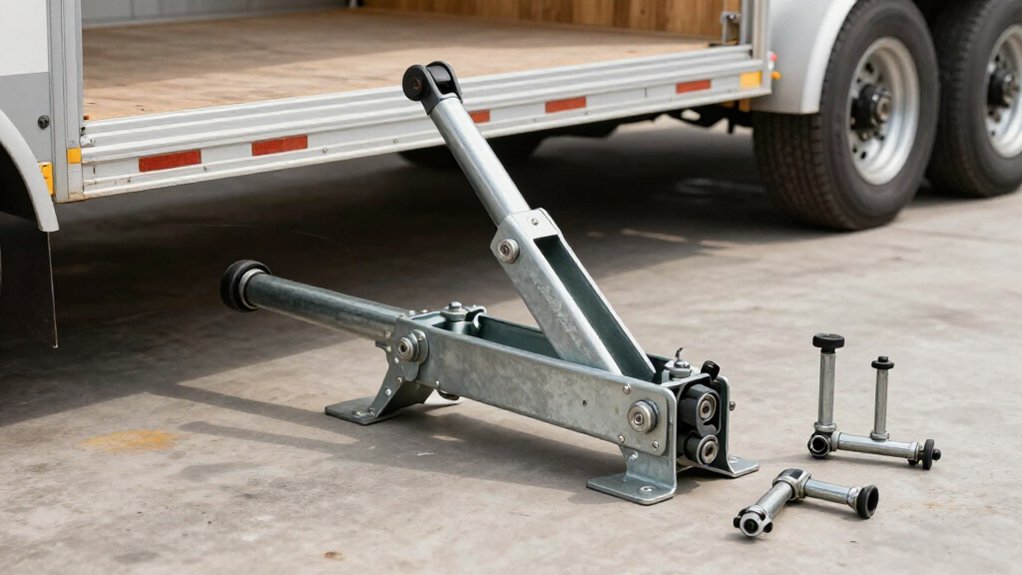
To choose a trailer tongue jack, weigh your trailer fully loaded and travel-ready; tongue weight is typically 10–15% of that total, not its GVWR. Measure at towing height on level ground when possible.
Select a jack rated for about 1.5–2× the measured tongue load to allow reserve for shock loads. Check the label for maximum vertical capacity and correct units. Avoid side-loading, and inspect mounts for corrosion or cracks.
More checks follow for safe fitment.
Weighing Loaded Tongue Weight
Base your jack selection on the tongue weight of your loaded trailer, not a brochure’s dry-weight figure or the trailer’s total GVWR.
Weigh the trailer in its travel-ready condition, with fuel, water, batteries, gear, and passengers aboard as applicable. If you’re towing a boat, use its wet weight; fuel alone adds about 6.3 lb per gallon. An 80-gallon tank contributes roughly 500 lb, which can change the tongue load.
Whenever possible, measure tongue weight directly using a suitable scale or purpose-built tongue scale, following the equipment’s instructions and keeping the trailer stable. Measure on level ground, with the coupler at towing height, and keep people clear of pinch points.
If you can’t measure it, estimate tongue weight at 10–15% of fully loaded trailer weight.
Trailer Jack Capacity by Tongue Weight
Choose a tongue jack by comparing its rated vertical capacity with your loaded trailer’s measured tongue weight, then add a safety margin: a common guideline is 1.5 to 2 times the tongue weight. Your tongue weight usually equals 10–15% of loaded trailer weight; heavier commercial setups may reach 15–20%. For a 5,000-lb trailer, estimate 500–750 lb, then round the selected rating upward.
| Tongue weight | Minimum factor | Jack rating |
|---|---|---|
| 500 lb | 1.5× | 750 lb |
For a measured 750 lb tongue load, choose at least 1,125–1,500 lb capacity. At roughly 2,500 lb, a 5,000 lb jack offers capacity beyond a 3,000 lb model. Hydraulic options span 5,000 to 30,000+ lb, but select by measured load—not category. Confirm the jack’s rating covers support.
Static and Shock Loads
A tongue jack must support static tongue weight and withstand temporary shock loads from bumps, rough ramps, and potholes. Your trailer’s tongue weight usually equals 10–15% of its loaded weight, but impacts can briefly raise the force on the jack. Size the jack for roughly 1.5 to 2 times your measured tongue weight to provide a margin against these spikes.
For a 5,000-pound loaded trailer with 500–750 pounds on the tongue, target at least 750–1,500 pounds of capacity; choosing more can help. Long trips and frequent launches increase exposure to shock loading, so extra capacity reduces strain, wear, and slow or stalled lifting. A jack barely above tongue weight may bind internally, overstress mounting hardware, or exceed its intended lifting demands during an impact.
Reading Capacity Labels
Find the jack’s capacity rating on a legible label, and confirm it specifies tongue load rather than gross trailer weight. Check the units and stated limits, then compare the working rating with your measured tongue weight and expected static or shock loads.
Don’t use the jack if its label is missing, unclear, or doesn’t match your application.
Find The Capacity Rating
When reading the jack’s capacity label, confirm it states the maximum vertical load the jack can safely lift and hold.
Use measured or estimated tongue weight to set the required rating; don’t rely on guesswork. Tongue weight typically equals 10–15% of a trailer’s loaded, wet weight. For example, a loaded 6,000-pound trailer may have 600–900 pounds of tongue weight, so verify your actual value before choosing.
If your estimate falls between 420 and 600 pounds, choose a jack rated for at least 600 pounds, preferably higher. A safety factor of about 1.5 times your tongue weight provides capacity margin. Check that the listed rating applies to tongue or uncoupled lifting; if the label specifies another condition or mount style, don’t assume it matches.
Identify Gross Versus Tongue
Separate the trailer’s GVWR, the maximum total loaded weight, from the tongue weight your jack must support.
Check the trailer’s GVWR label for its total rating, but don’t size the jack to that figure. The jack carries the vertical load at the coupler, not the entire trailer. Estimate tongue weight from the trailer’s wet, fully loaded weight; fuel, cargo, water, and equipment can change the load.
For many RV, utility, and boat trailers, tongue weight often falls 10–15% of loaded weight. Use that estimate as a starting point, or measure the tongue load. Read the jack’s capacity label to confirm it describes vertical lifting or supporting capacity. Then select a jack rated about 1.5–2 times your measured or estimated tongue weight, providing a margin for operation.
Check Units And Limits
Read the jack’s capacity label in the same units you used for tongue weight, usually pounds (lb), and confirm it specifies the maximum vertical load the jack can safely lift or support, not the trailer’s GVWR. Check any stated height or extension limit before setup; a longer leg can reduce stability and may change permitted capacity.
Compare the rating with your measured or calculated tongue weight; select a jack rated at least as high, with a safety margin, often 1.5 to 2 times that weight. Also follow listed operating-temperature or indoor/outdoor restrictions. If salt, moisture, or road exposure conflicts with stated conditions, choose equipment suited to that environment.
If the label is missing, unclear, or gives no applicable limit, contact the manufacturer before loading the jack for guidance on safe use.
Compare Static And Working Loads
After confirming the units and limits, check how the label defines capacity: the highest number is the rated maximum, but it may describe a static load the jack can hold at rest rather than the working load it can safely lift or support during normal operation.
Treat the static rating as a limit at rest, not proof that the jack can safely raise the same load. Find working capacity for vertical lifting or support in intended operation; don’t substitute another metric. Estimate tongue weight, often 10–15% of trailer gross vehicle weight, and choose a working capacity above it. A common margin is 1.5–2 times actual tongue weight. This reserve covers movement while lifting or lowering, but doesn’t replace manufacturer limits or proper setup. If only static capacity is stated, consult documentation before using that jack.
Verify Label Placement and Legibility
Before buying or using a tongue jack, check that its capacity label is securely mounted, protected from road spray and wear, and visible without obstruction from the trailer frame or brackets. After installation, read it from normal viewing angles without guessing at the rated lift or capacity. Confirm the marking specifies vertical support for tongue jack use; a base load or actuator rating doesn’t establish the jack’s allowable tongue weight. Compare that value with your measured tongue load.
Inspect the label near pivot points, where abrasion or corrosion can damage it, and after coastal or marine exposure. If printing fades or an obstruction prevents reading, don’t use the jack based on assumption. Replace it or obtain rating documentation from the manufacturer before operation.
Convert Tongue Weight to Capacity
To convert tongue weight into a jack capacity, multiply it by a safety factor of 1.5 to 2, then round up to the next suitable rating. A tongue weight estimate can come from loaded trailer weight: tongue weight commonly equals 10–15% of the trailer’s wet weight.
For a 5,000-pound loaded trailer, estimate 500–750 pounds at the tongue, then apply the factor to that figure. If your calculated tongue weight is 600 pounds, select a jack rated for at least 900–1,200 pounds, not merely 600.
For a boat, use wet weight, including fuel and gear; marine fuel adds about 6.3 pounds per gallon, so 80 gallons add more than 500 pounds. Round up so capacity exceeds calculated requirement and reduces lifting stress while you hitch or unhitch.
Side-Load and Corrosion Risks
Uneven ground, turning, or an offset coupler can shift the load away from the jack stem’s centerline, side-loading the jack and stressing its bracket and welds. This off-center force can exceed the jack’s rated vertical capacity; don’t use the stem to pull the trailer into alignment. Keep the trailer as level as possible while parking or unhitching, and center the jack in its mounting bracket instead of loading it at an angle.
Boat-trailer jacks face corrosion risk: splash, saltwater, and road spray can enter the screw or gear area and pivot or side-wind mechanism, causing rust and binding. Apply rust-resistant coatings and use a weatherproof cover where available to limit moisture reaching the inner tube, moving parts, and fasteners. Inspect the bracket, pivot pins, inner tube, and screw for pitting or looseness. Corrosion plus side-load can turn play into unsafe wobble; stop using a loose or damaged jack.
Dual-Axle Travel Trailer Case
For a dual-axle travel trailer, estimate tongue weight at 10–15% of its fully loaded, ready-to-go weight, then choose a jack rated for about 1.5–2 times that load. For example, a 5,000-pound trailer may carry about 500–750 pounds on its tongue; choose a 1,000–1,500-pound jack to provide that reserve.
Use wet weight and measure tongue load with the trailer level and loaded as you tow; published dry weight can understate demand. Confirm extended lift height raises the coupler above the hitch ball with roughly 4–5 inches of clearance, including on uneven ground.
If you launch often or level repeatedly, consider a suitably rated heavy-duty manual or electric jack to reduce cranking effort and time. Measure your frame and confirm the bracket fits; common mounts fit up to 3-by-5-inch frames.
Weld Cracks Around Mounts
Because a tongue jack concentrates bending loads where its bracket meets the trailer frame, cracks in the welds can signal an undersized jack or a poorly fitting mount. Stop loading or operating it until you assess the mount. Inspect both top and bottom weld seams for hairline fractures or rust tracking, particularly around adjustable brackets, where poor fit can add stress.
- Compare the jack rating with measured tongue weight; aim for roughly 1.5–2 times that load.
- Remember tongue weight often equals 10–15% of loaded trailer weight.
- Undersizing raises cyclic loads and can extend cracks.
- Have a qualified professional inspect and re-weld damaged areas; saltwater corrosion makes prompt repair especially important.
Before reuse, verify the mount fits your frame and the repaired structure is sound.
Bolt Pattern Compatibility
Before buying a tongue jack, confirm that its mounting pattern matches your trailer’s bracket: check the number of holes, measure their center-to-center spacing, and verify the required bolt diameter, thread type, and length. Common jacks aren’t universally compatible, so don’t assume a similar bracket will fit. Measure hole spacing exactly, center to center, and confirm the trailer’s bracket accepts the specified hardware.
- Match the hole count and exact center-to-center spacing; compare the jack bracket directly.
- Verify bolt diameter, thread type, and length against the trailer bracket.
- For a nonstandard pattern, choose an adjustable or alternate-fit mount; don’t force misaligned holes.
- Install proper grade hardware, torque it to specification, then recheck tightness regularly; tongue load can loosen a poor fit over time.
Conclusion
Choose a trailer tongue jack based on the loaded tongue weight—not the dry rating—and leave capacity margin for shock loads. Check the jack’s label, mount pattern, welds, and corrosion before installation.
Keep the load centered; side-loading can damage the jack or trailer. For a dual-axle travel trailer, verify the jack supports the full tongue load while parked.
If you find cracked welds, loose bolts, or uncertain ratings, stop and repair or replace the equipment before use.