Is an Electric Tongue Jack Worth It? Who Should Upgrade (and Who Shouldn’t)
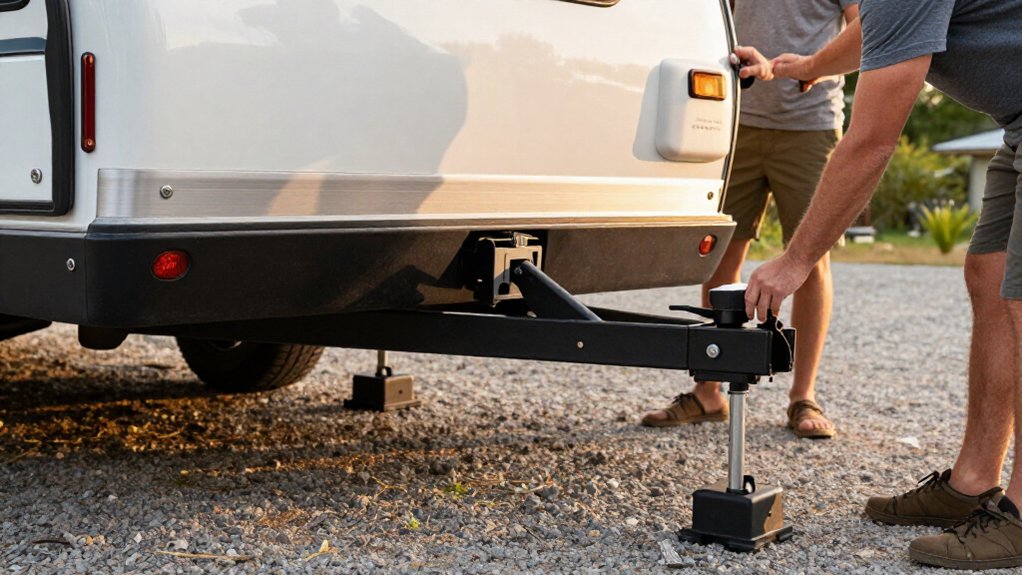
An electric tongue jack is worth it if you hitch alone often, make frequent trips, or need steady coupler-height adjustments; push-button control cuts cranking after long drives.
If you tow rarely, a properly rated manual jack is simpler and cheaper.
Size either jack for loaded tongue weight, not dry trailer weight, and verify mount clearance, battery condition, wiring, and ground stability.
Keep manual-override access and follow secure-coupling checks; the details below can help you choose.
Manual vs. Electric Jack Tradeoffs
Manual jacks keep things simple and inexpensive, but you’ll crank by hand every time you hitch or unhitch, and that effort can feel harder after a long drive. A manual sidewind or flip-foot jack can suit a lighter trailer; some sidewind models handle 1,500–4,000 pounds of tongue weight. You still supply the force, so check the jack’s rated capacity against your load.
An electric jack, usually 12 volts, raises or lowers in small increments at the push of a button, helping you set coupling height precisely and align the ball mount. Many fit existing three-hole mounts; verify fit and capacity before buying. If you tow occasionally and value low cost and simplicity, manual may be enough. For frequent camping, electric reduces repeated strain and improves positioning control.
Solo Hookup Frequency
If you often hitch and unhitch alone, a 12V electric tongue jack lets you adjust coupler height from the controls while you watch the ball mount align.
For regular travel, especially when you tow more than a few times a year, push-button adjustment reduces the effort of manual cranking. After a long drive, that strain can feel greater, and repeated solo hookups make the difference more noticeable.
You can make small, steady leveling corrections while checking alignment, rather than crawling in to crank, then stepping back to recheck the coupler. On uneven ground, controlled adjustments help you position the coupler over the ball without rushing. Keep the trailer secured and follow your coupling checks; the jack doesn’t replace confirming a connection. If you hook up only occasionally and don’t mind cranking, the time saved may not justify the purchase. Your hookup frequency—and whether you work alone—should guide the upgrade.
Load Rating for Your Trailer
How often you hook up matters, but the jack’s capacity must also match your trailer’s actual tongue weight—not its dry weight. Tongue weight often runs 10–15% of loaded trailer weight, so don’t size from a brochure’s dry figure. If you’re unsure, weigh the hitched setup at a CAT scale or similar.
| Load clue | Practical choice |
|---|---|
| Smaller rig | Around 2,000 lb rating |
| Mid-size/heavier rig | Around 3,500 lb rating |
| Uneven ground | Choose extra capacity |
| Old jack struggles | Increase your margin |
Choose a rating that exceeds your actual tongue load; don’t make the jack work near its limit. Close-to-capacity lifting strains the mechanism and can shorten lead-screw life.
A higher margin supports smoother lifting, especially when you hitch on uneven ground. If estimates vary, weigh before you buy.
Battery Draw During Setup
Your 12V electric jack draws high current in short bursts while you level, so battery capacity and condition matter even when setup takes only minutes. If that battery also powers lights or monitors, check its voltage after lifting and watch for slow operation that may signal low charge or poor connections.
Limit repeated adjustments when you’re off-grid, and inspect the fused wiring and connections to reduce power loss.
Power Use During Leveling
During leveling, an electric tongue jack draws power from your trailer’s 12V battery whenever the motor runs, so battery condition matters more than with a manual jack.
The motor’s amp draw is highest while it’s moving, including raising, lowering, and small corrections. Each adjustment uses power, and the convenience of incremental positioning may lead you to run more cycles than you’d make by hand. You’ll notice this draw most during setup, not while the jack sits idle.
Keep the trailer battery in sound condition before leveling, especially when you’re camping without shore power. Check that the jack’s wiring matches its installation instructions and that a fuse sits close to the battery’s positive terminal. That protection helps manage startup current and limits wiring risk if a fault occurs. Don’t use the tongue jack to lift the trailer beyond its rated load; always stabilize it with properly placed supports before working beneath it.
Battery Capacity Matters
Battery capacity matters most when the electric tongue jack cycles during setup or parking, because each lift and retract draws current from your trailer’s 12V battery. Frequent overnight stops, repeated leveling adjustments, or solo hitching with several height corrections increase the number of cycles and the battery reserve you use. A properly matched, larger motor can raise or lower the trailer faster than a manual crank, limiting draw time, but it still needs adequate battery capacity.
Check the manufacturer’s amp-draw rating and compare it with your battery’s amp-hour capacity to estimate reserve after setup. An aging, undersized, or cold-weakened battery may need frequent recharging. Don’t assume the jack will operate when voltage is low; maintain charge and follow the jack’s installation and operating limits.
Other Setup Loads
Each electric tongue-jack adjustment draws power from your trailer’s 12V battery, mainly for as long as the motor runs. You can often reach coupling height faster than you can by hand because the motor lifts at a controlled pace, so a typical hookup may use little battery capacity. But repeated hookups, unhookings, extended leveling, or several height adjustments keep the motor running longer and make the load more noticeable.
A healthy 12V battery and electrical connections matter most when you make frequent setup changes. Check that the jack has proper wiring and fuse protection, including a fuse near the positive terminal; poor connections or voltage drop can force the motor to work harder. Keep hands clear of moving parts, and stop if voltage falls.
Reducing Battery Draw
Beyond proper wiring, consider how often your setup routine runs the jack. It draws power only while lifting or lowering, but frequent overnight re-leveling or daily moves can add noticeable amp-hours over a trip. A 12-volt jack’s controlled, repeatable speed usually shortens adjustment time compared with extended manual cranking.
With a healthy deep-cycle, AGM, or gel battery, brief adjustments typically won’t compromise reliable setup. Draw matters more when your jack is near its rated capacity: heavier loads can keep the motor running longer and consume more power. Choose a jack rated for your trailer’s tongue load rather than relying on the battery to compensate.
Protect the circuit with an appropriately sized fuse near the positive terminal, and keep connections clean and corrosion-free. Apply dielectric grease to help limit corrosion and wasted power. Don’t bypass the fuse or exceed the jack’s rating.
Cold-Weather Cranking Reliability
Cold temperatures can stiffen a manual jack’s lead screw and reduce your 12V battery’s output, making reliable cranking less certain. Keep the screw lubricated, check electric-jack connections, and know how to use the manual backup before a cold snap.
Choose a winter-ready jack you can operate safely with gloves on.
Cold-Weather Cranking Challenges
When winter temperatures stiffen a manual jack’s lead screw and thicken its lubricant, cranking can take noticeably more effort just when you’re hitching after a drive.
Cold starts can make you work harder at the handle, especially after a winter drive. An electric tongue jack replaces turns with a 12V push-button lift, reducing effort. If you keep a manual jack, clean the exposed screw and apply white lithium grease along its full length at the season’s start and end; grit adds drag.
For an electric model, keep wiring connections corrosion-free and choose weather-resistant housing plus a manual override. That backup preserves control if extreme cold or an electrical fault stops powered operation. Smooth, maintained operation matters more than the jack’s capacity rating.
Battery Performance in Freezing Temperatures
Even a well-maintained electric tongue jack can slow down if its 12V battery loses capacity in freezing weather. Cold reduces usable capacity, and voltage sag can cut motor speed or keep it from delivering a full lift. Your battery’s age and state of charge affect reliability; an older or partly drained battery may cause sluggish starts.
Cold stiffens grease and raises friction in the gear drive and lead screw, increasing current draw and worsening voltage drop.
Before lifting, check battery charge and inspect terminals and jack wiring for corrosion or loose connections. Clean contacts and tighten them. For winter lifting, use a charged, cold-rated 12V battery with enough voltage headroom. Test the jack before travel, and stop if it struggles rather than risking an unstable setup.
Manual Backup in a Cold Snap
If a cold snap drains your battery or slows the motor, an electric tongue jack’s manual override can keep you hitching safely. Many electric models include weather-resistant housings and an override, so you can raise or lower the coupler when power falters or temperatures plunge.
Before relying on it, consult your jack’s manual and locate the override point. Keep that tool accessible, and support the trailer with equipment; never place yourself beneath an unsupported load.
Cold can make exposed metal parts and the lead screw resist movement, turning hand cranking into harder work. Apply white lithium grease along the exposed screw at the start and end of each season to limit friction. If you’re alone, lifting can reduce cranking, but practice the backup procedure.
Choosing a Winter-Ready Jack
Choose a winter-ready tongue jack based on capacity, weather protection, and reliable power connections. Electric models remove cold, stiff cranking, which matters when snow, ice, and road salt make a lead screw harder to turn. Select enough capacity for your rig; a 3,500-pound-class jack often suits a midsize trailer and avoids running near its limit when movement gets less smooth in freezing conditions. Choose a weather-resistant housing and a manual override so you can adjust the tongue if the motor or battery fails.
Before installation, verify the bolt pattern and mounting clearance. Inspect 12-volt wiring and protect battery-side connections from corrosion; poor connections cause many electric jack failures, not motor damage.
Manual users: grease the exposed screw with white lithium at both season changes.
A-Frame Mount Clearance
Check A-frame clearance before replacing a manual jack: electric models often use the same three-hole mounting pattern, but their motor housing, wiring, and moving foot need room throughout the full travel. Measure the mounting area and compare the jack’s dimensions and cable route with the frame, bumper, and crossmembers. Matching bolt holes don’t guarantee a fit.
Check the path from retracted to lowered, including the motor case, LED, wiring, and foot. A flip foot needs 4½ inches of ground-contact diameter, so allow room for larger parts. Check cross-slope: a lower jack or different retracted height can affect leg contact and coupling stability. Verify with your trailer hitched on firm ground; dry-fit if possible. If components touch or bind, don’t operate the jack until you’ve corrected the interference.
Motor Replacement Costs
An electric tongue jack adds a potential motor or drive-system repair that a manual jack doesn’t have. That cost can exceed maintenance on a manual jack, so weigh convenience against the chance you’ll need service. A 12-volt motor must lift the tongue load; on a 3,500-pound-class jack, failure may require replacing the power unit, not a quick adjustment.
The jack may fit the mounting points, which can simplify parts sourcing and labor. But that doesn’t make a motor replacement inexpensive: drive components drive the bill. If you tow more than a few times a year or use your equipment hard, budget for the possibility. Check replacement-unit availability and warranty coverage before buying. Keep the trailer supported with stands during service; never rely on the jack alone.
Poor Ground Connections
On rocky, soft, or uneven ground, either type of tongue jack can wobble or sink, but an electric jack’s push-button control makes it easier to correct the height and reseat the coupler without repeated cranking. Still, neither power source can compensate for a foot that lacks firm support. Before hitching or unhitching, check placement and confirm the foot sits fully on stable ground; poor contact can tilt the trailer and misalign the ball.
- On gravel, a 4½-inch flip-foot spreads load and improve contact.
- On a cross-slope, a swiveling sidewind foot can angle to meet the surface, reducing stress.
- If the foot sinks, the motor may cycle more or work harder; inspect mounting bolts and grease the lead screw twice yearly for smooth height corrections.
Emergency Hand-Crank Access
If a 12V battery dies or power fails, a manual override lets you raise or lower an electric tongue jack without its button controls. Before travel, locate the crank port on the jack body or identify the dedicated attachment point. Keep the crank accessible; road spray and UV can obscure or degrade exposed hardware.
Choose weather-resistant housing, and inspect the override for corrosion or obstruction.
If you hitch solo, a working crank can let you level the trailer and couple safely when buttons fail. Test it at home with the jack foot deployed; turn smoothly through its travel, and know where you can stand clear of pinch points.
- Keep crank within easy reach.
- Watch foot settle on firm ground.
- Stop turning if mechanism binds.
Conclusion
An electric tongue jack is worth it if you hitch alone, your trailer’s load rating fits the jack, and your battery and ground connections are dependable. Before upgrading, confirm A-frame clearance, account for cold-weather performance and motor replacement costs, and keep the emergency hand crank accessible.
If you tow infrequently or can crank without strain, a manual jack may be the choice. Either way, support the trailer and never work beneath an unstable load.