Trailer Tire Load Range Chart: Load Ranges C, D and E Compared
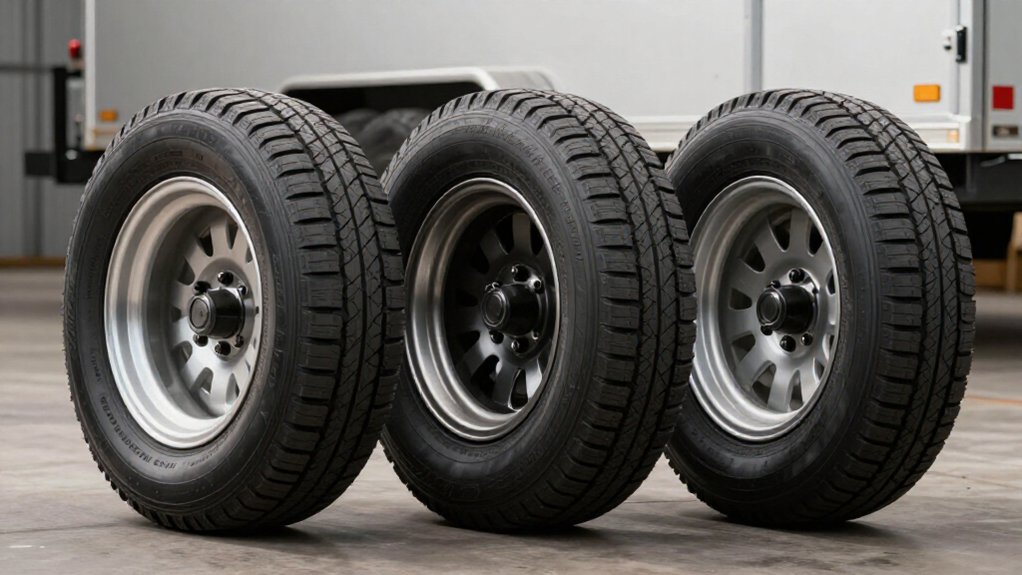
Load range sets your trailer’s tire capacity and maximum inflation pressure; tire size determines fit.
In model-specific examples, C carries 1,820 lb at 60 psi, D 1,610 lb at 65 psi, and E 3,040 lb at 95 psi, so don’t assume higher letters always mean greater capacity.
Check the exact tire’s sidewall and manufacturer load chart, then match pressure to load.
Keep going to see how ply ratings, spares, wear, and placards affect your checks.
C/D/E Capacity Snapshot
Load range determines a trailer tire’s load capacity and maximum inflation pressure, not its basic fit profile. Your tire’s size designation identifies its dimensional fit, while load range specifies the service limits you must observe. These are separate specifications, so don’t treat a higher load range as a change to the tire’s diameter, width, or approved rim compatibility.
When comparing options, check the complete sidewall marking and the trailer manufacturer’s requirements. Confirm that the selected tire matches the wheel and operating conditions, and inflate it according to the pressure associated with its rated service. Don’t infer fit from load range alone; use the tire size and wheel specifications to verify fit before installation. This distinction helps you evaluate tires without confusing capacity with fit requirements.
C/D/E Capacity Snapshot
For comparable trailer-tire applications, Load Range C is typically a 6-ply rating, with an example capacity of 1,820 lb per tire at 60 PSI; Load Range D steps up in pressure, with one 235/80R16 example rated at 1,610 lb at 65 PSI; and Load Range E is typically a 10-ply rating, with an example capacity of 3,040 lb at 95 PSI.
| Range | Example load | Pressure |
|---|---|---|
| C | 1,820 lb/tire | 60 PSI |
| D | 1,610 lb/tire | 65 PSI |
| E | 3,040 lb/tire | 95 PSI |
These figures are model-specific snapshots, not a ranking: the D example’s capacity is below C’s, despite its higher pressure.
Check each tire’s sidewall data, then match its load range and required inflation to your trailer placard and axle limits. Same-size C and D tires may differ substantially.
Ply Rating vs. Load Range
Although “6-ply” and “8-ply” still appear on trailer tires, they describe strength equivalence—not necessarily the tire’s actual number of plies.
Ply rating originated as a count of fabric layers, but modern tire construction can deliver equivalent strength with different materials. Load range C, D, or E gives you the practical capacity classification used to identify a tire’s maximum safe load at its specified maximum inflation pressure.
Higher ratings generally strengthen sidewalls and improve durability under heat and rough service. But you can’t exceed your trailer’s axle or GVWR limits. Use load range with tire load information to choose safe capacity; don’t treat ply count as capacity itself. Check the sidewall’s load-range marking; it identifies the capacity class your chart uses.
C/D/E Inflation-Pressure Ratings
Load Range C commonly uses 50–60 PSI, while D typically runs near 65 PSI and E near 80–100 PSI. You’ll reach each tire’s rated maximum load only at the sidewall’s maximum pressure; lower inflation reduces allowable load.
Use the inflation chart to match pressure and capacity to your trailer’s requirements.
Load Range C Pressure
Because pressure ratings vary by tire model and size, Load Range C tires typically reach their maximum rated load at 50–60 PSI; for example, a 205/75R14 may be rated for about 1,820 lb at 60 PSI.
Check the sidewall and manufacturer’s load table for the exact pressure associated with your tire’s size and capacity; the example isn’t universal. To use the chart correctly, inflate your C-rated tire to the maximum PSI specified for that tire when you need its labeled maximum load.
Don’t substitute a pressure listed for another load range, even if the tires share a size designation. Pressure supports the rated load only when you match the tire’s own specification. Confirm your trailer’s load remains within the tire’s stated capacity for safe towing.
Load Range D Pressure
For a typical trailer tire, Load Range D reaches its rated maximum load at about 65 PSI, compared with roughly 50 PSI for Load Range C and 80 to 100 PSI for Load Range E.
That rating applies only when you inflate the tire to its specified maximum cold pressure; running below it reduces the load capacity shown in the chart. For example, a Load Range D tire in size ST175/80D13 can carry about 1,610 pounds at 65 PSI, versus roughly 1,360 pounds for the Load Range C version at 50 PSI. Although the size marking matches, the D-rated tire has higher pressure and load capability because of its construction. Don’t assume both tires use the same inflation pressure. Check your tire’s sidewall load-range letter, then match inflation to that rating and the manufacturer’s instructions. Capacity figures apply at the specified pressure for your tire and operating conditions.
Load Range E Pressure
At what pressure does a Load Range E trailer tire reach its rated capacity? Load Range E trailer tires use 80–100 PSI, depending on tire design and size. That’s higher than Load Range C ratings of about 50–60 PSI and Load Range D ratings near 65 PSI.
For example, a 205/75R14 Load Range C tire carries about 1,820 pounds at 60 PSI, while a 235/80R16 Load Range E tire carries about 3,040 pounds at roughly 95 PSI. These figures compare sizes, so they don’t isolate load-range effects. Even with the same size designation, C, D, and E tires can require different pressures to reach their stamped ratings.
Check your tire’s sidewall specification and keep its load capacity within your axle and GVWR limits.
Pressure At Maximum Load
To carry its maximum listed load, a trailer tire must be inflated to the pressure specified for its load range and exact size. Load Range C commonly reaches that rating at 50 psi, with maximum capacity varying by size from roughly 1,360 to 1,820 pounds per tire. A typical D example carries 1,610 pounds at 65 psi. Load Range E ratings generally use 80 to 100 psi; one cited tire supports 3,040 pounds at 95 psi.
Compare this rated capacity with your trailer’s actual load: maximum-load pressure defines the tire’s stated limit. Running outside the required range can reduce usable capacity or increase heat and wear. Confirm the figure for your tire’s exact size and model before relying on its maximum-load rating in service.
Inflation Chart Guidance
Start with the load-range letter on your tire’s sidewall, then use the manufacturer’s chart to match its exact size and model to the correct inflation pressure. Check the chart for maximum load at that PSI; values can vary among tires within one load range.
For a C-rated tire, expect about 50–60 PSI, depending on its specification. The ST175/80D13 example carries about 1,360 pounds at 50 PSI. A D-rated version typically uses 65 PSI and carries about 1,610 pounds at that pressure. These figures illustrate the rating, not a universal schedule: don’t apply them to a different size or model.
E generally represents the highest-duty tier, but confirm its pressure and capacity in the chart; don’t infer either from the letter alone for yours.
Check Tire Manufacturing Dates
Check the DOT code on each trailer tire’s sidewall to determine when it was made: the final four digits, such as 2323, indicate the production week and year, in this case the 23rd week of 2023. Use that date to track service age, not tread depth alone. In many trailer applications, tires last about three to four years, but dry rot and other age-related damage can develop before the tread wears down.
UV exposure and oxygen speed rubber deterioration, so replace a tire nearing or beyond its recommended service age even when its tread still appears usable. Check the DOT dates across your trailer; similar dates help you identify age differences that may contribute to uneven aging and variation in grip or durability. If the code is unclear, read the full marking on the sidewall or ask the tire manufacturer, providing the exact tire size and load range. Record each date carefully during routine inspections to support consistent replacement decisions.
Spare-Tire Load Matching
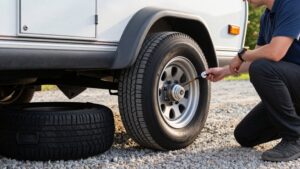
After recording each tire’s manufacturing date, verify that the spare’s load range matches the trailer placard’s requirement, not just its size. Compare the spare’s sidewall rating and inflation pressure with the placard. A one-range-lower spare may carry less load at placard PSI, raising heat, wear, and failure risk when loaded.
Typical Load Range C ST tires carry 1,360–1,820 pounds per tire at 50–60 psi; Load Range D commonly carries 1,610–3,040 pounds at 65–95 psi, depending on size and model. A higher-range spare, such as D replacing C, fits and is stronger, but inflate it to placard pressure and stay within axle and GVWR limits. If unsure, consult the sidewall and exact-size manufacturer load/inflation chart, or ask your trailer maker for the VIN-specific spare specification.
Loaded Boat-Trailer Example
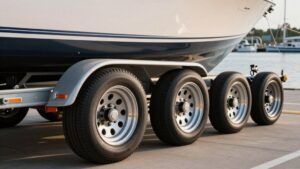
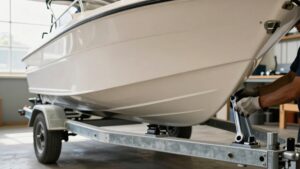
For a loaded boat trailer, choose Load Range C, D, or E by matching each tire’s capacity to the trailer’s axle rating and GVWR, not by size alone.
For a common utility-light setup, Load Range C carries 1,360-1,820 lb per tire, depending on size and pressure; one 205/75R14 example supports roughly 1,820 lb at 60 PSI. For heavier applications, a Load Range D example provides about 1,610 lb at 65 PSI; choose it only when that capacity meets your axle rating.
Load Range E may suit a higher-rated trailer: a 235/80R16 example is rated near 3,040 lb at 95 PSI and represents the 10-ply strength class. Check your placard and GVWR, then you’ll inflate each tire to its sidewall maximum PSI for rated capacity.
Uneven Tire Wear Clues
Uneven tread wear can signal that your tire load range or pressure doesn’t match the trailer’s actual axle rating and GVWR, leaving one side overloaded or underinflated.
- Center-tread balding usually points to overinflation; check pressure against the tire’s specified PSI—often about 50–60 for Load Range C or 65 for D.
- Shoulder wear suggests underinflation; you’ll often see both edges scrub.
- Cupping or saw-tooth wear points to suspension or track misalignment, or imbalance, even when load range is correct.
- Excessive outside-shoulder wear may mean that axle side carries more weight or the tires don’t share the load evenly.
- Rapid feathering or localized hot spots suggest repeated operation near maximum capacity; added heat accelerates wear, so preserve a safety margin.
Inspect tires; correct causes before towing.
Trailer Placard Verification
To confirm that uneven wear isn’t masking a tire mismatch, check the trailer’s weight and tire placard, usually on an interior wall near the door or on the frame. Use its specifications, not tire size alone, to verify:
- Record required tire size and load range, C, D, or E, from the placard.
- Treat listed load range capacity as valid only at its specified PSI.
- Match tire capacity to GVWR, axle limits, and axle/tire count.
- Set inflation pressure to placard value; C often needs 50–60 PSI, D about 65 PSI, model-dependent.
- Don’t infer capacity from size: ST175/80D13 can be C or D.
If yours is missing or unclear, contact the manufacturer with your VIN to confirm the exact load range and pressure for your trailer.
Conclusion
Use the load-range chart to compare each tire’s rated capacity at its specified inflation pressure; C, D, and E are not interchangeable labels. Confirm the trailer placard, tire size, load index, manufacturing date, and spare match your setup. Then weigh the loaded trailer and verify each tire can support its share, including uneven loading.
Inspect wear regularly for pressure or alignment clues. Don’t rely on ply-rating terminology alone: follow the tire’s marked pressure and capacity, and replace any tire that can’t meet the verified load.