Boat Trailer Tire Size Chart: Sizes by Rim Diameter and Boat Weight
Choose ST trailer tires by your fully loaded trailer’s measured axle loads, not boat weight or rim diameter alone. Include fuel, gear, batteries, and installed equipment; measure tongue weight because it transfers load to the hitch.
Divide each axle’s load across its tires according to the actual setup, then match each tire’s size and load-range rating at specified cold pressure.
Check rim fit and axle limits; the sizing details below cover fitment, clearance, and spares.
Boat-Weight Tire Sizing
Choose ST (special trailer) tires whose load range meets or exceeds the load each tire must carry; account for the loaded trailer and axle distribution, not just the boat’s dry weight.
Estimate the trailer’s total ready-to-launch weight, including fuel, gear, batteries, and installed equipment, then determine how that load is shared across its axles and tires. Don’t divide total weight evenly unless the axle and tire arrangement supports that assumption; use the manufacturer’s ratings or measured axle loads.
Select a load range whose rated capacity per tire covers its share with an appropriate safety margin, while staying within axle and trailer limits. Load ranges such as C, D, and E indicate different capacities, but the rating applies only at the specified inflation pressure. Check each sidewall for its exact size, load range, and pressure requirement. Inflate to the specified pressure when cold; underinflation increases heat, while overloading risks tire failure during every pre-trip inspection.
Load Ratings by Rim Diameter
Because tire sizes and load ranges vary by rim diameter, compare the exact tire’s capacity and required pressure, not diameter alone, with the trailer’s axle load. A 13-inch wheel may accept different capacities, so verify the listed rating at its specified pressure and divide the axle requirement across its tires.
| Rim and size | Example capacity |
|---|---|
| 13-inch ST175/80-13 | 1,100 lb at 35 psi (Range B) |
| 13-inch C78-13 | 1,480 lb at 50 psi (Range C) |
| 13-inch D78-13 | 1,725 lb at 65 psi (Range D) |
| 8-inch 5.70-8 | 910 lb at 75 psi (C); 1,075 lb at 100 psi (D) |
Don’t exceed the rim’s approved pressure, and confirm capacity before each trip with trailer.
ST Tire Markings Explained
ST on a trailer tire means “Special Trailer” and identifies construction designed for trailer service, with stronger sidewalls than typical passenger tires.
In a marking such as ST205/75R14, 205 gives tire width in millimeters, while 75 is the aspect ratio: sidewall height equals 75% of that width. The R identifies radial construction, which generally runs cooler and lasts longer than a bias-ply trailer tire.
Your load-range letter, such as C, D, or E, indicates the tire’s load capacity; higher letters support higher loads. Always match the marked rim diameter—14 inches in this example—to your trailer wheel, and verify that the load range supports your boat’s total trailer weight. A size match doesn’t establish that the tire can safely carry your loaded trailer.
Cold Inflation Pressure
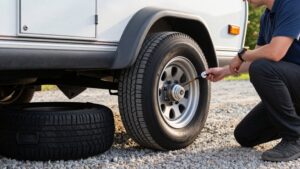
Set your ST trailer tires to the cold PSI shown on the sidewall, measuring before driving while the tires are cool. Match pressure to the tire’s load range and your trailer’s required load capacity, and account for temperature changes.
Check pressure weekly; don’t overinflate or underinflate, as either can compromise load capacity and safety.
Check Tire Sidewall Pressure
Before each trip, check the trailer tire’s sidewall for its maximum cold inflation pressure—measured before driving, while the tire is cool—and match the load range (B, C, D, or E) to the tire’s stated load capacity. Use the pressure printed for that tire and load range; don’t estimate PSI from rim diameter or boat weight alone. For an ST205/75R14, sidewall pressure and rating define the allowable load.
A C-range example may support roughly 760–910 pounds at about 90 psi, depending on tire size. Confirm the exact figures on your tire, since ratings vary. Check pressure at least monthly and before trips, then adjust to the specified cold value.
Correct pressure helps preserve rated capacity and limit uneven wear; too little or too much can compromise handling, increase heat, or damage the tire. If the sidewall data don’t match your trailer’s required load, choose a properly rated tire rather than compensating with guessed pressure. Consult your trailer and tire manufacturer for guidance.
Measure Tires When Cold
Because tire pressure rises as the tire heats up, check and adjust it when the tires are cold—before driving or after they’ve sat.
Use the tire’s sidewall load-range marking—B, C, D, or E—to identify the cold-pressure specification for that tire. Don’t substitute a typical PSI value: tires with the same rim diameter can require different pressures when their load ranges differ.
If you inflate a warm tire to its cold-pressure target, pressure may be too low after it cools. That underinflation can reduce load capacity and accelerate tread wear.
Check pressure weekly and follow the manufacturer’s cold-pressure specification. Measure before each trip, and adjust after the tire has returned to ambient temperature. Record the specified pressure so you can verify each tire.
Follow Trailer Load Ratings
Once you’ve checked pressure when the tires are cold, match each tire’s PSI to its load range and the chart for its exact size.
Use the sidewall to identify the tire’s load range (B, C, D or E) and specified inflation pressure. Don’t substitute a rating from another size; load capacity depends on both size and pressure. For example, C-range tires may carry roughly 760-1,165 pounds at about 50-75 psi, depending on the exact tire.
Confirm the applicable figure in a chart for your size, such as ST205/75R14 or S175/80R13.
If you inflate below the specified pressure, the tire can’t safely support its listed load and may overheat or fail. Check pressure regularly, typically weekly, and compare every tire’s reading with its rating.
Adjust for Temperature Changes
Since tire pressure rises as the tire warms during driving, check and set it when the tire is cold—ideally after it has sat for several hours.
Use a gauge before towing, and compare the reading with the tire maker’s cold inflation specification. The sidewall or load table identifies the maximum cold pressure; letter ranges such as B, C, or D can have different ratings.
A warm tire may read higher, but don’t change your target to match that temporary increase. Maintain the specified cold psi so the tire supports the trailer’s rated load. Recheck after major weather swings and before long trips.
If your setup sits near a load-range threshold, confirm its cold setting before departure.
Avoid Overinflation and Underinflation
To protect your trailer tires, set pressure to the manufacturer’s cold inflation specification before each trip; overinflation can shrink the contact patch and increase impact damage, while underinflation causes excess sidewall flex and heat that can lead to premature wear or failure.
Use the pressure listed for your tire’s load range, not a car or ATV value. For example, an ST205/75R14 tire in load range C may call for 50–60 psi, depending on its load rating; check the tire or trailer manufacturer’s specification rather than assuming one pressure fits every tire. Check pressure weekly and before towing, with a reliable gauge while tires are cold—before driving or after they’ve cooled. Highway use raises pressure, so don’t adjust it based on warm readings alone.
Account for Tongue Weight
Because tongue weight transfers part of the trailer’s load to the hitch, include it when evaluating what each axle and tire carries.
Measure tongue weight with the trailer loaded as you tow it. Though often 10–15% of total trailer load, use your measured value, not an estimate. Combine axle load and load transfer caused by tongue weight to determine what each tire carries.
Select tires whose load ratings meet or exceed that demand, then verify the specified load range and inflation pressure.
Excessive tongue weight can overload front axle tires even if rear tires remain within their ratings. Too little tongue weight can increase sway, accelerate tire wear, and raise sidewall stress. Don’t choose capacity from total trailer weight; measure loads and confirm before travel.
Tandem-Axle Load Sharing
Although tandem axles typically share the trailer’s load, don’t assume each tire carries exactly one-quarter of the total weight.
You should size tires using total trailer weight and each tire’s ST load rating, not an ideal split. Divide weight across axles and tires, then verify combined axle load stays within each tire’s maximum capacity at required cold pressure in its load table.
Select the appropriate load range, such as C, D, or E.
For dependable sharing, align axles and keep them at the same ride height. Inspect suspension and frame condition; worn springs, bent beams, or uneven bearing wear can shift weight onto one axle.
That imbalance raises tire loads and can accelerate damage. Have defects corrected before towing, and recheck tire pressure before each trip.
Pontoon Trailer Tire Fitment
After confirming each tire can carry its share of the load, check that the size also fits your pontoon trailer.
Choose a rim diameter—commonly 13–14 inches—and match the tire’s load range to your boat and axle weight so each tire has capacity. Many pontoon setups use ST radial tires; their reinforced sidewalls help resist sway and support heavy, non-driven loads. Before buying, verify the wheel’s bolt pattern and width. A 5×4.5-inch pattern must match your hub, and the tire must suit the rim width.
Check the tire’s diameter against ride height and fender clearance, because switching from 13-inch to 14-inch can change these. If you’re using a spare bracket on a dual-frame pontoon trailer, confirm its dimensions fit your frame layout and tire size.
Valve Stem Clearance
Even a correctly sized boat-trailer tire can be unsafe if its valve stem contacts the wheel well, fender, or mounting bracket when the trailer turns or carries a load. Measure the available gap with the trailer at full steering lock and at its normal loaded ride height; suspension movement can reduce clearance.
Before finalizing tire size, check the rim width, bolt pattern, and stem position against your wheel and bracket requirements. Use this verification:
- Match rim width and bolt pattern, such as 5×4.5, to your hub.
- Check stem clearance through full turns and loaded travel; allow no contact.
- Ensure you can access an ST205/75R14 valve for weekly pressure checks without removing the wheel.
- Preserve access for inflation and inspection; hardware mustn’t obstruct the stem.
Spare Tire Compatibility
Once you’ve confirmed valve-stem clearance, check that your spare matches the road tires’ ST size, rim diameter, and bolt pattern, such as 5×4.5. Choose a trailer-appropriate load range; C is common on trailer spares and must support your loaded trailer.
Use the same trailer radial ST construction when possible; don’t mix sizing or construction, which can alter stability and performance. For a spare package, verify the mounting bracket fits your frame and hardware before travel.
- Confirm bracket fit on your dual 2×4 or 2×5 frames.
- Verify included kit hardware; some brackets include both bolt nuts.
- Check dimensions: example, 10-3/8 inches tall x 4-5/8 inches top width.
- Mount securely; recheck clearance and fastener tightness.
Inspect the mount before every trip.
Conclusion
Use the chart as a starting point, then verify each tire’s load rating, size, and cold pressure against your trailer placard and axle limits. Include actual tongue weight, account for tandem-axle sharing, and confirm rim, valve stem, and spare fitment. Choose ST tires that meet or exceed required capacity; don’t compensate for an under-rated tire by overinflating it.
Before every trip, inspect tread, sidewalls, and pressure. Replace damaged tires promptly, and follow the manufacturer’s guidance.