Kinetic Recovery Rope vs Recovery Strap: Which Pulls Stuck Vehicles Better?
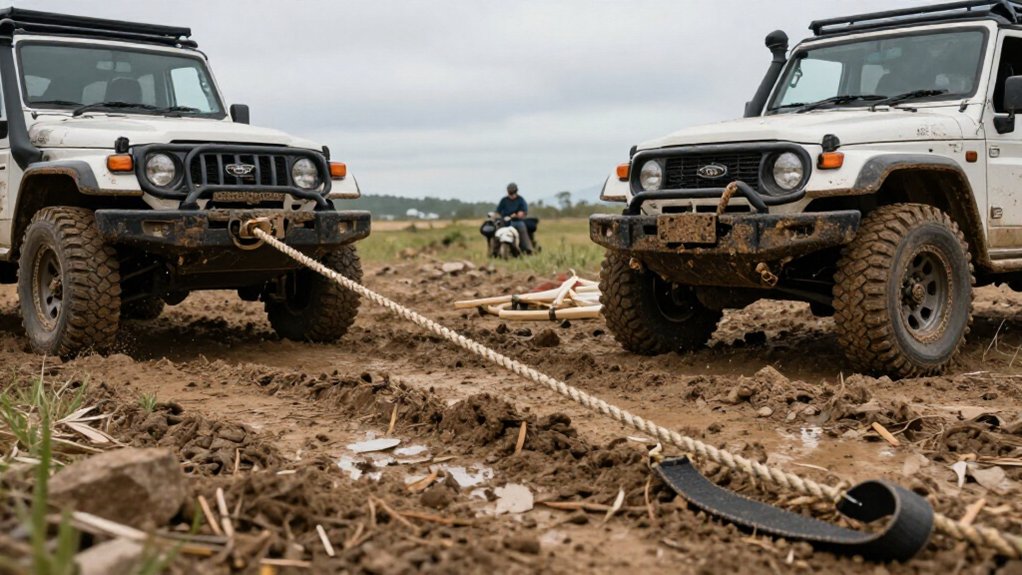
A kinetic recovery rope usually frees a deeply stuck vehicle better because its 20–30% stretch stores energy and releases a stronger pull.
Choose a low-stretch recovery strap when you need a steadier, controlled tow, not a snatch recovery.
Match the line’s rating to your vehicle, connect only to rated chassis recovery points, and keep everyone clear of the line of pull.
Mud calls for a slow pull; axle-deep sand may need more slack.
The details below help you choose and use each safely.
Pulling Force and Stretch
A kinetic recovery rope delivers a stronger snatch effect because it stretches under load, stores energy, and releases it as the rope tightens. You can use this stored energy to break axle-deep sand or deep mud; a short, dynamic pull may free tires that a steady tug won’t.
| Gear | Stretch | Best use |
|---|---|---|
| Kinetic rope | 20–30% | Snatch recovery |
| Tow strap | 5–10% | Steady pull |
A premium 30-foot rope may extend 6–9 feet before force peaks. Choose rated equipment and inspect it before use; inadequate elasticity can weaken the first tug.
More stretch isn’t automatically safer or better: match elasticity to the recovery task, and don’t use a low-stretch strap for a snatch. A lower-quality kinetic rope stretching near 20% stores less energy than one reaching 30%, so you may need another controlled attempt to succeed.
Load Transfer and Vehicle Anchoring
When a kinetic recovery rope stretches, it stores energy and transfers a stronger pull as it tightens; a recovery strap’s minimal stretch delivers a steadier load. You’ll need to manage slack differently for each setup. Lay out slack with a kinetic rope so it can extend and build energy before loading the stuck vehicle. With a recovery strap, take up slack gradually to maintain a controlled connection.
Anchor either line only to rated recovery points attached to solid chassis locations. Never connect it to a receiver ball: concentrated loads can break the ball or mount and create dangerous projectiles. Check each point’s rating, condition, and clearance before pulling. A 30-foot kinetic rope stretching 20–30% may grow roughly 6–9 feet, so allow room for movement and keep everyone clear. Proper anchoring and slack control help deliver force safely.
Field-Tested Recovery Outcomes
In field recoveries, a kinetic rope often frees axle-deep vehicles in sand or mud faster because its 20–30% stretch stores energy and adds force as it recoils. With premium nylon construction, a 30-foot rope can extend roughly 6–9 feet, turning a slow running pull into a sharper free-up.
When you’re bogged deep, use gradual momentum: let the rope stretch, then pause; if the first tug fails, repeat with more slack, not a harder impact.
Setup Speed and Attachment Points
Secure the kinetic rope to rated recovery points on both vehicles, using soft shackles where possible to protect the rope fibers; never attach it to a receiver hitch ball. Before moving, confirm each connection sits directly on a solid point and that shackles are secured; a slipping or tearing anchor can turn a controlled pull into a failure.
Lay out about six to ten feet of slack, then have the pulling driver creep forward steadily until the rope goes taut and starts to elongate. Only then use a controlled throttle increase or running start to build the snatch effect. Clear people from the line of pull.
If the first attempt doesn’t free the vehicle, stop, inspect the setup, add slack, and repeat; don’t yank immediately or accelerate before the rope engages.
Vehicle Weight and Rope Ratings
For a safe, effective pull, match the recovery gear’s rating to the vehicle’s GVWR: many guidelines recommend a kinetic rope with breaking strength about 2–3 times that figure, while low-stretch tow straps need a higher safety margin.
Choose diameter by vehicle mass: a 7/8-inch rope is commonly suited to vehicles under about 4,000 pounds, a 1-inch rope up to 6,000 pounds, and a 1¼-inch rope up to 10,000 pounds.
For example, a 30-foot, 1-inch kinetic rope may carry a 10,000-pound load rating. Its 20–30% stretch stores energy and adds a yank, but you must stay within its working rating. An undersized rope can lose freeing performance or fail; correctly rated gear preserves its designed elastic behavior and helps limit damage during a snatch recovery.
UV and Chemical Exposure
Because kinetic recovery ropes and straps are typically nylon, prolonged UV exposure and heat can accelerate fiber aging and reduce strength.
Nylon can lose strength faster when you leave a line in sunlight. Store your rope or strap covered, cool, and dry; UV and heat together can compound wear after exposure. Oils, fuel, and many solvents can also weaken fibers.
If contamination occurs, stop using the line until you’ve cleaned and inspected it. Wash it with warm, soapy water, then let it dry fully before storage so residue doesn’t contribute to deterioration. Check for fraying, glazing, or loss of stiffness. If you find damage or undue wear, or can’t judge the exposure severity, replace the rope or strap instead of relying on uncertain strength.
Rope Snapback Injury Hazards
Even a well-maintained kinetic recovery rope can cause severe injury if it fails under tension or slips from a recovery point. During a pull, the rope stretches, often 20–30%, and stores energy. If it breaks or disconnects, recoil can travel rapidly and violently through the danger zone beside the rope, turning it into a projectile hazard.
Keep every part of your body out of the rope’s line, above it, and across its path. Stand off to the side, never near either vehicle. Before pulling, move bystanders and recovery workers clear of both vehicles and the rope’s path.
Manage slack to limit shock loading, and use only rated, inspected gear attached to proper recovery points. Weak or mismatched components can fail, increasing snapback injury risk.
Recovery Gear Durability Factors
You’ll find that a kinetic rope’s nylon construction is designed to stretch, while a recovery strap’s webbing stretches far less, so use each only within its rated load. Heat from repeated hard pulls, abrasion, and overloading can weaken fibers and shorten service life.
Inspect for cuts or fraying before each use, allow hot gear to cool, and clean and dry it after recovery.
Material and Construction
Material and construction determine how recovery gear handles repeated loads: quality kinetic ropes use nylon 6 or 6.6 fibers designed to stretch about 20–30%, storing and releasing energy during a recovery. That stretch lets you store energy and release it to help pull a vehicle.
Durability depends on fiber quality and controlled loading; use proper technique and allow slack rather than applying an abrupt, rigid pull. A recovery strap isn’t automatically elastic: some use kinetic construction, while tow or draw straps stretch only about 5–10%. Their limited give transfers more shock to recovery points and vehicle components.
Size a kinetic rope for the vehicle’s mass; guidance commonly targets breaking strength of 2–3× GVWR. For example, 7/8-inch rope suits vehicles under 4,000 pounds, a 1-inch rope up to about 6,000 pounds, and 1-1/4-inch rope about 10,000 pounds. Confirm manufacturer limits and use rated recovery points; never exceed the system’s capacity.
Wear and Tear
Repeated high-load cycles can make a kinetic rope’s nylon fibers heat up and rub against one another, gradually weakening them despite their 20–30% stretch. That stretch absorbs shock, but repeated recovery loads create internal heat and fiber friction, so inspect your rope regularly and replace it when damaged or worn.
Tow straps stretch only about 5–10% and transfer force quickly. If you drag one over rock, abrasion can fray fibers, while limited give concentrates shock at weak points.
Handle kinetic gear: lay slack cleanly, avoid twisting or dragging it under tension, and choose a rope rated around two to three times your vehicle’s weight or GVWR. An undersized rope faces harsher stress cycles and may suffer permanent damage. After use, shake or wipe away grit; wash with warm, soapy water and dry completely. Trapped sand and dust can abrade fibers during your next pull. Check the length and connection points before every recovery, and retire gear if you find cuts, fraying, or other damage. Follow the manufacturer’s limits, and never rely on appearance to judge a rope’s condition.
Mud Versus Sand Recoveries
Mud and sand demand different extraction techniques, so use a kinetic rope’s 20–30% stretch with only 6–10 feet of slack and a slow pull in mud. In axle-deep sand, you may need more slack and slightly more throttle, but pause between attempts to limit heat buildup.
A kinetic rope generally frees stuck vehicles more effectively than a low-stretch strap, but inspect it for abrasion and fraying before each pull.
Mud Extraction Challenges
Because mud clings to tires and resists flowing aside, a kinetic recovery rope can be more effective than a tow strap when extracting a bogged vehicle.
Mud’s adhesion creates suction that often demands a brief forceful release, unlike sand, where controlled traction and momentum matter more. A rope stretching about 20–30% stores energy and helps break that grip.
Lay roughly 6–10 feet of slack on the ground; then pull slowly and steadily, letting the rope tighten and stretch before it recoils. This limits shock to vehicles and recovery points.
- Use rated points and compatible gear.
- Keep people clear of the rope’s recoil zone.
- Never use a tow strap for mud snatches; minimal stretch can transfer damaging loads.
- Stop if connections shift or gear strains.
Sand Recovery Technique
Sand recoveries often need a sharper pull than mud recoveries, so use a kinetic rope or snatch strap rather than a low-stretch tow strap. Its nylon can stretch roughly 20–30%, storing energy to help break a vehicle free when its tires have dug down to the axles.
Lay out about 6–10 feet of slack, then begin with a slow, steady pull. Use a running start only if needed; let the rope go taut and stretch before it delivers the snatch. Keep everyone well clear of the line and account for its movement: a 30-foot rope can lengthen about 6–9 feet under load.
If the first pull fails, add slack and increase throttle gradually. Sand may take several controlled pulls to shift from digging to sliding; mud often responds to gentler traction increases.
Choosing the Right Gear**
Choose your recovery gear based on how the vehicle is stuck: in mud or deep ruts, use a low-stretch tow strap for a steady, predictable pull; in loose, axle-deep sand or heavy snow, use a kinetic rope or strap to deliver the sharper pull needed when traction is gone.
- A flat tow strap stretches about 5–10%, limiting snatch and keeping force predictable. It suits steady extraction from ruts.
- Kinetic gear stretches about 20–30%, storing energy for a sharper pull.
- Leave 6–10 feet of slack so the rope stretches smoothly before loading.
- If the first pull fails, add slack and effort gradually. Use kinetic gear for short snatch recoveries, not towing; attach only to rated recovery points, never receiver balls.
When Winches Beat Both
When a stuck vehicle can’t be safely yanked, a winch beats both a recovery strap and a kinetic rope by applying force gradually, with little snatch-like shock when you control spool speed and line tension.
Unlike kinetic recovery ropes that need slack and a running pull, a winch works from near-zero slack. In axle-deep sand, you can build tension steadily, where kinetic timing may prove inconsistent.
Anchor to a rated recovery point, use a tree saver, and keep the line straight through the fairlead to avoid side-loading. Use properly rated recovery gear. Your anchor and rigging usually set the limit, not rope stretch. Proper winching can reduce shock damage to bumpers, frames, and recovery points. Save kinetic gear for a safe, clear snatch-and-winching release.
Conclusion
Choose a kinetic recovery rope when you need controlled stretch to pull a stuck vehicle from mud or sand; use a recovery strap only when its rating and your setup suit a non-stretch pull. Match gear to vehicle weight, inspect it, and attach only to rated recovery points, not tow balls or improvised anchors.
Keep everyone clear of the line and its snapback zone. If you can’t verify the setup, or the vehicle won’t move safely, stop and use a winch or professional recovery.