What Should Trailer Tire Pressure Be? Why Max PSI Is Usually Right
Set your trailer tires to the cold pressure molded on each sidewall, usually its “Max PSI,” to support the tire’s rated load.
Check every tire, including the spare, with a gauge before towing; heat can raise pressure by 5–15 psi.
If your gauge reads bar, multiply PSI by 0.06895.
Max PSI assumes the correct load range and a suitably rated wheel.
Never exceed trailer GVWR or axle limits.
More checks can help prevent tire trouble.
Cold-Pressure Check Before Towing
Before towing, check each trailer tire when it’s cold, before driving or after the trailer has sat for a few hours, because heat from riding can raise pressure by about 5–15 psi.
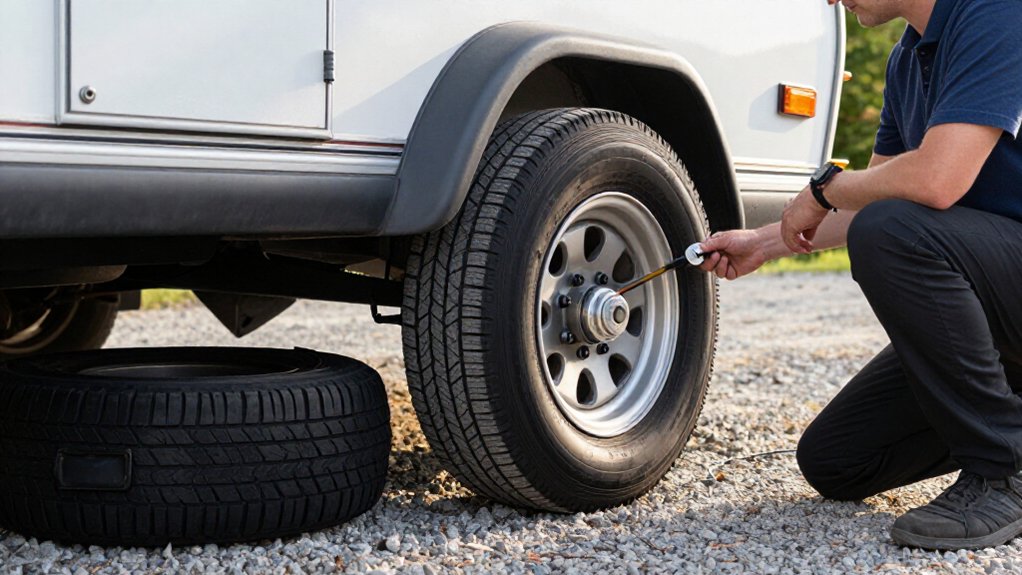
Use a tire pressure gauge; don’t judge pressure by appearance, since many pressure problems aren’t visible. Check every tire before each trip, including spares if carried.
If your trailer sits, check pressure at least every two weeks. Low pressure can make a tire overheat, increasing the chance of failure while towing.
If a reading is low, add air in short spurts, then measure again with the gauge. If it’s too high, press the Schrader valve to release a little air at a time, checking after each adjustment. Make changes while the tire remains cold.
Reading Tire Sidewall PSI
Find the PSI molded into the tire’s sidewall, usually listed in both psi and kPa. Use the sidewall’s “Max PSI” as your cold-pressure target; that rating supports the tire’s full load capacity. Don’t confuse it with the trailer’s tire-and-load sticker: check that sticker for matching tire size and pressure, but use the tire’s own maximum as your key reference.
Confirm the “ST” marking and load range—often B, C, or D—so you know you have the specified special-trailer tire. Measure with a reliable gauge, not by sight, after the tires have rested. Heat from driving raises pressure, so a hot reading won’t show your cold setting.
| Clue | Check | Action |
|---|---|---|
| Max PSI | Cold target | Gauge it |
| ST | Trailer tire | Verify |
| Range | B/C/D | Match spec |
Psi-To-Bar Conversion
If your gauge reads bar, convert the tire’s cold sidewall max PSI by multiplying it by 0.06895—for example, 65 PSI is about 4.48 bar. The precise factor is 0.0689476, so 50 PSI converts to about 3.45 bar.
If your sidewall shows only PSI, this calculation gives you a reliable bar target; convert the stamped cold maximum, not a pressure measured after driving. Check pressure before towing, when the tire’s cold, and set your gauge to the converted value.
For quick estimates, 1 bar is about 14.5 PSI, making 60 PSI roughly 4.1 bar. Don’t confuse a warm reading with your starting target: heat can raise pressure by 5–15 PSI. Let the tire cool before checking or adjusting it. Use the sidewall’s maximum PSI as your reference every time. Repeat this before each towing trip.
Load Range and Capacity
Your trailer tires’ load range tells you how much weight they can safely carry, so match their ratings to your trailer’s GVWR and actual load. Their rated capacity assumes you inflate them to the sidewall’s maximum cold PSI, but your wheels must also be rated for that pressure.
When replacing tires, check both tire and wheel ratings, overloading or choosing a lower-rated tire can cause excess heat, premature wear, or failure.
Understanding Load Ranges
Because a tire’s size alone doesn’t confirm it can carry the load, match its Load Range, B, C, D, or higher, to the trailer’s required capacity, using the tire-and-load information or GVWR as your guide. Each range indicates a tire’s maximum load at a specific cold inflation pressure, listed on its sidewall. The letter alone isn’t a pressure setting, so consult the tire’s load-and-inflation information.
The sidewall’s Max PSI typically provides rated capacity, but only when cold and if your wheel accepts that pressure. A lower rim pressure limit constrains the assembly and may reduce safe capacity. A correctly sized tire with a mismatched or lower Load Range may still leave you under-capacity. Check both ratings carefully before towing, and respect the lower pressure limit.
Matching Capacity to Load
Once you’ve checked the load range, match the tires’ capacity to your trailer’s GVWR on its capacity plate or sticker—not just their size.
Choose tires whose load range and combined rated capacity suit the trailer’s GVWR, allowing for the load each tire supports. Don’t select a tire by size alone; two same-size tires can have different ratings. Check that every wheel and rim meets the tire’s pressure and load requirements.
Your setup’s capacity stops at its lowest-rated component. A tire-and-wheel combination limited to 100 psi may support about 900 pounds per wheel, even if the tire carries a higher rating. Trailer tires often marked “ST” follow trailer-specific load ratings, not assumptions from passenger-car tires. Use the tire’s cold-inflation maximum to achieve its rated capacity, and replace any mismatched component before towing.
PSI and Load Capacity
Inflate trailer tires to the maximum cold PSI stamped on the sidewall to get their full rated load capacity. That pressure lets the tire carry the load specified for its load range, commonly marked B, C, or D. Underinflating can reduce usable capacity and increase heat, raising the risk of tire failure.
Check your wheel or rim’s pressure and load limits, too. The tire isn’t the only constraint: your setup’s practical capacity depends on its weakest component. For example, even a tire rated for 100 psi may be limited to 900 pounds per wheel if the rim can’t safely support more. When replacing tires, match the original size and load range, and use ST construction if specified. Confirm the replacement can handle your trailer’s GVWR at the required cold pressure.
Reading Tire Load Ratings
To read a trailer tire’s load rating, check its sidewall for the load range (such as B, C, or D), maximum cold PSI, and rated capacity. Compare tire capacity with your trailer’s GVWR to confirm the setup can carry the required weight safely. The sidewall’s max PSI is tied to that load rating; pressure above or below it can reduce capacity or cause heat and wear.
For example, a 205/75R14 tire rated around 1,760 pounds may require about 50 PSI to reach that published capacity. Check your wheel or rim’s pressure and load limits too: the lower-rated component sets the system’s limit. When replacing tires, match the original size and load range; a lower-rated combination may provide less capacity than your trailer was designed to support.
Avoiding Tire Overload
Correct tire pressure won’t prevent overload if the tire or wheel can’t support the load. Check both ratings before you tow: your tire’s load capacity and your wheel or rim’s maximum pressure rating. Use the tire’s sidewall maximum PSI as your starting target; that pressure gives the tire its full designed load capacity for its load range.
But if your rim can’t handle that pressure, it becomes the limit, and you may not be able to use the tire’s full capacity. Match your tires’ load range to your trailer’s ratings, and never exceed its GVWR or GAWR. Correct PSI can’t compensate for tires that are undersized for the load. Excess weight increases heat buildup and failure risk, so keep the trailer, axles, tires, and wheels within their respective limits.
Matching PSI to Trailer Load
Although your trailer’s load determines the capacity you need, set each tire to its maximum cold pressure on the sidewall to use its full rated capacity. Your usable capacity depends on the weakest component: tire load rating or wheel rating. Even at 100 psi, a tire may be limited to 900 pounds per wheel if the rim can’t support more.
Check your capacity plate and choose replacement tires with a load range that supports your trailer’s GVWR; correct pressure can’t compensate for an under-rated tire. Use a gauge when tires are cold, after sitting a few hours. Driving can add roughly 5–15 psi, but set pressure before travel, not by warm readings. Keep pressure and load within the wheel’s ratings, and follow the manufacturer’s limits.
Spare Tire Pressure Checks
Once you’ve set your road tires to the proper cold pressure, check the spare too—it can lose air while sitting. Use a pressure gauge before travel, while the tire’s cold; appearance alone can’t confirm safe inflation.
Inflate the spare to the PSI stamped on its sidewall, typically the maximum for its load range. That pressure supports its rated load, so don’t rely on whether it looks full. If the marking’s missing or unreadable, check the trailer’s tire-and-load sticker near the tongue or consult the model paperwork for the specified PSI.
Include the spare in every pre-trip inspection and recheck it about every two weeks if you don’t travel. Low pressure can contribute to overheating and tire failure. If you overinflate it, press the Schrader valve pin to release air, then verify with your gauge.
Uneven Wear From Underinflation
On the road, underinflated trailer tires flex more under load, changing the tread’s contact pattern and speeding wear near the outer edges while the center may wear less. That pattern signals more than cosmetic damage: low pressure reduces your tire’s load capacity.
During towing, excess flex can build heat, worsen tread damage, and cause premature failure. Don’t trust appearance; check each tire with a gauge before every trip, while it’s cold.
Inflate it to the sidewall’s stated PSI, commonly the maximum. If your trailer sits unused, check pressure every two weeks. Driving may raise pressure roughly 5–15 psi, but that doesn’t confirm the cold setting was correct. Set pressure before towing, and respond promptly to low readings or edge wear to protect your trailer.
Valve Stem Leaks
If a trailer tire keeps losing air, a leaking valve stem may be the cause, even if you inflated it correctly. A slow seep can lower pressure without obvious visual change, so don’t judge inflation by tire appearance. Check each tire with a gauge, preferably when cold, and compare readings over time.
- Confirm pressure loss with a gauge rather than relying on appearance.
- Inspect the valve stem for damage or looseness.
- Replace a leaking stem; this is often a simple, inexpensive repair.
- After service, recheck pressure and set it to the sidewall’s maximum PSI.
- Monitor the reading for the next day or two to confirm the leak has stopped.
If pressure keeps falling, don’t just top up; fix the leak first.
Boat Trailer PSI Tools
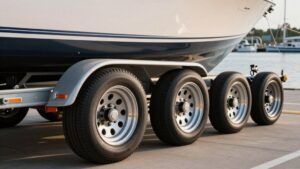
Using a reliable tire pressure gauge, digital models are often easiest, set each cold boat trailer tire to the PSI embossed on its sidewall. Don’t rely on appearance: trailer tires often need 50–65 psi, more than many vehicle tires. A gauge reveals actual pressure before towing.
- Check the trailer tongue sticker near the VIN plate for tire size and PSI as a secondary check.
- Remove the valve cap and press the gauge squarely onto the Schrader valve.
- Add air in small bursts, then measure again.
- If you overfill, depress the valve pin briefly and recheck.
- Check every tire, including the spare; leaks or rim damage can lower pressure unnoticed.
Check tires when cold and use the sidewall PSI target unless the trailer sticker specifies the correct tire-size pressure. Your spare matters, too.
Conclusion
Before towing, check each tire cold and inflate it to the pressure listed on its sidewall, unless your trailer or tire manufacturer specifies otherwise. Don’t exceed the tire’s rating, and confirm its load capacity suits your trailer.
Check the spare, valve stems, and pressure again after temperature changes or repairs. Use a reliable gauge, and convert PSI to bar carefully if needed. Proper pressure helps your tires carry loads safely and reduces uneven wear, heat buildup, and blowout risk.