What Strength Recovery Strap Do I Need? Break Strength by Vehicle Weight
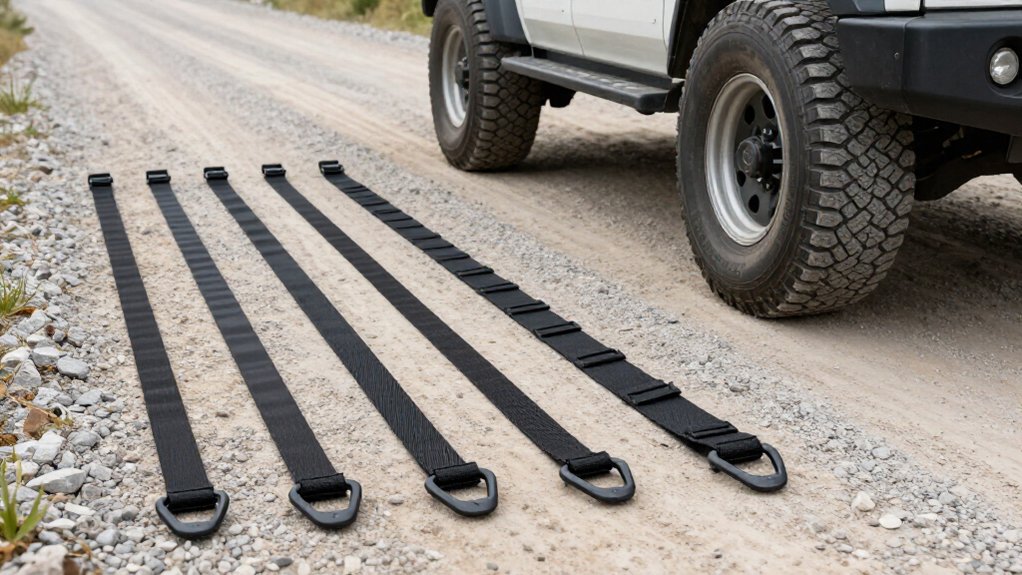
Choose a recovery strap with minimum breaking strength (MBS) about two to three times the stuck vehicle’s gross vehicle weight (GVW).
For a 6,000-pound vehicle, you need at least 12,000-pound MBS; 18,000 pounds or more gives a margin.
Treat MBS as a strength rating, not a safe working load.
Check WLL, recovery-point and shackle ratings, and manufacturer instructions.
Size for the heaviest load involved, and remember dynamic snatches can create higher forces.
More guidance follows.
Vehicle-Weight Break Strength
Choose a recovery strap with a minimum break strength (MBS) about 2–3 times the gross vehicle weight of the heaviest vehicle involved; usually the stuck vehicle, whose weight determines the extraction load. For a 6,000-pound GVW, target 12,000 pounds MBS; about 18,000 gives more margin.
For an 8,000-pound GVW, target at least 16,000 pounds, ideally about 24,000. Size the strap for the stuck vehicle, not the pulling vehicle: it must handle extraction forces transferred to recovery points. MBS isn’t a safe working load or a guarantee of safe recovery. Knots can reduce strap or rope strength by 50% or more, so don’t knot the strap. An oversized strap won’t automatically make your setup safer; it may increase shock loads at recovery points without meaningful benefit.
Sedan-to-HD Truck Ratings
For a sedan-to-HD-truck recovery, size the strap to the heavier vehicle’s GVW, not simply by choosing the biggest rating. For this pairing, use the sedan’s GVW as the sizing reference; the strap may face the truck’s heavier stuck load if the sedan can’t free it. Check the door sticker or manual for GVW (or curb weight plus payload) first. Use MBS of 2–3× that figure.
| GVW | Minimum MBS | Preferred MBS |
|---|---|---|
| 6,000 lb | 12,000 lb | 18,000 lb+ |
| Verify GVW | Match rated hardware | Avoid oversized mismatch |
Confirm the strap’s MBS and connect both ends to rated recovery points, not a hitch ball, receiver, axle, or steering. Apply WLL logic: a higher rating isn’t automatically safer; it can pass more shock to points and hardware when the recovered vehicle is much lighter.
Static vs. Kinetic Loading
When you pull steadily with little or no shock, the load is static, so WLL is a useful reference—but you still need to match the strap to the stuck vehicle’s weight. Kinetic loading starts when a vehicle gains momentum and the strap goes taut. The nylon stretches, stores energy, then releases it in a snatch.
That peak can far exceed static tension, so a strap chosen for pulling may fail during recovery. Size it for the stuck vehicle’s weight: target WLL near three times its vehicle weight, with breaking strength about two to three times that weight. Knots, wrong end hardware, or weak attachment points can become failure points under load; knots can cut strength by 50% or more. Use recovery points and follow the maker’s instructions.
Rating-Label Safety Factors
Check the label’s minimum breaking strength (MBS), but use the working load limit (WLL) to guide safe use; a high break rating alone doesn’t ensure protection. Choose an MBS about 2-3 times the heaviest vehicle’s gross vehicle weight (GVW): for example, at least 12,000 lb for 6,000 lb GVW, ideally 18,000 lb or more.
Match rated recovery points and shackles to the load, and avoid knots or mismatched connections that can weaken the system.
Break Strength Versus WLL
Choose a recovery strap by its working load limit (WLL), not its break-strength label alone; the minimum breaking strength should be roughly 2–3 times the heaviest vehicle’s gross vehicle weight (GVW).
Use WLL to judge the load the strap is intended to handle, while treating minimum break strength (MBS) as a separate ceiling, not a usable working target. As a rule, aim for MBS near three times the stuck vehicle’s GVW, and check the lighter vehicle when estimating shock loads transferred through the system.
Don’t assume a larger break-strength figure makes recovery safer: an oversized strap can pass greater shock forces into recovery points and hardware. Match the strap’s WLL to the job and pair it with hardware rated for the load. Inspect the strap and connection points, keep people clear of the line, and avoid jerking the vehicle. If vehicle weights or equipment ratings are uncertain, stop and verify them.
Understanding Label Ratings
A recovery strap’s label should show both its Working Load Limit (WLL) and Minimum Break Strength (MBS); use the WLL for safety comparisons, and treat MBS as a strength margin, not a working target. When you compare labels, check which rating each number represents; a high MBS doesn’t replace a suitable WLL. Choose by the stuck vehicle’s weight, not the recovery vehicle’s.
As a practical MBS reference, aim for roughly two to three times the heaviest vehicle’s gross vehicle weight (GVW): for 6,000 lb, at least about 12,000 lb, preferably 18,000 lb or more; for 8,000 lb, at least about 16,000 lb, preferably 24,000 lb or more. Inspect the tag before use and confirm the rating applies to the strap’s configuration. Don’t tie a recovery strap: knots can reduce its strength by about 50% or more. Follow the manufacturer’s instructions and replace a strap with an unreadable label. Verify that the tag identifies the strap for vehicle recovery, not for towing or lifting.
Safety Factor Basics
Once you’ve confirmed the label’s MBS, use it, not a marketing “pull force,” to judge the strap’s strength margin. Build a practical buffer by choosing a label rating roughly two to three times the heaviest vehicle’s GVW in the recovery. For a 6,000-pound vehicle, target about 12,000 pounds; 18,000 pounds or more gives additional margin.
For an 8,000-pound vehicle, target about 16,000 pounds, with 24,000 pounds or more preferred. These are planning benchmarks, not guarantees that every recovery load stays within the rating. Keep the strap straight and use compatible, properly rated connection points. Don’t tie knots to shorten or secure it: knots can reduce strength by roughly 50% or more, consuming much of your safety margin. Inspect the whole setup before loading, and stop if you can’t verify its condition or rating. Keep others clear until you’ve checked the route and connections.
Minimum Breaking Strength
When comparing ratings, use the strap’s labeled minimum breaking strength (MBS) and target two to three times the heaviest vehicle’s GVW.
For a vehicle near 6,000 lb GVW, choose at least 12,000 lb MBS; 18,000 lb or more gives additional margin. At 8,000 lb GVW, start at 16,000 lb MBS and preferably select 24,000 lb or higher.
Treat these as label-based screening targets, not guarantees that a strap is suitable for every recovery. Read the manufacturer’s label carefully; don’t confuse breaking strength with working load.
Never assume an impressive MBS makes the complete setup safe. Knots can reduce strap strength by 50 percent or more, while weak or incompatible hardware and improper recovery points may become the failure link. Follow instructions carefully every time.
Match Ratings to Recovery Loads
Match the strap to the lighter, stuck vehicle’s GVW, and use its labeled ratings—not guesswork—to guide your choice. Choose a working load limit (WLL) around three times that vehicle’s gross vehicle weight. Treat minimum breaking strength (MBS) as a separate figure: a larger break rating alone doesn’t make a setup safe when the WLL or connected hardware is mismatched.
Use GVW as a check. For a 6,000-pound vehicle, target about 12,000-pound MBS, with 18,000 pounds or more preferred. For an 8,000-pound vehicle, target about 16,000-pound MBS, ideally 24,000 pounds or higher. These figures don’t replace the strap’s WLL guidance or manufacturer instructions.
Check every component before recovery. Recovery points and rated shackles must suit the load; the weakest link limits the whole system.
Matching Ratings to Recovery Setup
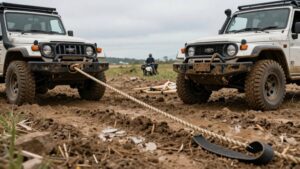
Because a kinetic pull can place far more force on a strap than the vehicle’s static weight, size the strap for the stuck vehicle’s weight and use its working load limit (WLL), not break strength alone, to guide selection.
Compare the strap’s break strength (MBS) with the gross vehicle weight (GVW) of the heaviest vehicle involved: target two to three times GVW. A 6,000-pound vehicle calls for at least 12,000 pounds MBS; 18,000 pounds provides a margin. Don’t treat break strength as a substitute for checking WLL and component ratings.
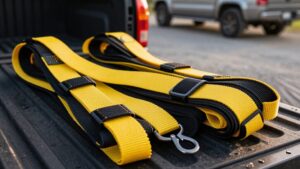
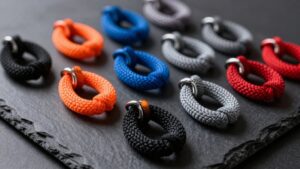
Higher-rated straps transfer shock into recovery points and shackles. Match their ratings. Use a nylon recovery strap with loop ends, rated points, and soft shackles—not a tow strap or mismatched metal hardware.
Oversized Loads and Trailers
With an oversized load or trailer, size the recovery strap for the heaviest connected weight, not just the tow vehicle. Use the combined gross vehicle weight (GVW) to select by minimum break strength (MBS). Aim for an MBS two to three times the heaviest weight involved.
At 6,000 pounds, choose at least 12,000-pound MBS, preferably 18,000 or higher; at 8,000 pounds, choose at least 16,000, preferably 24,000 or higher.
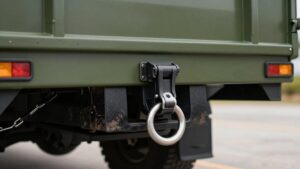
Check that rated recovery points and shackles meet the strap’s capacity; the weakest component sets the limit. Use recovery straps with loop ends and rated points, not towing hardware. Don’t tie knots: they can cut webbing strength by half or more. Keep shock loads off unrated parts to prevent failure and injury.
Sedan Stuck in Snow
For a sedan stuck in snow, choose a recovery strap by the sedan’s gross vehicle weight (GVW), not by guesswork. For a sedan near 6,000 pounds GVW, choose MBS of 12,000, 18,000 pounds or higher: roughly two to three times the heaviest vehicle’s GVW. Size the strap for the lighter, stuck sedan. Check its working load limit (WLL) and follow the manufacturer’s rating.
Use a nylon recovery strap with 10–20% stretch; it absorbs shock during controlled pulls. A tow strap with little stretch can transmit abrupt loads, making it a poor choice for freeing a snow-buried sedan. A rating doesn’t automatically improve safety; it may transfer greater shock loads to unsuitable recovery points.
Connect the loop ends to rated factory tow hooks or frame points with soft shackles or D-rings. Don’t use metal hooks for dynamic recovery. Keep people clear.
Damaged Webbing Inspection
Before using a recovery strap, inspect its full length, including both sewn loops and any dampener, for cuts, fraying, pulled stitching, glazing, chemical burns, or flat spots that may indicate weakened fibers. Pay particular attention to loop ends and glazed or heat-damaged areas; damage there can become the weak point under load.
Retire any strap that’s been shock-loaded to failure or shows deformation; it may be weakened even when it looks mostly fine.
- Check for knots, weld spatter, abrasion from poor contact, or webbing stressed by mismatched metal hardware.
- Retire a strap with any of these defects; don’t use it for recovery.
- After a questionable pull, recheck for new wear before the next recovery; damage can progress and reduce break strength before failure.
Nylon vs. Polyester Stretch
Nylon recovery straps stretch roughly 10–20% under load, and sometimes more, storing energy that helps pull a stuck vehicle free. Stretch can sometimes approach 30%. That elastic response absorbs shock, then transfers your recovery vehicle’s motion into extraction force as the strap goes taut. Polyester tow straps typically stretch under 5%, making them better for controlled towing, not snatch recoveries.
- Choose nylon when you need elastic energy transfer for a stuck vehicle.
- Use polyester for steady towing; don’t treat low-stretch webbing as a snatch strap.
- Check WLL and MBS, and keep everyone clear of the danger zone.
Nylon’s recoil can release energy unpredictably, so manage dampening and keep bystanders away from the line and vehicles. Match ratings to your recovery plan; stretch doesn’t replace adequate strength.
Conclusion
Choose a recovery strap by matching its labeled break strength to your vehicle’s weight, recovery method, and the highest-load part of your setup, not by choosing the biggest number available. Static pulls and kinetic recoveries load straps differently, so follow the strap and vehicle manufacturers’ guidance. Include trailers and cargo in your calculations, and don’t assume a light sedan needs only a light strap.
Before each use, inspect the webbing, labels, and hardware; retire damaged gear. If ratings or conditions are uncertain, stop and consult a qualified recovery professional.