Aluminum vs Steel Hitch Cargo Carrier: Weight, Rust and Price Compared
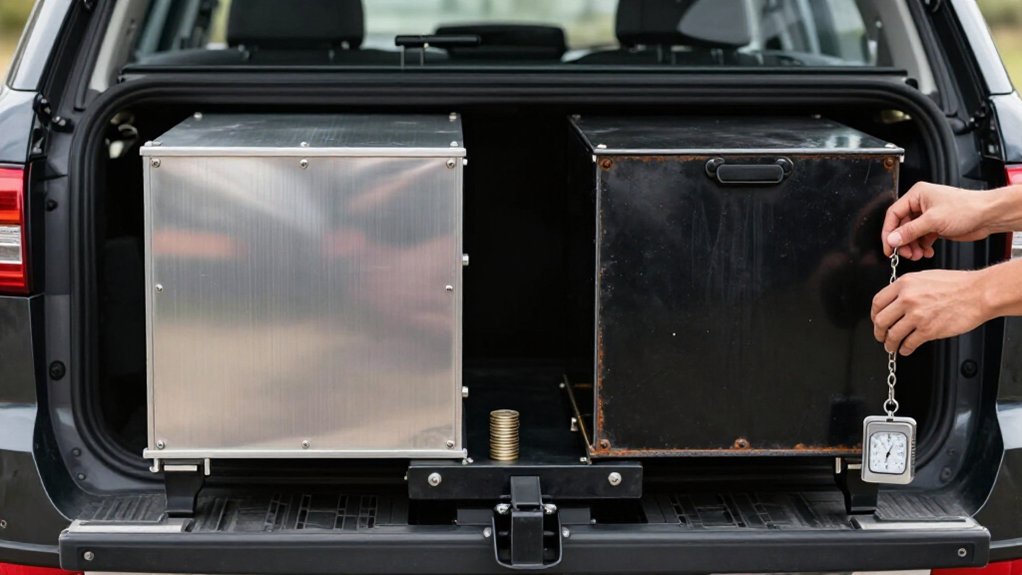
Aluminum hitch carriers cost more upfront but resist rust naturally, reducing upkeep on winter roads.
Steel usually costs less and may need repainting when its coating gets scratched.
Weight differences can be small: a steel Mockins weighs about 44 pounds, compared with roughly 42 pounds for the aluminum PakMule Pro.
That two-pound gap doesn’t change carrier capacity; check both carrier and hitch limits.
Compare construction, fit, and clearance.
More details can guide your choice.
Weight, Rust, and Price Comparison
On weight, rust resistance, and price, aluminum trades a higher upfront cost for easier handling and less corrosion maintenance.
You may find installation simpler with aluminum: the PakMule Pro weighs about 42 pounds, while Mockins steel weighs about 44. These models illustrate a modest difference, not a universal rule.
| Factor | Comparison |
|---|---|
| Handling | Aluminum is lighter |
| Corrosion | Aluminum resists rust; steel needs intact coating |
| Price | Aluminum often costs more |
Compare prices: a Curt aluminum 19-by-60-inch carrier rated for 500 pounds costs about $295.95; steel alternatives may cost less. Don’t infer capacity from material alone: compare model ratings, since design can support loads.
A lifetime warranty covers structural or material defects, not finish wear, so material and coating matter more for limiting corrosion.
Welded Joints and Tubing
While aluminum resists rust better than steel, its frame depends on well-designed tubing and consistent welds to withstand regular use. Compared with steel, aluminum has lower raw material strength, so manufacturers may use thicker tubes and extra crossmembers to support the frame.
You should compare the carrier’s rated capacity with its construction rather than assume that either metal guarantees strength; some aluminum models are rated for 500 or 650 pounds. Inspect corner joints and connections for solid, uniform welds, since inconsistent seams can become weak points under loading and travel.
Steel frames can use slimmer tubing for similar structural demands, though design and workmanship still matter. Check that tube ends are closed and that the frame allows drainage, which limits water trapped inside. Stainless-steel hardware and careful separation of contacting metals can also reduce abrasion around joints. A protective finish should cover exposed seams consistently.
Salt-Spray Exposure Performance
Salt spray can challenge either hitch carrier from its first trip on treated roads, where deicers, mud, and water reach the frame, corners, and welds. If you drive salted routes, corrosion becomes a day-one concern.
Aluminum resists rust naturally, making it a choice for year-round use in northern winters, mountain regions, and coastal salt air. Still, check whether its tubes have sealed ends and drainage paths; those details help keep water from standing inside members.
Steel depends more on surface protection. Look for prep and a thick, even powder coating; chips around bolt holes or folding joints can expose steel and start rust. Stainless hardware and limited contact between dissimilar metals can slow corrosion where salty water lingers at fasteners. Inspect both materials after exposure.
Tool-Free Assembly Availability
Corrosion resistance differs by material, but assembly convenience depends more on the carrier’s design: tool-free setup is uncommon for both aluminum and steel models. You’ll find exceptions, but material alone won’t predict assembly time. Mockins’ Folding Heavy-Duty uses a plug-and-play design and included hardware, taking about 20 minutes rather than slow manual assembly.
Budget steel models such as Harbor Freight’s HaulMaster may need dozens of screws and nuts; an electric wrench speeds the work but doesn’t make assembly tool-free. PakMule Pro arrives fully assembled, avoiding major assembly, though it isn’t technically tool-free. Most carriers still need a locking pin to secure the hitch connection. Mockins, PakMule Pro, and Yakima Swingbase or gear systems specify one, so quick setup doesn’t mean completely tool-free attachment.
Vehicle Fit and Clearance
Start with receiver compatibility: the carrier’s shank must match your hitch opening, commonly 1¼, 2, or 2½ inches. Then compare hitch height and ground clearance: a raised or angled shank can keep the tray above speed bumps, while a low setup may scrape uneven terrain. Measure projection; Mockins extends 35.5 inches from the receiver, versus 39.25 inches for PakMule Pro, which can reduce driveway clearance.
- Compare dimensions with your bumper, doors, and obstacles; Mockins measures 60.25 × 21.25 × 7.25 inches, while PakMule Pro is 66 × 29.5 × 7.5 inches.
- Check access: Mockins flips vertically only when empty, so unloading’s required before opening the tailgate.
- Choose the tray that suits your space; confirm dimensions and access against your vehicle.
Replacement Hardware Availability
Beyond the carrier’s material, replacement-hardware support depends on the brand and design: standard hitch pins may be easier to source than proprietary shank or clamp parts.
Check whether the maker stocks locks, pins, and clamp components before you buy; a supplied lockable pin doesn’t guarantee that replacements remain available. Standardized pins and locks can be easier to find across brands, while a proprietary shank or anti-rattle clamp may require a direct order.
For example, a PakMule Pro’s specific retention setup depends on its matching pin and correctly tightened threaded bolt, so generic parts may not fit. Assembly also matters: if your HaulMaster uses dozens of small screws and nuts, losing or stripping one can make a complete hardware kit useful. Compare aluminum and steel models by parts support, not frame material. When ordering, match the pin type, diameter, shank, and receiver-interface clamp to prevent poor fit, added rattle, or stress.
Load Rating Variations
Hardware support tells you how a carrier can be maintained; its load rating tells you how much it can safely carry. Compare each model’s listed capacity, not its material: Mockins rates 500 pounds, PakMule Pro 650, while Yakima Swingbase+GearLocker permits only 100 pounds in the bin.
Two 500-pound carriers may use different structures, so obey both ratings and your vehicle’s receiver limit. The lowest applicable vehicle, hitch, or carrier limit sets your practical ceiling.
- Count cargo and carrier together: the carrier itself uses hitch capacity; Mockins weighs 44 pounds, PakMule Pro 42.
- Check receiver fit and shank style, folding, fixed, or angled, to limit movement and failure risk.
- Don’t exceed limits: overloading can sag baskets, bend frames permanently, crack welds, or damage shanks and receivers.
Steel vs. Aluminum Weight Tradeoffs
Aluminum carriers are often lighter than steel models, which can make installation and removal easier, but design features can narrow the gap. For example, a 42-pound aluminum carrier may weigh less than a 44-pound steel model, though weights vary by size and hardware.
You’ll need to subtract the carrier’s weight from your hitch’s limit to determine the cargo capacity available to you.
Carrier Weight Differences
Although aluminum carriers are typically easier to lift, align, and remove, material alone doesn’t determine weight: the steel Mockins weighs 44 lb, while the larger PakMule Pro aluminum carrier weighs 42 lb. That two-pound difference shows why you should compare the complete carrier, not assume aluminum always weighs less. The PakMule Pro’s internal platform measures 64 x 27.5 x 6.5 inches, yet its weight remains close to the smaller steel example.
Design, dimensions, and included features all shape what you’ll handle overall.
- If you install and remove it often, aluminum’s easier handling can matter more than small scale differences.
- Check each model’s dimensions and structure before comparing listed weights for fit.
- A heavier steel frame isn’t automatically stronger; compare construction, specifications, and material labels alone.
Impact on Payload Capacity
The carrier’s weight also affects how much of your hitch’s payload limit remains for cargo. An aluminum model often weighs less than a comparable steel carrier, leaving more capacity for gear when your receiver has a tight limit. In examples, the aluminum carrier weighs 42 pounds, versus 44 pounds for steel; that two-pound difference frees two pounds of hitch capacity, not two pounds of extra rated carrier capacity.
Your vehicle’s hitch rating must accommodate the carrier plus cargo, while you must respect the carrier’s rated maximum. Material doesn’t change that limit: use either 500-pound-rated model only up to 500 pounds. Capacity varies by design; a 42-pound aluminum PakMule Pro, for example, is rated for 650 pounds, while some carriers stop at 500. Aluminum’s lower weight can help you stay within your hitch’s ceiling; check both ratings before loading.
Best Choice by Vehicle Type
For cars and minivans, a roughly 42-pound aluminum carrier can reduce rear squat and make installation easier than a heavier steel model. SUVs and crossovers can support either material, while pickup trucks may also suit either; aluminum resists salt and rain with less upkeep.
If you remove the carrier often or drive in wet, salty conditions, aluminum offers practical advantages, while steel may cost less if you account for coating maintenance.
SUVs and Crossovers
If your SUV or crossover has tight hitch clearance, choose an aluminum carrier with an angled shank to raise the tray and improve ground clearance. Its lower weight can make lifting, aligning, and removing it easier than steel; tested carriers weigh about 42 pounds versus 44 pounds. But compare ratings and your hitch limit before loading: some aluminum models support 650 pounds, while steel options may be rated 500 pounds.
- Aluminum resists rust naturally on salted roads, while steel depends on intact powder coating.
- Check corners, shanks, and bolt holes; scratches can expose steel and start corrosion.
- Weigh upfront price against upkeep: aluminum may cost more, such as $295.95 for a Curt 19×60 aluminum carrier rated 500 pounds, versus a price near $188.46.
Pickup Trucks
Pickup owners who prioritize easier handling or drive on salted roads will generally prefer aluminum: a PakMule Pro weighs about 42 pounds, compared with 44 pounds for the steel Mockins, and aluminum resists corrosion without relying on an intact coating.
If you’re installing or removing the carrier frequently, that two-pound difference can reduce lifting effort, though the shank adds handling weight. For a budget-focused purchase, steel may cost less: Mockins carries a one-year warranty and 500-pound maximum load, while aluminum options such as Curt’s C18100 list for up to about $295.95.
On northern or coastal routes, steel needs a protective finish to limit rust. Before choosing, compare the carrier’s 500–650-pound rating with your receiver and hitch limits; select capacity for your cargo, not material alone.
Cars and Minivans
Cars and minivans generally benefit from a lighter aluminum carrier, which is easier to lift and helps conserve limited hitch and payload capacity. Before choosing, compare the carrier’s own weight and rated load with your vehicle’s hitch and payload limits; a 500–650-pound rating doesn’t mean your car can carry that much.
- Aluminum models weigh about 42–44 pounds and resist salted-road corrosion naturally; steel costs less but needs sound coating and periodic spray-paint upkeep.
- A 500-pound aluminum option may cost around $295.95 upfront, but lower maintenance can improve its long-term value.
- Check your receiver’s 1¼-inch or 2-inch shank, plus ground clearance and stability over bumps, to avoid bottoming out.
Choose steel if its lower price outweighs lifting effort and upkeep for your typical use case.
Best Choice for Winter Roads
On winter roads, aluminum usually outlasts steel because road salt and de-icers can corrode steel when its protective coating gets scratched or chipped. That makes aluminum a practical choice if you drive salted routes often. Yet don’t treat every model alike: durable powder-coated or anodized finishes and stainless-steel hardware can further limit damage from spray and standing moisture.
Steel may cost less, while an aluminum carrier such as a Curt 19×60, rated for 500 pounds, can cost about $295.95.
Aluminum’s lower weight can ease installation or removal when you’re wearing gloves; a PakMule Pro weighs about 42 pounds, compared with the 44-pound, 500-pound-rated Mockins steel model. Still, ratings vary by model. Check your vehicle and hitch limits; never exceed either rating.
Conclusion
Choose steel if you prioritize lower upfront cost and high load ratings, and don’t mind added weight or regular rust prevention. Pick aluminum if you want easier handling, better corrosion resistance, and simpler long-term care, though you’ll usually pay more.
Before buying, compare welded joints, tubing quality, salt-spray performance, assembly method, and your vehicle’s clearance and hitch rating. For winter roads, aluminum generally needs less upkeep, while coated steel can remain a practical value with maintenance.