Can You Pull a Fifth Wheel With a Short Bed Truck? Sliders vs Pin-Box Offsets
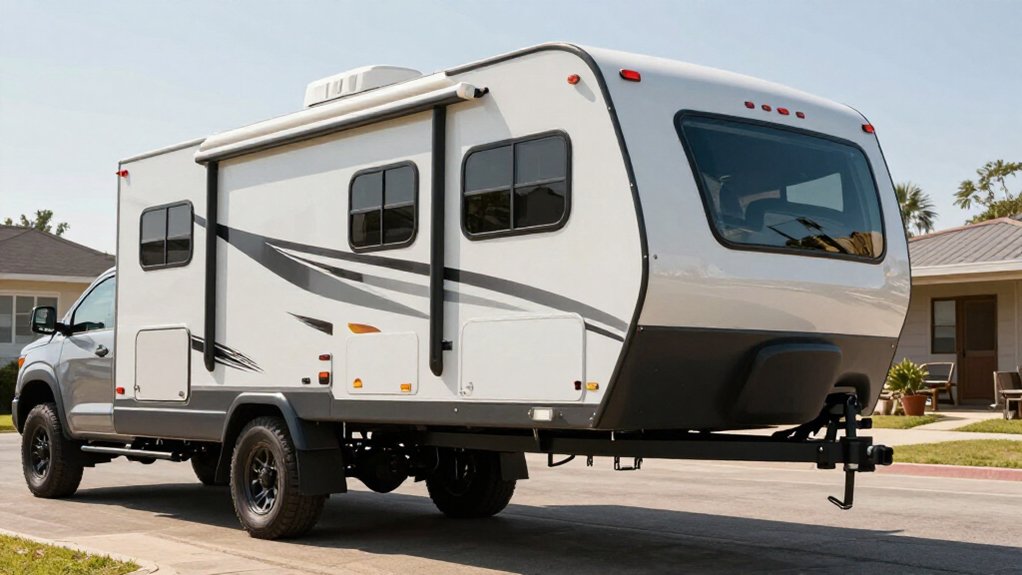
Yes, you can tow a fifth-wheel with a short-bed truck, but verify turning clearance and ratings. Measure from hitch pivot to cab; allow at least half the trailer’s front width plus four inches.
Sliders move the hitch rearward for turns; approved offset pin boxes can move the pivot back, but verify hitch compatibility and sway limits.
Manual sliders need repositioning; automatic units shift during turns.
Use these checks to choose safely before first tight turn.
Short-Bed Towing Clearance
Short-bed trucks often leave just 20–27 inches between the rear axle and the cab, so a tight turn can swing the fifth wheel into the cab. Before towing, measure your actual cab-to-axle clearance and compare it with the trailer’s front width. A useful minimum is half the trailer’s front width plus 4 inches: for a 96-inch-wide front, you need at least 52 inches of cab clearance through the turn.
If that space is insufficient, a correctly sized slider can add turning room equal to its travel; a 12-inch slider adds about 12 inches. Set and lock the hitch as directed, then test slowly in a large, open area. Check both directions and reproduce your tightest backing turn, watching cab clearance throughout, if possible.
Fifth-Wheel Pin-Box Offsets
A slider isn’t the only way to gain cab clearance: some fifth-wheel pin boxes move the trailer’s effective pivot point rearward by up to about 22 inches.
These offsets can help you keep a short-bed truck’s cab clear because the pivot sits farther back. But a rotational kingpin box changes how the trailer pivots relative to your truck and can increase sway sensitivity.
Check the geometry: measure from the hitch or axle center to the cab, then compare that space with half the trailer’s front width. For a 96-inch cap, allow at least 52 inches of clearance, including a four-inch margin. A nonrotating offset may preserve stability. Choose a solution suited to your truck and trailer, and follow the hitch maker’s limits.
Turning at Fuel Stops
At fuel stops, tight, low-speed turns can bring the fifth wheel’s front close to the cab, especially with only 20–27 inches of cab-to-axle clearance. A useful check is to compare the hitch head, or axle, to the cab: keep that distance at least four inches greater than half the trailer’s width. For example, 54 inches of clearance against a 48-inch half-width leaves six inches.
If your margin’s tight, a slider can add its travel; 40 inches plus a 12-inch shift gives 52 inches. An offset pin box moves the pivot rearward, sometimes by about 22 inches, but don’t assume that guarantees clearance. In an open area, recreate your fuel-stop turn slowly and watch the trailer nose throughout. Confirm it clears the cab before making the same turn near pumps or traffic. Check mirrors and stop immediately if the gap closes; never judge clearance from the cab alone during the maneuver.
Manual vs. Automatic Sliders
With a manual slider, you move the hitch head—often about 12 inches—before a tight turn, so you must set it correctly to prevent cab contact. An automatic slider adjusts the hitch during turns, reducing the need to stop and reposition it while maintaining clearance.
To choose, check your cab-to-trailer clearance and consider whether you’ll reliably operate a manual slider; don’t pair a slider with a Sidewinder if the manufacturer advises against it.
Manual Slider Operation
Manual sliders give you direct control over cab clearance, but you must stop and reposition the hitch before a tight turn. Before towing, confirm the slider’s travel and the trailer’s front width against your truck’s clearance; short-bed setups may need four inches beyond half the trailer’s front width. Set the hitch forward for highway travel to support handling.
At a campsite, stop, release the lock, move the plate rearward, then relock it and verify engagement before turning. A 12-inch slider can add 12 inches of axle-to-cab clearance, but position alone can’t guarantee safety. If you leave the hitch too far forward, the trailer nose may strike the cab. Practice a slow, full-turn clearance test in an open area before maneuvering near obstacles.
Automatic Slider Convenience
Because a short-bed truck may have only 20–27 inches of cab-to-axle clearance, an automatic slider can move the hitch rearward during a turn without requiring you to stop and reposition it. That movement creates turning room from the slider’s deployed travel; it doesn’t change trailer width or eliminate the need to verify clearance.
For example, if your axle-to-cab distance is 40 inches and you need about four inches beyond half the trailer’s 48-inch width, a 12-inch slide can provide 52 inches of effective clearance during a turn.
With power operation, you can focus on maneuvering instead of stopping at each tight corner to reposition the hitch. Still, follow the maker’s instructions, confirm the slider moves as designed, and watch the trailer and cab. Slow down, use a spotter when needed, and stop if clearance looks uncertain.
Choosing Between Slider Types
Power sliders simplify tight turns by moving the hitch rearward automatically, while manual sliders require you to reposition the hitch before maneuvering.
Choose based on how often you turn tightly and whether you’ll reliably stop to shift. Your clearance target is roughly four inches more than half the pin-box width; verify it on your truck-trailer combination.
| Situation | Manual | Automatic |
|---|---|---|
| Tight turns | Move hitch rearward first | Deploys under load |
| Frequent maneuvering | Requires routine | Simplifies operation |
| 5.5–6.5-ft bed | Check cab gap | Check deployment |
| Before travel | Confirm forward position | Confirm system operation |
A 12-inch slide can add 12 inches to axle-to-cab measurement, but insufficient clearance can let the nose strike your cab. Choose an auto-slider if you make tight turns often; choose manual if you’ll shift before one.
Truck and Trailer Weight Ratings
Before comparing sliders with pin-box offsets, verify your truck’s payload and GCWR, your trailer’s gross rating, and the loaded pin weight. Keep pin weight within the truck’s axle, hitch, and payload limits, and ensure every hitch or offset component is rated for the load.
Improved cab clearance doesn’t increase capacity, so choose a 16K or 19K setup that matches your trailer’s actual requirements.
Gross Weight Ratings
A short-bed truck can tow a fifth wheel only when the loaded rig stays within every applicable rating—not just the trailer’s gross weight. Check your truck’s tow rating and GCWR, then compare them with the loaded truck and trailer. Confirm the hitch, head, wedge, pin box, and axles meet individual limits.
Trailer GVWR doesn’t reveal whether king-pin weight exceeds hitch or truck limits. A 19,000-pound Sidewinder or Super 5 isn’t interchangeable with a 16,000-pound system; match its rating to loaded pin weight. Slider travel and pin-box offsets may improve clearance, but don’t raise ratings.
After changing slider length, geometry, or wedge, verify compatibility and ratings, then recheck loaded weights before towing. Check trailer axle limits, and weigh the travel-ready rig on certified scales.
Payload Capacity
Your truck’s payload limit must cover the loaded fifth-wheel pin weight, hitch hardware, passengers, and cargo—not just the trailer’s listed GVWR.
Weigh the rig as towed; GVWR alone doesn’t reveal pin load. Add occupants, gear, slider or offset hardware to the payload tally. Confirm the loaded truck stays below GVWR and the combination within GCWR. Check trailer axle weights against GAWRs. Clearance hardware may shift hitch placement and consume payload; recalculate after installation.
| Check | What to include | Safe comparison |
|---|---|---|
| Truck payload | Pin load, people, gear, hardware | Truck payload rating |
| Weight limits | Truck and trailer loaded weights | GVWR, GCWR, GAWR |
Measure loaded pin weight on a scale, then verify ratings on labels and manuals. Don’t use dry figures or assume clearance hardware leaves payload unchanged for your exact configuration.
Hitch Weight Limits
For a short-bed setup, clearance doesn’t change the weight limits: the allowable load is the lowest rating of the truck’s fifth-wheel hitch point, the trailer’s king pin, and the hitch system. A 20-27-inch clearance setup helps you turn, but it doesn’t raise any limit.
For many short-bed rigs, Sidewinders are rated up to 16,000 pounds standard or 19,000 heavy-duty; match the unit to your trailer’s GVWR and measured pin weight, not the truck’s advertised tow rating.
Also check the trailer’s published maximum pin weight; a high-capacity hitch won’t excuse exceeding it, which can overload your hitch and suspension. Weigh truck and trailer on a scale, then verify pin load against your truck’s rating for its hitch configuration and hitch capacity. If any rating’s exceeded, don’t tow.
Parking on Uneven Campsites
On an uneven campsite, don’t assume cab clearance will match what you measured on level ground: a slope can change hitch angle, and suspension movement can bring the trailer’s front corner closer to the cab. Before parking, position truck and trailer level; height differences alter hitch geometry and clearance. Then make a slow static-pivot check: turn the wheel slightly left and right while a spotter watches the trailer nose and king-pin area. Stop if clearance narrows.
Short-bed turning may require about 48 inches of trailer swing within 20–27 inches of cab clearance; slopes can shrink that margin. A 12-inch slider adds roughly 12 inches, but uneven angles can affect safe turning. A rearward offset pivot can help too; recheck clearance as ground level changes.
Pin-Box Compatibility Limits
Although an offset pin box can move the trailer’s pivot rearward by as much as about 22 inches, it may add sway risk and won’t work with every hitch. Before buying, verify your hitch and pin-box combination: a rotational kingpin can be mechanically incompatible. PullRite, for example, says its #331724 rotational pin-box wedge isn’t suitable with the #1900 Super 5 hitch.
Inspect required spacers and isolators: if a Rota-Flex isolator block shifts out of position, use #4446 to move it back, or use #4447 to help prevent slipping. Distinguish Sidewinder-style geometry, which shifts the kingpin pivot rather than relying on a rotational pin box. Finally, confirm cab clearance: a 96-inch-wide trailer front needs about 48 inches under the half-width rule, especially on tight turns.
Misreading Hitch Height
A fifth-wheel hitch’s height affects more than trailer level; it changes how the front cap swings toward the cab, so a clearance check can be misleading if the setup’s wrong. Level your truck and trailer on firm ground, then match the hitch and pin-box height specifications before measuring. Even a few inches of ride-height error can change the trailer’s attitude, bringing its leading edge closer during a turn.
- Confirm the hitch height matches the trailer and pin-box specifications.
- Don’t judge cab clearance by kingpin distance alone; watch the front cap.
- If you change height or fit an offset wedge, verify correct pin-box geometry.
- Slowly test a tight turn before travel, stopping at any sign of contact.
That’s safer than discovering interference on the road.
Check Door-Jamb Payload Label
Before choosing a slider hitch or pin-box offset, check your truck’s door-jamb certification label to confirm its payload capacity. That rating tells you how much weight the truck can carry, including occupants, cargo, hitch, accessories, and fifth-wheel pin weight. Check the trailer’s published pin weight, then compare it with payload left after people and gear are aboard.
The pin weight transfers directly to the truck, so don’t use the trailer’s total weight as a substitute. A slider hitch or offset pin-box may solve cab clearance while turning, but neither increases payload nor changes rated limits. If you’re close to the sticker’s maximum, reduce cargo or occupants before towing; never assume a clearance upgrade makes an overloaded setup safe.
Recheck your load each trip, including tools, water, and hitch hardware. Keep axle and tire ratings within limits too, and stop if measured weights exceed.
Conclusion
You can tow a fifth wheel with a short-bed truck, but clearance depends on your cab, trailer, hitch, and pin-box geometry. Choose a compatible slider or offset pin box, and verify turning clearance before tight fuel stops.
Check hitch height, truck and trailer ratings, and the door-jamb payload label; never exceed any limit. Practice turns in an area, including on uneven ground. If you’re unsure, get a hitch installer to confirm your setup before travel.