Pintle Hitch vs Ball Hitch: Strength, Noise and When to Use Each
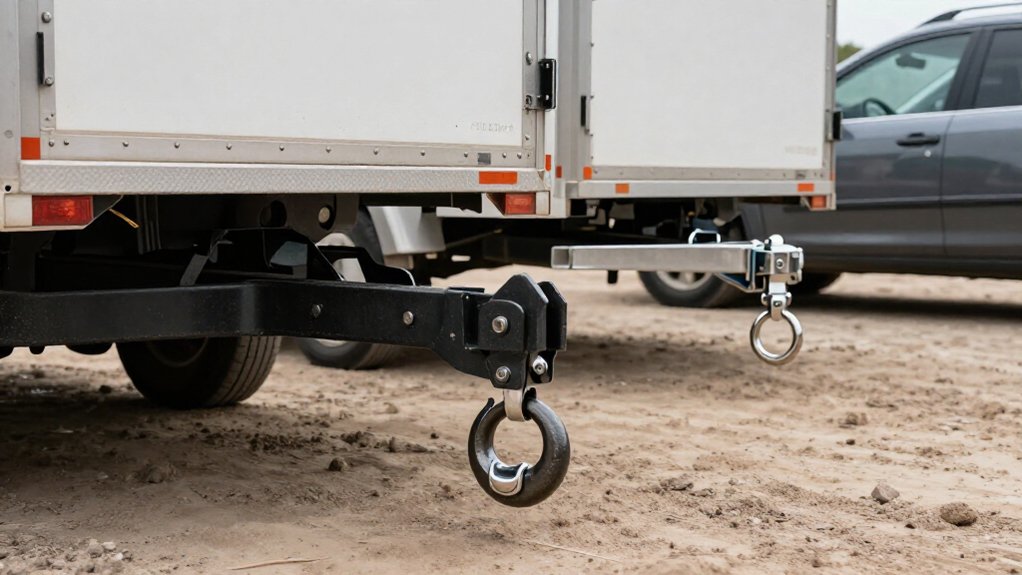
Choose a pintle hitch for heavy loads or uneven terrain; its hook-and-ring connection allows more articulation, but you’ll hear clunks, particularly with an empty trailer or light tongue weight. A ball hitch usually rides quieter and suits smoother, lighter-duty towing, though alignment matters.
Check every component’s rating and tongue-weight limit; the lowest-rated part governs. Balance cargo, secure the latch and pin, and slow down over ground. The sections ahead explain how to match your setup.
Noise and Vibration Comparison
With a pintle hitch, expect more clunking and visible movement than with a ball hitch: the hook-and-ring connection allows extra articulation over uneven ground, and an empty trailer can make that slack more noticeable. That movement can produce bangs and vibration, especially with light tongue weight.
A correctly matched, properly tightened setup with tongue weight can run quietly; inspect the lock and hitch, and investigate any increase in play. Ball hitches usually sound quieter because their geometry limits comparable movement. If your ball-hitch rig rattles, check for receiver-insert slop: an empty trailer can amplify that noise through the vehicle body. Don’t treat loud impact or excessive movement as normal; stop and correct looseness before continuing.
| Setup | Typical sound |
|---|---|
| Pintle | More clunking |
| Ball | Usually quieter |
Hook-and-Ring Connection
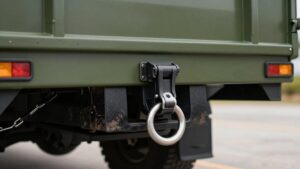
A pintle hitch connects your vehicle-mounted hook to the trailer’s lunette ring, which drops onto or passes through the hook and is secured by a locking arm and safety pin or lock. Unlike a ball-and-socket joint, this interlock uses metal contact between the hook and ring; it doesn’t clamp the ring into a fixed socket.
- Inspect the hook, ring, latch, and pin for wear, cracks, or deformation before coupling.
- Seat the ring fully, then close the locking arm and install its safety pin or lock.
- Verify the latch can’t lift open and that the ring matches the hitch’s rated size.
Expect clunks or rattle when lightly loaded; correct matching and tongue weight can minimize excessive play.
Follow the maker’s rating and proper coupling procedure.
Traction on Uneven Terrain
When a trailer crosses ruts or uneven ground, a pintle hitch’s greater vertical and horizontal articulation lets the lunette ring move without binding as readily as many ball-hitch connections. That extra movement helps the coupling stay engaged as your trailer walks over bumps at different angles, reducing stress that a less-articulating joint may transfer to mounts. For agricultural or construction hauling, you can maintain control across rutted jobsite routes, but articulation doesn’t replace traction, suitable tires, or a correctly rated hitch.
Expect more visible movement and occasional clanking, especially with a light or empty trailer; set tongue weight within the trailer and vehicle limits to reduce banging. A ball hitch can handle uneven ground, too; but you may notice harsher motion or binding sooner when the trailer twists. Slow down, secure the load, and inspect the coupling and mounts before travel. Check your tires and coupling after rough sections, especially before driving faster.
Backing Into Tight Spaces
Tight backing often favors a pintle hitch on uneven ground because its hook-and-lunette-ring connection allows more articulation and can be easier to engage without precise ball-and-socket alignment. That extra movement can help you guide a trailer when the approach is skewed or hitch heights differ slightly, reducing the chance of a hard bind.
- Move slowly, use a spotter, and pause often to check trailer clearance on both sides.
- With a pintle, let the ring settle onto the hook; don’t force engagement at an angle.
- A ball hitch can be quieter, but align carefully; slack may make trailer response less predictable.
On either setup, inspect for mechanical looseness before moving, keep hands clear of pinch points, and stop if the trailer binds or swings unexpectedly.
Coupler and Receiver Fit
Coupler fit depends on the connection: a pintle’s lunette ring must seat over the hook with the locking arm fully engaged, while a ball mount or shank should fit securely in the receiver.
For a pintle, check ring-to-hook clearance and set mount height with its bolt-hole positions; poor alignment can leave movement. For a ball setup, receiver play between the opening and insert can cause rattling, especially with a lightly loaded trailer.
Don’t treat looseness as slack: match components and secure the mount as specified. Adequate tongue weight helps press either coupling into place and reduce movement, but it can’t correct mismatched parts or an improperly engaged lock. Before towing, verify the connection is seated, locked, and appropriate for your load and equipment ratings.
Wear-Point Inspection Cadence
Secure fit is only the starting point; inspect a pintle hitch at every hookup and at least every trip or few hundred miles, whichever comes first.
At each hookup, check:
- Inspect the lunette ring for ovaling, deformation, weld cracks, and excess play; growing movement can increase clunking.
- Check hook and combo-ball contact surfaces for rounding, pitting, or cracks; confirm the arm seats fully and the safety pin locks with little wobble.
- Inspect mounting holes and rated fasteners for elongation, fretting, corrosion, or shear.
Impact-loading can loosen or wear parts without obvious damage, so don’t rely on noise alone.
After rough or off-road runs, inspect again and verify torque as needed; stop and repair any cracked, loose, or distorted component before the next trip.
Tongue Weight Limits
Although pintle hitches often support more tongue weight than common ball-hitch setups, you must stay within the ratings of both the hitch and trailer. Check the lowest-rated component, including the coupler, drawbar, receiver, and trailer, before loading. Set cargo so the trailer carries adequate tongue weight; a rear-heavy load can unload the hitch and let the connection move.
That movement may cause slop, clanking, or banging with either hitch type. A pintle’s ring can still rattle when lightly loaded or empty, but correct loading helps the trailer and hitch damp force changes. Verify hitch height and weight distribution too: poor setup can reduce tongue load even when your cargo appears balanced. Use a scale, adjust the load before towing, and never exceed rated limits.
Tongue Weight Limits
Check your trailer’s tongue weight against the ratings for your hitch, mount, and vehicle; the lowest limit governs. Pintle and ball setups can have different tongue weight capacities, so don’t assume one hitch type supports more without checking its specifications.
Load the trailer to maintain the required tongue weight, since too little can increase connection movement and noise.
Tongue Weight Ratings
Tongue-weight limits determine how much downward force the hitch can safely support, so match the trailer’s tongue weight to the lowest rating for the trailer tongue, lunette ring, hitch connection, receiver, and tow vehicle. Weigh the loaded trailer at its actual towing attitude; cargo placement and hitch height can change effective tongue load.
Use these checks:
- Keep measured tongue weight within every component’s published rating.
- Don’t tow with too little tongue weight; a lightly loaded connection can move more, causing pintle-ring slop or ball-hitch banging.
- Correct load balance before departure, then recheck after changes.
Adequate tongue weight firms the ride and reduces rattling and bouncing. Pintle setups often carry higher tongue ratings for heavy work, but poor geometry can still increase ring movement despite a secure latch.
Hitch-Specific Limits
Because pintle hitches often have higher tongue-weight ratings than typical ball-mount setups, they can suit heavy trailers—but the hitch’s rating alone doesn’t determine stability. Check the complete load path: your receiver, drawbar, pintle or ball mount, and trailer coupling each have a tongue-weight limit. Use the lowest applicable rating, and stay within your tow vehicle and trailer limits.
A ball hitch can become the constraint on a high-GTW trailer, especially if you load cargo far back or place heavy gear near the rear. With either hitch, insufficient tongue weight lets the connection move vertically and horizontally during starts, stops, and turns, creating noise and reducing control.
Set pintle height and distribute cargo so adequate weight bears on the hitch; a lightly loaded pintle may rattle more. Verify tongue weight with a scale, then secure the load and recheck after adjustments. A higher rating alone won’t guarantee stability or quiet.
Best Hitch for Heavy Loads
For heavy loads, compare each hitch’s rated gross trailer weight and tongue weight with your trailer’s actual demands. A pintle hitch often suits higher-capacity towing and rough terrain, while a ball hitch may reach its limits sooner.
Match the hitch, mount, and tongue weight to the load, and secure all hardware to specification.
Load Capacity Ratings
When heavy loads push a typical ball-mount setup near its limits, a pintle hitch may offer more capacity: its hook-and-lunette design is commonly used for high-GTW industrial and equipment trailers.
You should compare the stamped gross trailer weight (GTW) ratings of the hitch, lunette ring, mount, and vehicle; the lowest-rated component governs.
Use these checks before towing:
- Match every component’s rating to your trailer’s required GTW.
- Choose pintle hardware for dump, machinery, or forestry loads when a ball setup approaches its rating.
- Treat clatter or sheared bolts as warning signs; stop and inspect for overload or incorrect hardware.
A combo pintle/ball can bridge applications, but it doesn’t raise the rating of any part. Set hitch height correctly, maintain suitable tongue weight, and follow manufacturer specifications always.
Tongue Weight Limits
GTW ratings show how much a hitch can tow, but tongue-weight limits determine how much downward force the connection can safely carry. For heavy construction, agricultural, or industrial trailers, a pintle hitch often offers greater tongue-weight capacity than a standard ball setup. Still, you must keep actual tongue weight within the ratings for the hitch, pintle hook, lunette ring, and trailer. Don’t assume a higher GTW rating means the connection can handle more downward force.
Correct tongue weight and distribution help keep the coupling settled during acceleration, braking, and turns. Too little loading or poor balance can cause movement and clunking with either hitch type. Pintle height can also shift weight distribution, so check the setup and measure tongue weight. Stay within every component’s limits; excessive or insufficient tongue weight can reduce control and strain the connection.
Match Hitch To Load
If your trailer carries heavy loads or travels over rough terrain, a pintle hitch is often the better match. Its hook-and-lunette connection suits higher gross trailer and tongue weights, while allowing movement over uneven ground. Choose it for equipment, construction, agricultural, or utility work when your ball system’s rating or articulation limit becomes a concern.
- Check the hitch’s rated capacity against loaded trailer weight and tongue weight.
- Set pintle height and bolt alignment correctly; maintain adequate tongue weight.
- Lock the arm fully around the lunette ring and inspect coupling before travel.
Proper setup can reduce noise and slop. For routine light-to-medium towing, a ball hitch may be; don’t exceed either component’s rating, and verify your vehicle, mount, and trailer ratings.
Heavy-Duty Towing Applications
For construction, agriculture, forestry, and utility work, a pintle hitch provides a rugged, high-capacity connection for heavy trailers and equipment. Its hook-and-lunette design suits higher trailer and gross trailer weight ratings. Choose it when you tow backhoes, generators, dozers, or large implements behind a dump truck.
The added vertical and horizontal articulation helps keep the coupling engaged over uneven ground, but it doesn’t replace correct ratings, tongue weight, or secure installation. Match the hook to the lunette ring, verify every component’s capacity, and inspect for wear before each trip. You may hear more clunking with an empty or lightly loaded trailer; proper setup and adequate tongue weight often reduce it.
For rugged industrial or military logistics, this dependable interface can outperform a typical ball mount.
Conclusion
Choose a pintle hitch when you need articulation and rugged strength on rough terrain or with heavy equipment. You’ll hear more noise and vibration, so verify the ring and coupler ratings, receiver fit, and tongue weight.
Choose a ball hitch for quieter towing, tighter maneuvering, and smoother highway handling, provided your load stays within rated limits. Inspect connections, secure your load, and follow vehicle and trailer ratings. If uncertain, reduce load or consult a professional.