How Much Weight Can a Hitch Cargo Carrier Hold? Tongue Weight Math Explained
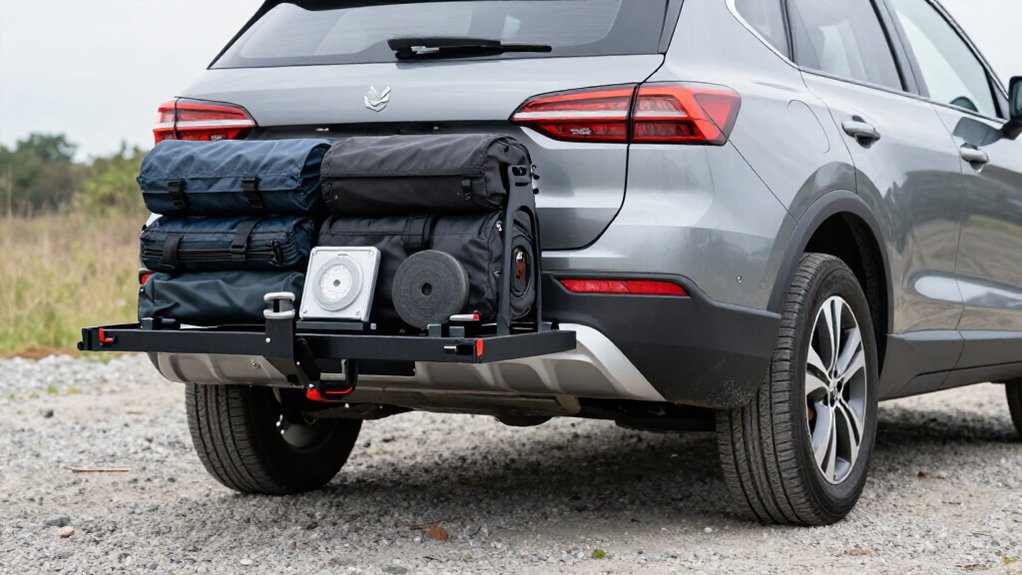
Your hitch cargo carrier can hold only the lowest rated limit of the carrier, receiver, and vehicle’s tongue-weight capacity, minus the carrier’s empty weight. Check the vehicle owner’s manual and receiver label; receiver size alone doesn’t prove capacity.
Tongue weight is the downward force at the hitch, generally 9–15% of trailer gross weight. Keep the carrier and cargo within every limit, secure cargo, and measure after changes.
An extender can reduce capacity.
The checks below clarify.
Hitch Tongue Weight Math
To calculate a hitch cargo carrier’s safe load, use the lower of your vehicle’s tongue-weight capacity and the hitch’s maximum tongue weight. Check your owner’s manual for the vehicle rating and the hitch label or specifications for its maximum tongue weight (TWC). Your usable allowance can’t exceed the smaller figure.
If your documentation lists only gross trailer weight rating (GTWR), estimate tongue capacity at about 10% of GTWR; this is an approximation, not a substitute for a stated rating. For towing, tongue weight typically targets 10%–15% of gross trailer weight. That guideline doesn’t set a cargo carrier’s rating.
Place cargo close to the vehicle and distribute it securely; moving weight rearward increases leverage on the hitch and suspension, reducing the practical safe load overall.
Cargo Carrier Weight Limits
Set your cargo carrier’s usable weight limit by choosing the lowest rating among the carrier, hitch receiver, and vehicle tongue weight. Most carriers carry 300–500 lb, but your setup’s limit may be lower. Check all three ratings before loading.
| Rating | What to check |
|---|---|
| Carrier | Published capacity |
| Receiver | Tongue-weight limit |
| Vehicle | Manual’s maximum tongue weight |
Estimate payload by subtracting the carrier’s empty weight—often 30–70 lb—from the lowest tongue-weight limit. If you know only GTWR, estimate tongue-weight capacity at about 10% of GTWR, then subtract carrier weight. Keep heavy items close to the bumper; placing them farther back increases leverage on the hitch and suspension. Secure the load and leave a margin below the limit. Never treat the carrier’s advertised capacity as permission to exceed your vehicle or receiver rating.
Tongue Weight Basics
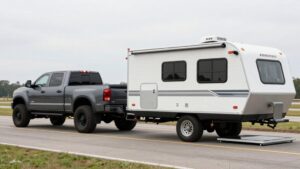
Tongue weight is the downward force a trailer’s tongue puts on your vehicle’s hitch, and it should generally equal about 9–15% of the trailer’s gross weight.
To estimate it, multiply GTW by 0.09 and 0.15. For a 5,000-pound trailer, that gives roughly 450–750 pounds, with about 600 pounds as a common estimate. Measure tongue weight with the trailer level and loaded as you’ll tow it; cargo placement changes the load at the hitch.
If you carry too little tongue weight, under about 10% of GTW, the trailer can sway more, and its movement can lift your vehicle’s rear. Too much, over about 15%, can overload the rear suspension and tires, while making steering and braking less predictable.
Keep the load balanced, then verify the actual tongue weight with an appropriate scale before driving. Check again after repositioning gear, because even small changes can shift weight between the trailer axle and hitch.
Trailer Class Weight Ratings
Hitch classes I through IV set different limits for tongue weight and cargo, so don’t assume a larger receiver alone means greater capacity. Check your hitch and vehicle ratings, then use the lowest limit in your setup to determine your safe load.
If you only have the GTWR, estimate tongue-weight capacity at about 10% of that rating.
Class I Rating
Because a Class I receiver is built for lighter loads, its tongue-weight limit, not the receiver opening alone, usually determines how much a hitch cargo carrier can safely carry. A Class I hitch typically has a 1.25-inch opening, but opening size alone doesn’t establish its rating. Check your vehicle’s owner’s manual and hitch label for tongue-weight capacity (TWC).
Your usable payload is the lowest of the carrier rating, vehicle TWC, and receiver TWC, minus the carrier’s own weight, often 30–70 pounds. If you know only GTWR, estimate tongue weight at about 10% of GTWR, then confirm that figure stays within every Class I limit. For a trailer, tongue weight commonly runs 10–15% of its weight; don’t treat that range as permission to exceed your rated capacity. Include cargo and carrier weight in your calculation. Keep the load centered, secure it, and check rear-axle and vehicle-payload limits too before driving, and after the first stop.
Class II Rating
A Class II hitch is typically a light-to-medium-duty setup with a 1.25-inch receiver, but that opening doesn’t determine how much a cargo carrier can safely hold. Your usable limit depends on tongue weight: the hitch and vehicle must support the carrier and its cargo. Use the lower of your vehicle’s maximum tongue-weight rating and the receiver’s rating.
Factory ratings assume normal driving and proper load distribution; exceed them, and added sag can destabilize handling. If you only know GTWR, estimate tongue weight at about 10%: a 5,000-pound GTWR suggests roughly 500 pounds.
For a carrier, take the lowest of its capacity, hitch rating, and vehicle rating, then subtract the carrier’s own weight. That remainder is your practical cargo allowance; secure loads and recheck limits.
Class III Rating
Moving up from a Class II to a Class III hitch doesn’t automatically increase your cargo carrier’s safe load. A Class III is a common heavy-duty receiver on many SUVs and often has a 2-inch opening, but size alone doesn’t confirm its class.
Your carrier’s loaded weight must stay within both your vehicle’s maximum tongue weight and your hitch’s tongue weight capacity. Use the lower rating as your working limit. If you only have the gross trailer weight rating (GTWR), estimate tongue weight at about 10% of GTWR, then compare that estimate with both limits.
Next, subtract the carrier’s empty weight from your allowable tongue weight to find the cargo allowance. Check the carrier’s own rating, too; don’t exceed it even when your vehicle and hitch have capacity remaining.
Class IV Rating
Although a Class IV receiver is a heavy-duty 2-inch hitch, its rating doesn’t set your cargo carrier’s safe payload by itself. Class IV describes the hitch system’s towing capacity under normal conditions, but cargo carriers load the receiver vertically through tongue weight. That distinction matters: a trailer’s gross rating isn’t the amount you can place on the carrier.
If you know only GTWR, estimate tongue weight at roughly 10 percent: multiply GTWR by 0.10. Then use that load in your Class IV compatibility math, alongside the receiver’s rated vertical limit. Your usable payload is still capped by the tow vehicle’s maximum tongue weight and the lowest-rated component; a high carrier rating can’t raise either limit. Treat carrier capacity as an upper bound, not permission.
Verify Hitch Capacity
Before depending on a carrier’s rated payload, verify the receiver’s tongue-weight capacity (TWC) on its label or in the documentation, then use the lower rating in the setup.
Confirm receiver class and opening match the carrier: StowAway models fit Class II (1.25-inch) and Class III/IV (typically 2-inch) receivers. Don’t assume class from opening alone; Class I/II receivers can have 2-inch openings, while Class V is typically 2.5-inch.
Check the rating against the receiver-size chart.
If documentation lists only GTWR, approximate tongue capacity at about 10% of GTWR, then compare it with published vehicle and hitch limits. Your carrier’s usable load can’t surpass the lower tongue-weight limit or receiver’s class-rated capacity. Thus, a carrier rated for 300–500 pounds doesn’t guarantee you can carry that much safely today.
Checking Vehicle and Carrier Ratings
Start with the lowest rating in mind: check your vehicle’s maximum tongue weight in the owner’s manual or on its certification plate, then check the hitch label or documentation. Use the lower vehicle or hitch tongue-weight capacity; if their listed limits differ, the smaller governs. If you can find only your vehicle’s gross trailer weight rating (GTWR), estimate tongue-weight capacity at about 10% of GTWR for planning, then verify before loading.
Next, check the carrier’s maximum load rating and its empty weight. Subtract that empty weight from the vehicle/hitch limit to find the weight available for cargo. Your usable cargo limit is the lower of that result or the carrier’s rated capacity. Include all cargo carefully in your calculation, and never exceed either rating.
Hitch Extender Impact
Because an extender moves the carrier farther from the vehicle, it increases leverage on the hitch and frame; StowAway recommends using one only with a Class 3 (2-inch) hitch or larger. An extender cuts StowAway carrier capacity by about one-third, so keep gear near or below 130 pounds. It doesn’t change receiver size or the hitch’s rated tongue-weight limit, but it increases mechanical stress and lowers your practical payload margin.
If your load already approaches either the vehicle’s tongue-weight maximum or the carrier rating, an extender may push the setup beyond safe effective limits. Reassess your tongue-weight and fit assumptions whenever you add hitch hardware. Center and secure the load to reduce strain, and follow the lowest applicable vehicle, hitch, and carrier rated limit.
Using a Bathroom Scale
After adding an extender or changing your cargo, verify the load with a bathroom scale. Set the trailer on a flat, level surface, then use blocks to raise the coupler to hitch-ball height. Place the tongue on the scale, centered directly over the platform; keep the trailer wheels off the scale.
Weigh the loaded setup as you’ll tow it, because cargo placement changes tongue weight. For a carrier, measure its hitch-point load. Compare trailer tongue weight with the target of about 10–15% of gross trailer weight (GTW): a 5,000-pound GTW trailer calls for 600 pounds.
If your reading falls outside that range, move heavier items closer to the axle and measure again before driving. Never exceed your hitch or vehicle limits.
Preventing Cargo Shift
To prevent cargo shifts from changing tongue weight, strap every item securely and block forward and sideways movement.
- Pack heavier items low and toward the hitch; this reduces leverage and limits changes in downward force if cargo moves.
- Use rated straps and carrier rails to restrain each piece; don’t rely on friction or a closed lid to hold loose gear.
- Recheck tension before each trip and after sharp turns or rough roads, when vibration can loosen tie-downs.
- Stop if cargo shifts; restore secure placement before driving, and keep tongue weight within the recommended 10–15% range to help prevent sag or sway.
If a tie-down loosens, stop safely, reposition the load, retighten every strap, and inspect the carrier before continuing. Never continue with unsecured cargo.
Calculating Loaded Carrier Weight
Once the cargo is secured, calculate how much weight your carrier can safely hold. Check your owner’s manual and hitch label; use the lower tongue-weight rating as your limit.
- Subtract the carrier’s empty weight, often 30–70 pounds, from that limit. The result is the maximum cargo weight before considering the platform rating.
- Compare that result with the carrier’s stated capacity. Many support 300–500 pounds, but some StowAway models cap loads at 200 pounds for 2-hitch designs or 125 pounds for Class II boxes.
- If estimating from towing data, approximate tongue weight at 10% of GTWR, then subtract carrier weight and use the lower rating.
- Weigh the complete load, including straps and boxes, and recalculate before travel. Placement and leverage affect safety, not the ratings themselves.
Conclusion
Before loading a hitch cargo carrier, check your vehicle, hitch, and carrier ratings: your usable limit is the lowest applicable tongue-weight rating. Count the carrier’s weight, cargo, and any extender; an extender can reduce hitch capacity. If you’re unsure, estimate tongue load with a properly positioned bathroom scale and stay within every limit.
Secure cargo against shifting, then recheck it after driving. Don’t exceed a rating to fit one more item; redistribute or remove weight instead.