Gooseneck Vs 5th Wheel Hitch: Ride Quality, Bed Space and Cost
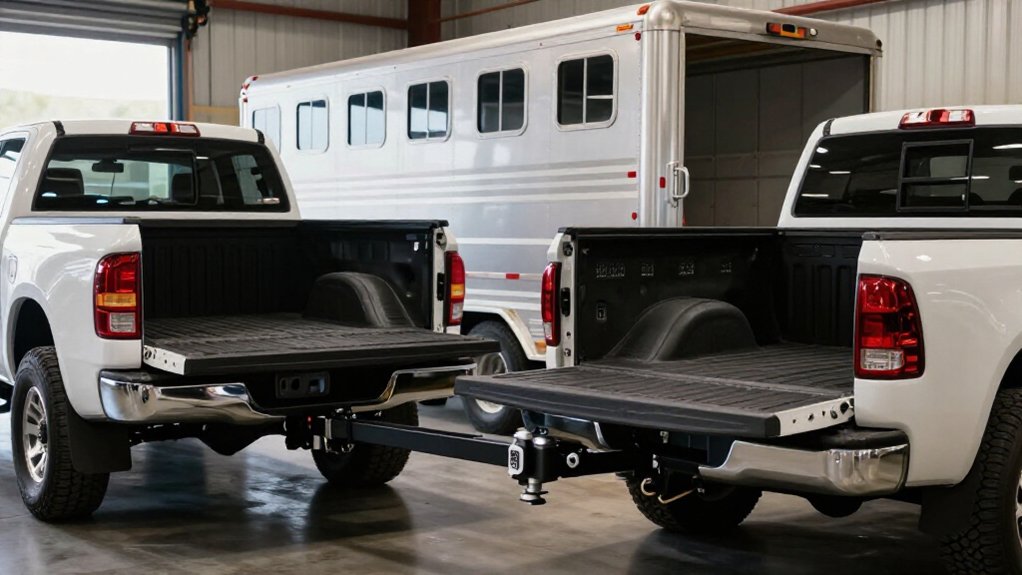
A fifth-wheel hitch gives you a smoother highway ride by reducing chucking, while a gooseneck costs less and leaves more truck-bed space when uncoupled.
A fifth wheel uses a kingpin and jaw; a gooseneck lowers its coupler onto a bed-mounted ball.
Compare installation cost, payload ratings, and cab clearance before choosing.
For long-distance comfort, a fifth wheel may suit you; for bed utility and lower cost, choose a gooseneck.
Check how clearance, hookup, and maintenance shape your decision.
Ride Quality, Bed Space, Cost
If ride comfort is your priority, a fifth-wheel hitch usually delivers a smoother, more stable highway ride because its jaw plate secures the trailer’s kingpin and helps reduce chucking. By contrast, a gooseneck can pass more vibration into your truck, particularly when you tow a lighter trailer. Your choice also affects bed utility and purchase cost:
| Priority | Fifth-wheel | Gooseneck |
|---|---|---|
| Ride | Smoother highway feel; less chucking | More vibration, especially with light trailers |
| Bed use | Hitch and rails occupy more space | Compact, often removable ball preserves space |
| Upfront cost | Typically higher; complex installation | Usually lower, especially factory-style fit |
Choose a fifth wheel for long-distance comfort and reduced chucking. Choose a gooseneck if you value lower cost and a bed you can reclaim for everyday hauling when you aren’t towing.
Coupler and Mounting Design
Beyond ride quality and bed space, the main difference is how each hitch connects to your truck.
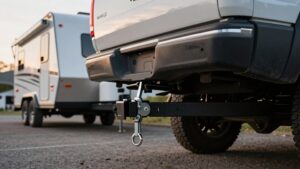
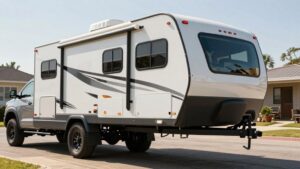
A gooseneck hitch places a ball in the bed, over or just ahead of the rear axle. You lower the trailer’s coupler vertically onto that ball, creating a compact pivot and a flexible connection. A 5th wheel uses a kingpin that locks into a horseshoe-shaped jaw on a hitch plate bolted to the truck.
That plate-and-jaw assembly spreads towing loads differently and generally limits lateral movement, reducing chucking. When planning installation, check the trailer’s coupler height and bed geometry for a gooseneck; for a 5th wheel, verify rail or plate placement and clearances. Choose the system that matches your trailer’s coupling and your truck’s mounting hardware.
Bed-Space Preservation Compared
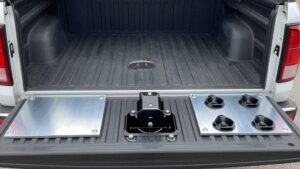
For everyday hauling, a gooseneck usually preserves more usable bed space: its compact ball can often retract or be removed when you disconnect the trailer. Because the ball sits over or slightly ahead of the rear axle, it leaves most of the bed available when you’re not towing.
That open floor makes loading tools, supplies, or bulky cargo more practical between trips.
A fifth-wheel hitch occupies more space: its large jaw-and-kingpin head and rails remain within the bed area, limiting storage when the trailer’s detached. If you use your truck for non-RV work, compare that utility against the fifth wheel’s stability benefits.
Choose a gooseneck when preserving bed capacity matters most; choose a fifth wheel when its ride advantages justify an obstructed surface.
Coupling and Uncoupling Steps
Coupling and uncoupling differ because each hitch locks to the trailer in a different way. Move slowly, use a spotter, and verify each lock or release before driving.
- For gooseneck, back until coupler centers over bed ball. Lower the jack until it seats, then confirm its safety mechanism fully engages.
- To uncouple, level the trailer and raise the landing gear until it supports load. Pull the coupler release, then lift coupler clear of ball.
- For fifth wheel, align the kingpin with the hitch head. Slowly back beneath it, or raise the trailer, until the pin enters the jaws; confirm they lock.
- To uncouple, support weight on the landing gear, open the jaws with the release handle, then pull forward until the kingpin clears.
Cab-to-Axle Clearance
When you turn sharply, the trailer’s front corners can hit the back of your truck cab, especially with a short bed.
A fifth-wheel hitch can address this risk with a slider that moves the hitch pivot rearward, often by up to about 12 inches on some models. That added clearance helps during tight, low-speed turns, but you must engage the slider when maneuvering and return it to the towing position as directed by its manufacturer.
Gooseneck setups use an offset coupler or ball to shift the pivot; some designs add about 10 inches of clearance. This approach can reduce cab-strike risk while retaining heavy-duty towing capacity.
Long-bed trucks usually provide more clearance, whereas short-bed trucks often need a slider or offset before you buy. Choose based on your truck’s bed length and the trailer’s nose shape.
Greasing Coupler Contact Points
Grease the gooseneck ball and the coupler’s internal contact surfaces to keep the joint moving smoothly under heavy pin weight, which often transfers about 15%–25% of the loaded trailer’s weight to the truck.
Then follow this service sequence:
- Clean the ball and coupler contact points, removing old grease and debris so grit can’t accelerate metal-to-metal wear.
- Apply the manufacturer-specified grease at its stated intervals; correct lubrication limits wear and vibration in the vertical interface.
- Lubricate moving and locking parts too, helping the coupler pivot without binding after repeated hookups, especially with heavy equipment or flatbeds.
- After each hookup, verify full seating and lock engagement; a secure fit reduces looseness and chucking, though it can’t erase the gooseneck’s inherently firmer ride under load.
Electrical Connector Placement
Electrical connector placement depends on the hitch layout: a gooseneck ball usually leaves more bed space, while a 5th wheel’s rails and hitch plate can restrict access and interfere with the plug. On trucks, the 7-way connector often sits on the driver side near the tail.
With a gooseneck, route its cable so it won’t snag as you swing into or out of the coupler. A 5th wheel’s rail-and-plate structure calls for more clearance around the hitch head and, if fitted, sliding rails. Account for slider travel—up to 12 inches on some systems—when choosing the connector location, so wiring won’t bind during turns. For frequent RV hookups, align the outlet with the trailer plug’s reach. Leave enough slack for coupling and avoid snags.
Hitch Maintenance Requirements
Grease your 5th wheel kingpin plate or gooseneck ball and coupler regularly, and keep contact surfaces clean to support full, smooth engagement. Inspect high-load areas for scoring, pitting, and corrosion, and check mounting hardware for looseness.
Before each trip, verify the latch indicators and confirm safety chains or breakaway components are correctly routed.
Routine Cleaning and Lubrication
Regular cleaning and lubrication help both gooseneck and fifth-wheel hitches couple smoothly and resist premature wear.
Before each hookup, remove road grime from the kingpin and jaw or the ball and coupler; clean contact surfaces to prevent rough engagement. Follow this routine:
- Apply the manufacturer-specified grease to the hitch head and locking mechanism; don’t substitute an incompatible lubricant.
- After wet, salty, or muddy trips, wipe grease points and pivots clean before adding fresh lubricant, so contaminants don’t enter bearings or moving parts.
- Work grease through every zerk, then confirm the locking mechanism engages fully; partial engagement can increase movement and accelerate wear.
- Retighten mounting hardware as specified; these hitches transfer vertical loads to the truck, and loose bolts can compromise stability and create noise.
Inspection and Wear Checks
Inspect your gooseneck or fifth-wheel hitch at every hookup to catch wear before it causes excess movement or unsafe coupling. Check the ball, coupler latch, and chain points for cracks, corrosion, pitting, or looseness; defects can increase play and degrade ride feel. On a fifth wheel, inspect kingpin and jaw contact surfaces, confirm full lock engagement, and check jaws, pivots, and hitch-head looseness that can cause chucking.
Verify mounting bolts, rails, and bed reinforcements remain tight and rust-free on either system; towing loads can loosen fasteners and create instability. Lubricate swivel, slider, and hinge wear points as your manual specifies to limit grit- and vibration-related wear.
During routine checks, confirm the hitch is level and adjusted to trailer pin or coupler height; misalignment accelerates uneven wear and increases noise and shock transfer. Recheck after demanding trips, and replace damaged components before towing again safely.
Livestock and Equipment Hauling
When selecting a livestock trailer, you’ll often find goosenecks favored for demanding agricultural use. Match your equipment’s loaded weight to the hitch, truck, and trailer ratings, not the hitch rating alone. For job-site maneuverability, consider the route and bed space you’ll need between runs.
Livestock Trailer Selection
For livestock and equipment hauling, a gooseneck often suits the job better than a 5th wheel: its bed-mounted ball-and-coupler supports heavy loads and leaves more truck-bed space available when you’re not towing. Choose your setup around these operating priorities:
- Turning: A gooseneck generally makes sharper turns in farmyards and tight job sites; some short-bed 5th-wheel trucks need a slider.
- Ride: Its ball connection can pass more road vibration to livestock than a 5th wheel’s kingpin-and-jaw design.
- On rough roads or with lighter loads, consider a shock-compensating or road-compensation hitch.
- Bed access: You’ll retain usable space between trips because the ball leaves less hardware above the bed.
Match the trailer and hitch to your routes, cargo, and truck configuration. Check clearance before each hookup carefully.
Equipment Weight Capacity
Turning clearance and bed access matter, but your load’s weight may decide the hitch type. For livestock and equipment hauling, compare the trailer’s loaded GVWR and payload rating with your truck, hitch, and axle limits; the lowest rating governs. Goosenecks typically reach towing capacities above 30,000 pounds when the truck and hitch carry matching ratings.
Fifth-wheel systems commonly top out around 20,000 to 25,000 pounds in commercial use, though they suit many RV and toy-hauler loads. Some gooseneck trailers carry GVWRs near 40,000 pounds, depending on model and configuration. Both hitch types transfer roughly 15% to 25% of loaded trailer weight to your bed, so verify pin or tongue load against truck payload. The MAXX-D YHB10234 offers 28,900 pounds of payload on dual 16,000-pound axles.
Job Site Maneuverability
On crowded job sites, goosenecks generally maneuver more easily than many fixed 5th-wheel setups. With a ball-and-coupler, you can make tighter turns when backing livestock into pens or positioning equipment in crowded lots. A 5th-wheel trailer’s front corners may approach your cab on a short-bed truck, so tight turns may require a slider or offset strategy; some sliders offer up to about 12 inches of rearward travel.
- Choose a gooseneck when frequent low-speed backing and repositioning outweigh long-highway ride smoothness.
- Expect a more jolty feel over rough ground from the ball-and-coupler connection.
- Either hitch transfers roughly 15%–25% of loaded trailer weight to your truck bed, supporting traction and stability.
- When uncoupled, a gooseneck typically leaves more usable bed space during each shift.
Verify Truck Payload Ratings
Before choosing a gooseneck or fifth-wheel setup, verify your truck’s payload: subtract its total curb weight from its GVWR, then compare the result with the trailer’s expected pin or coupler weight. A trailer’s loaded weight, not its average, provides the useful estimate: goosenecks commonly transfer 15%–25% of that weight to your bed.
Calculate that range, then check your truck’s verified payload and the hitch’s rated pin or coupler capacity; the hitch’s maximum rating alone isn’t enough. A tow rating can look adequate while payload is exceeded, compromising handling and safety.
For context, a 3/4-ton pickup often suits lighter 14K goosenecks, while one-ton dually trucks are standard near full payload with 21K-plus builds. Confirm your specific ratings for your combination before you choose either hitch.
Conclusion
Choose a gooseneck hitch when you need maximum bed space and a compact, durable setup for livestock or equipment. Select a fifth-wheel hitch when you’ll prioritize smoother ride quality and easier coupling, accepting reduced bed access and higher cost.
Before deciding, verify your truck’s payload, axle ratings, cab-to-axle clearance, and connector location. Compare installation and maintenance needs, too. Match the hitch to your trailer and hauling routine, then confirm every rating before every tow.