Curt vs Draw-Tite Trailer Hitch: Fit, Finish and Price Compared
Both Curt C13409 and Draw-Tite 76271 give you a Class III, 2-inch receiver, a 14½-inch installed height, and lifetime warranty coverage, so warranty length won’t decide the comparison.
Draw-Tite places its pin-hole center 5 inches behind the bumper; Curt places it 4 inches back, which can affect rack clearance.
Both use powder coats, though their coating descriptions differ.
Draw-Tite has slightly higher towing ratings.
Compare fit, capacity, price, and terms; the details below clarify key trade-offs.
Warranty Coverage by Brand
Although the exact terms can vary by part number, Curt and Draw-Tite both advertise lifetime warranties for their trailer hitch receivers, so warranty length doesn’t distinguish these Class III, 2-inch models.
| Brand | Warranty |
|---|---|
| Curt | Lifetime advertised |
| Draw-Tite | Lifetime advertised |
The comparison notes list a lifetime warranty for each brand, indicating similar stated coverage for this receiver class. Consequently, you shouldn’t choose between these models on warranty length alone.
Neither comparison detail identifies a material difference in warranty terms, but a brand-level statement doesn’t establish every condition for your specific hitch. Before purchase, check the warranty document for your exact part number and application. Confirm its duration, exclusions, and claim requirements before relying on coverage. That keeps your decision tied to documented protection, not a general claim.
Hitch Receiver Design
Both Curt #C13409 and Draw-Tite #76271 use a Class III, 2-inch receiver and sit at the same 14½-inch installed height.
Their bodies occupy nearly the same position, so your fit will be nearly identical. The practical difference is the pin-hole center: Draw-Tite places it 5 inches from the bumper edge, while Curt places it 4 inches away. Check your accessory’s clearance before choosing.
- With Draw-Tite, keep the rack’s closest edge more than 5 inches from the pin-hole center to avoid interference.
- Curt’s 1-inch shorter setback may suit a rack whose clearance is limited.
- Both use concealed cross-tubes and reduce ground clearance versus higher-clearance designs; assess your vehicle and routes.
For either hitch, verify rack dimensions against installed receiver position, not class or height alone.
Powder-Coat Finish Durability
Receiver fit is nearly identical, but finish terminology differs: Curt describes an A-coating as UV-resistant, while Draw-Tite specifies an E-coating; both use powder-coated finishes intended to resist corrosion. Those labels don’t establish which hitch lasts longer: discussion offers no unbiased, long-term head-to-head durability testing.
Owner reports describe Curt hitches with no noticeable rust after two to three years in Texas and Canada, but those examples reflect conditions, not a controlled comparison. In either case, inspect the coating regularly, especially if you drive on salted roads. Chips can expose steel and invite corrosion. You can add protection by applying an undercoating or spraying Fluid Film inside the receiver each fall. Consistent maintenance matters more than choosing between coating names when you’re managing salt exposure.
Bumper Clearance During Installation
During installation, the key clearance difference is fore/aft: Draw-Tite #76271 places the pin-hole center 5 inches behind the bumper edge, while Curt #C13409 places it 4 inches behind. Both receivers share a 14-1/2-inch installed height, so you’re comparing fore/aft positioning, not vertical clearance. Measure from the pin-hole center rather than the receiver-tube edge; that reference defines the stated bumper offset.
- With #76271, check that your bike rack’s closest edge remains more than 5 inches from the pin-hole center.
- With #C13409, the pin-hole sits 1 inch nearer the bumper, which may alter rack clearance.
- That shift can determine whether your rack tilts, clears, or contacts nearby components during installation.
Compare the rack’s actual position before tightening; the receiver opening alone won’t establish bumper clearance reliably.
Vehicle-Specific Mounting Points
For vehicle-specific fit, compare the bumper edge, installed receiver height, and pin-hole center on your exact trim. Both the Curt #C13409 and Draw-Tite #76271 are Class III hitches with 2-inch receivers, and each sits about 14½ inches high when installed.
Their pin-hole centers differ: Curt places the center 4 inches behind the bumper edge, while Draw-Tite recesses it 5 inches. That one-inch offset can change how your rack or other accessory aligns, even though the hitch class, receiver size, and installed height match.
Check the accessory’s clearance requirements against the pin-hole position. With the Draw-Tite, verify that your bike rack’s closest edge stays more than 5 inches from the pin-hole center. Before choosing either hitch for your vehicle, confirm these mounting-point measurements for your exact bumper and trim.
Replacement Hardware Expenses
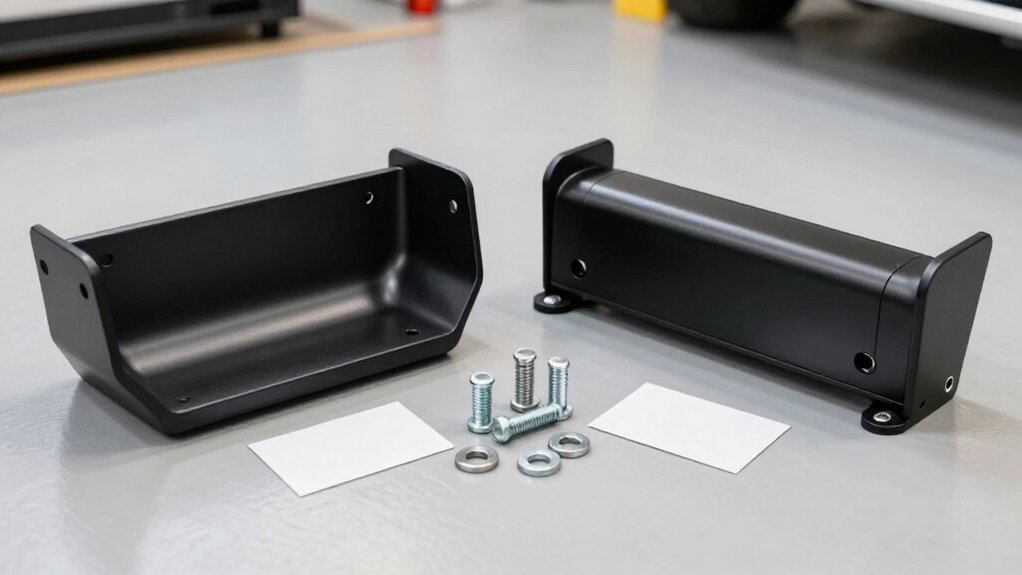
If either hitch arrives with missing or incorrect bolts, washers, or spacers, you’ll need to source replacement hardware separately, adding cost. Compare the likely costs before ordering:
- Curt’s receiver is American-made, but its mounting hardware may be imported; supplier availability and delivery time can vary if you need replacement fasteners.
- Draw-Tite’s hardware also needs to match the vehicle and hitch; don’t assume a similar-looking bolt, washer, or spacer will fit either kit.
- If you change plates or reposition a bike rack, the 4-inch Curt #C13409 versus 5-inch Draw-Tite #76271 pin-hole recess may call for alignment parts or separate rack straps, adapters, or pins. A compatible Tekonsha #118467 wiring kit won’t replace receiver fasteners; budget for the correct hardware separately. Verify part numbers before purchase.
Reduced Ground Clearance
Both the Curt #C13409 and Draw-Tite #76271 reduce ground clearance because their receiver and cross-tubes sit below the bumper; at the same 14½-inch installed height, their clearance impact should be effectively equivalent.
You’ll notice this limitation most when you cross steep driveways, speed bumps, or rough terrain, where the lower receiver and tubes sit closer to the road. Both hitches use concealed cross-tubes and require no bumper cutout, so the reduced clearance reflects their under-bumper packaging, not differing bumper modifications.
Check accessory clearance with each hitch loaded: the Curt pin-hole center sits four inches from the bumper edge, while the Draw-Tite center sits five inches away. That small geometric difference can affect an accessory’s position, but it doesn’t alter the shared clearance characteristic.
When comparing these options, consider your vehicle’s typical routes and approach angles; neither hitch provides a ground-clearance advantage based on its stated installed height. Your loaded setup determines actual accessory clearance in use.
Installation Tool Requirements
You’ll use basic metric and standard hand tools to secure either hitch, then torque each fastener to the value in its instructions. Before tightening, position the receiver level; both models sit 14½ inches high, but the Curt pin-hole center is 4 inches from the bumper edge, versus 5 inches for Draw-Tite.
If you’re adding wiring, route and secure the harness while the mounting hardware remains accessible.
Required Tools
Gather the same basic tools for either the Curt #C13409 or Draw-Tite #76271: metric or standard sockets and wrenches to remove factory fasteners and tighten the hitch hardware, plus a ratchet and torque wrench to meet the manual’s specified torque values.
Both are Class III hitches with 2-inch receivers, so their basic tool requirements are largely identical. Check the instruction sheet for socket sizes; mounting hardware commonly calls for 13mm-19mm tools. Use a snug-fitting wrench or socket to avoid stripping fasteners.
- Keep a ratchet ready for controlled tightening.
- Use the torque wrench to apply each specified value; don’t tighten bolts by feel.
- Have a tape measure and level nearby to check alignment before final tightening. Both hitches share the same 14-1/2-inch installed height, so alignment checks don’t change the tool list.
Installation Equipment
Before installing either the Curt #C13409 or Draw-Tite #76271, confirm that you have the correct hardware pack and the tools specified in its instructions. Although both are Class III, 2-inch receivers with similar mounting points, their hardware packs can vary, so use the instructions for your specific hitch.
Prepare standard metric or SAE hand tools, including a ratchet, sockets, and a torque wrench, to remove and tighten the mounting bolts beneath the bumper. Keep a tape measure handy to check pin-hole setback: Curt measures 4 inches from the bumper edge, while Draw-Tite measures 5 inches. This difference may affect bike rack clearance.
Use a drill and bits only if your vehicle-specific instructions require them; follow the specified procedure to prevent misalignment and changes to the listed 14-1/2-inch installed height.
For optional Tekonsha #118467 wiring, have cutters, strippers, electrical tape, and zip ties ready.
Maximum Towing Capacity Differences
For the same vehicle application, Curt #C13409 and Draw-Tite #76271 share Class III ratings, though Draw-Tite’s listed GTW and tongue-weight limits are slightly higher. Your vehicle’s towing and payload limits still cap the load, regardless of hitch capacity.
If you’ll tow near those limits, #76271 also supports a weight-distribution system; the comparison doesn’t specify that compatibility for #C13409.
Rated Towing Limits
Although both are 2-inch Class III hitches with contextually similar maximum towing capacity, Draw-Tite #76271 has marginally higher tongue-weight and gross-trailer-weight ratings than Curt #C13409. That difference concerns the hitch’s tongue-weight (TW) and gross-trailer-weight (GTW) limits; it doesn’t establish a meaningfully higher maximum tow limit for Draw-Tite.
- Compare each hitch’s labeled TW and GTW with your trailer’s actual loaded tongue weight and total weight; don’t infer capacity from brand alone.
- Draw-Tite supports a weight-distribution system, useful when you need that setup for towing stability.
- Both install at 14½ inches, and pin-hole position doesn’t change their rated limits.
For a comparison, read the labels and select the hitch whose ratings cover your loaded trailer; the modest rating edge isn’t a substitute for checking specifications.
Vehicle Capacity Constraints
In regards to rated capacity, Curt #C13409 and Draw-Tite #76271 are equivalent: both are Class III 2-inch hitches with the same tongue-weight and gross-trailer-weight ratings. That means neither model raises your vehicle’s maximum towing limit over the other; the hitch ratings match, so your choice doesn’t change the practical ceiling. Check your vehicle manufacturer’s towing specifications before selecting a trailer, because the vehicle, not the hitch class alone, sets the limit you must observe.
Your usable capacity is accordingly governed by the lower applicable vehicle or hitch rating. Draw-Tite #76271 is identified as compatible with a weight-distribution system for camper towing, which may support an appropriate setup under load, but it doesn’t increase either hitch’s stated capacity or override your vehicle’s rating. Curt #C13409 has no higher rated capacity advantage in this comparison. Keep the trailer and equipment within all applicable limits. Recheck ratings whenever your vehicle or trailer configuration changes.
Tongue Weight Considerations
When tongue-weight margin matters, Draw-Tite #76271 has a slight edge over Curt #C13409, with a higher stated tongue-weight rating and slightly higher gross-trailer-weight rating.
- Both hitches are Class III, 2-inch receivers, but you should treat each hitch-label tongue-weight (TW) and gross-trailer-weight (GTW) limits as controlling, whether you tow or carry a bike rack.
- If you use a weight-distribution system, #76271 is explicitly compatible; that setup can help manage load transfer, but it doesn’t raise the hitch’s stated maximums.
- Verify pin-hole center placement and keep your rack’s nearest edge more than 5 inches from #76271’s pin-hole center, so leverage doesn’t increase stresses beyond the rating’s assumptions. Don’t infer identical real-world margin from their shared class; compare published specifications and choose Draw-Tite when you need extra cushion.
Towing Stability Under Load
Because Curt #C13409 and Draw-Tite #76271 are Class III 2-inch hitches with the same weight ratings and 14-1/2-inch installed height, proper installation and trailer weight distribution, not brand, should drive towing stability.
Your stability depends more on secure installation and balanced loading within ratings than receiver brand. For camper towing, Draw-Tite #76271 explicitly supports weight-distribution systems, a useful advantage: the system can help level your truck and suspension, improving stability over towing without it. Curt #C13409 doesn’t state the same compatibility, so confirm your specific hardware suits its receiver before relying on weight distribution.
For racks, Curt’s pin-hole center is 4 inches from the bumper edge; Draw-Tite’s is 5 inches. That difference can affect clearance and safe accessory mounting when you carry weight near the hitch. Both share the same installed height, keeping trailer and rack geometry consistent.
Conclusion
Choose CURT or Draw-Tite by checking the exact hitch model against your vehicle’s mounting points, clearance, and towing limits—not by brand alone. Compare receiver design, finish, warranty, installation-tool needs, and price before you buy.
Either hitch can provide stable towing when properly matched, installed, and used within its rated capacity. Confirm bumper clearance and ground clearance on your vehicle, then follow the manufacturer’s instructions. That gives you a practical fit-and-value comparison without assuming one brand is universally better.