Do Hitch Extenders Reduce Tongue Weight Capacity? How Much You Lose
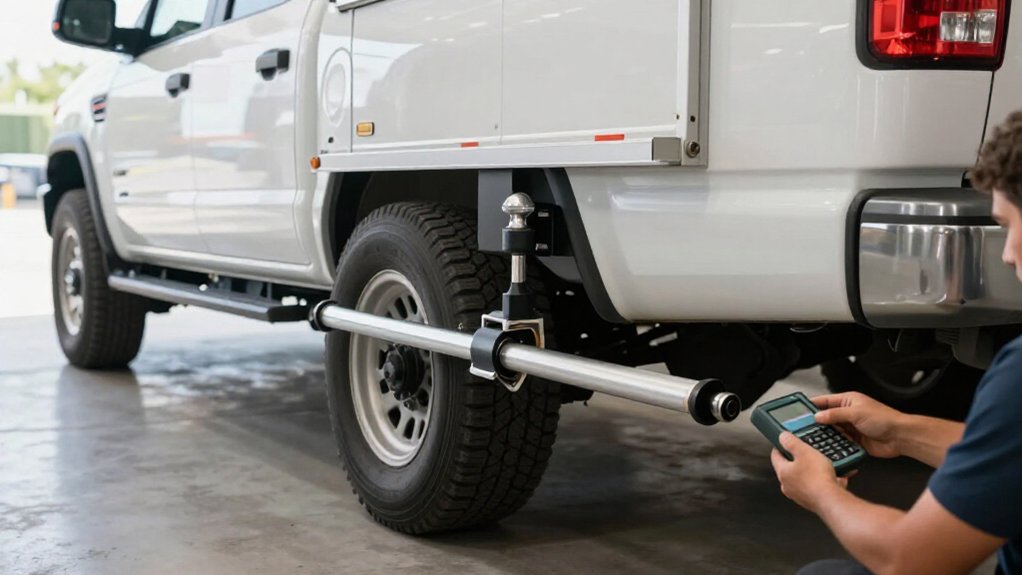
A hitch extender doesn’t change your trailer’s actual tongue weight, but it can reduce the hitch’s usable tongue-weight capacity.
A common conservative planning rule is to assume about a 50% reduction; however, that isn’t a universal formula.
Check the extender’s rating at its specific length, then compare your measured tongue weight with the lowest applicable rating for the hitch, receiver, ball mount, and extender.
More detail can help you verify your safe limit before towing.
Tongue Weight Reduction Math
A hitch extender doesn’t change your trailer’s actual tongue weight; it reduces the hitch’s capacity by moving the load farther from the receiver and adding movement. Because manufacturers rarely publish an exact reduction formula by extension length, use a conservative planning rule: assume an extender cuts the hitch’s rated tongue weight capacity by 50%.
This figure isn’t a precise calculation tied to inches; it’s a liability-focused guideline, and the actual reduction depends on extension distance and the extender’s rating. Check the hitch, receiver, and ball mount ratings, and use the lowest value as your limit.
If your tow rating assumes the hitch’s maximum tongue weight, recalculate your allowable tongue weight using the reduced capacity. Your trailer’s tongue weight remains unchanged; don’t load beyond that limit.
Hitch-Extension Leverage Effect
By moving the trailer load farther from the receiver, a hitch extender increases leverage on the hitch connection and reduces its effective tongue-weight capacity. That distance increases the turning moment on the receiver for the tongue load. The assembly may also develop play; when your trailer pulls or crosses bumps, motion can increase shock loads at the hitch.
Manufacturers don’t publish a universal relationship between extension length and capacity, so you can’t calculate an exact reduction from length alone. A common conservative rule is to treat an extender as cutting the connection’s rated tongue-weight capacity by about 50%. That figure is a liability-focused simplification, not an exact engineering result. It reduces the capacity rating you can rely on; it doesn’t change the trailer’s tongue weight.
Real-World Tongue Weight Loss
In practice, an extender reduces the tongue-weight capacity you can safely rely on, not the trailer’s actual tongue weight.
A conservative planning rule is to assume the receiver’s rated tongue-weight capacity falls by about 50 percent with an extender. This isn’t guaranteed for every setup; leverage, extension length, construction, and added joint movement affect the result.
You need to weigh your trailer’s tongue and compare it with the reduced allowable capacity. Don’t treat the receiver rating alone as your limit: the extender has its own rating, which may be lower. For example, part RP45292 can become the limiting component.
Added flex and play can amplify impact loads as the trailer moves, stressing the hitch beyond tongue load. Check the vehicle, receiver, and extender limits, apply the most restrictive rating, and leave a safety margin. If you can’t verify a rating, don’t tow.
Straight Versus Angled Extenders
A straight extender moves the coupler rearward, increasing leverage and bending stress on your hitch. An angled extender adds an offset that can introduce bending in multiple directions and torsional loads, making alignment and trailer position more consequential.
Don’t assume either design causes a fixed capacity loss; check the extender’s rating for your exact model and match it to your receiver.
Straight Extender Geometry
Even though a straight hitch extender doesn’t change the load path as much as an angled one, it still lengthens the lever arm and adds mechanical play, which can reduce tongue-weight capacity.
A straight extender moves the hitch connection farther from the receiver, so the same trailer load creates more bending moment at the hitch. Its added joints and clearance can also allow movement under load. Don’t assume that straight alignment preserves the hitch’s original rating. If the manufacturer doesn’t provide a specific calculation, many users apply a conservative reduction of about 50 percent, but that isn’t a universal rating or substitute for product guidance.
Check the published limits for your exact extender and length, then compare them with the hitch and ball mount or adapter. Your usable tongue-weight limit is the lowest applicable rating; never exceed it, and account for the trailer’s actual loaded tongue weight before each trip or any change in your setup.
Angled Extender Leverage
Angled extenders add off-axis leverage, so tongue weight can twist the hitch assembly as well as bend it. Unlike a straight extender, an angled unit shifts the trailer connection away from the receiver’s centerline. That offset can load different hitch components in bending and shear, depending on where the tongue weight acts.
The result is a more complex stress path, not simply a longer straight load arm. Added distance from the hitch throat still increases torque in either design, but the angle introduces torsional loading that a straight extender doesn’t create to the same degree. Don’t infer an angled extender’s rating from a straight model of similar length. Check its published, geometry-specific tongue-weight rating. Keep the connection aligned, secure, and within all component ratings.
Comparing Capacity Loss
Compare capacity by the load each extender puts on the hitch, not by shape alone: both straight and angled designs increase leverage and can reduce the tongue weight the assembly can safely handle. A straight extender generally keeps the trailer tongue aligned with the receiver centerline. As a conservative estimate, you might assume it cuts tongue-weight capacity by about 50%, but that figure isn’t a universal, length-based manufacturer rating.
An angled extender changes how the load acts on the hitch, potentially adding leverage beyond that simple estimate. Treat its loss as at least as significant and less predictable than a straight extender’s. Check the stamped ratings for the extender, receiver, hitch, and ball mount. Your allowable tongue weight is limited by the lowest-rated component; don’t exceed it, regardless of extender shape.
Receiver Class Differences
Receiver class and tube size affect which extender models you can use, but they don’t determine capacity by themselves. Check the extender’s model- and length-specific tongue-weight rating, since added distance increases leverage and can reduce capacity; often more with 2-inch setups.
Your system’s limit is the lowest rating among the hitch, ball mount, and extender.
Class-Specific Ratings
Although hitch class affects the system’s limits, it doesn’t determine extender capacity by itself. Check each component’s published tongue-weight rating before towing. Many Class III and IV extender setups use a conservative guideline of reducing tongue-weight capacity by about 50 percent.
That figure reflects added leverage and connection play; it isn’t a universal deduction assigned solely by receiver class. Your system’s allowable tongue weight is limited by its lowest-rated component. If the extender adapter is rated below the hitch, use the adapter’s lower limit rather than the hitch’s higher rating.
Conversely, when the extender’s rating equals or exceeds the hitch rating, the hitch and added leverage may govern. A long ball mount may already carry a reduced rating because it increases distance from the receiver; an extender adds further leverage. Follow every component rating and the vehicle’s limits.
Receiver Size Differences
A 2½-inch receiver doesn’t automatically lose the same tongue-weight capacity as a 2-inch receiver when you add an extender. The effect depends on the rated components and the leverage and movement the extender introduces, not on receiver size alone.
With a 2-inch setup, you’ll often see “about 50%” used as a conservative shorthand when an extender adds leverage and play; don’t treat it as a universal formula. On a 2½-inch setup, the extender’s own rating may set the limit, even when the hitch is rated higher.
For example, RP45292 has substantially less capacity than a typical 2½-inch hitch. Check the hitch and extender labels or manufacturer specifications, and use the lower applicable rating. You can’t determine safe tongue weight from receiver dimensions in isolation.
Capacity Reduction By Class
Because an extender increases leverage, you can’t assume the same tongue-weight reduction applies across receiver classes. A 2-inch and a 2-1/2-inch receiver may have different baseline ratings, but class alone doesn’t determine your usable capacity.
The extender’s published rating and length matter. Moving the load farther from the receiver increases leverage, and longer extensions can impose greater limits. Some extenders, such as RP45292, are rated well below a 2-1/2-inch hitch. Long ball mounts also reduce capacity for the same reason.
Check components’ tongue-weight ratings, then use the lowest limit; a weaker extender or mount governs regardless of receiver class. Don’t assume a higher-class receiver preserves its rating with an extender installed. Verify the manufacturer’s capacity guidance for your setup before loading or towing.
Spare-Tire Clearance
If your spare tire blocks the trailer coupler or chains, an extender may provide clearance, but it also moves the hitch point farther from the receiver and increases leverage. Before choosing one, measure the gap between the spare tire and coupler and chain hardware with the trailer loaded. Set rear suspension at its lowest expected position; that’s when interference and leverage are greatest.
Check clearance through suspension travel and confirm the coupler and chains won’t contact the tire during turns or road movement. An extender that clears the tire still increases stress on the receiver area because it places the load farther out. Apply the extender-related capacity reduction to your hitch’s rating; don’t size the setup by clearance alone. Verify the extender’s published limits.
Lowest-Rated Component Governs
Clearing the spare tire doesn’t determine how much tongue weight the setup can safely carry; the lowest-rated component does. An extender increases leverage on your hitch and adds movement to the assembly, reducing rated capacity. Check the ratings for your hitch receiver, ball mount, and extender, then use the lowest as the system’s governing limit.
If your hitch is rated higher than your ball mount or extender, the lower rating still controls. For example, a specific extender, such as part RP45292, may cap capacity below your vehicle hitch’s rating. Many manufacturers don’t publish a precise reduction tied to extender length, so the commonly cited 50% reduction serves as a conservative guideline, not a universal formula. Don’t assume the extender affects only the hitch; base your safe load on the minimum component rating.
Ignoring Extender Pin Ratings
Ignoring an extender’s pin rating leaves out one factor in a safety check; it doesn’t prevent the added leverage and movement from reducing the assembly’s rated tongue-weight capacity. Your concern isn’t limited to whether a pin can resist a stated load. The extension changes the hitch system’s leverage, while clearance can allow extra movement under braking, bumps, or sway.
A commonly cited conservative estimate is a 50% capacity reduction, but that’s not a guaranteed formula: the loss varies with extension length and leverage. It describes the assembly’s ability to carry tongue load, not a change in your trailer’s measured tongue weight.
- Don’t equate pin strength with system capacity alone.
- Account for leverage and movement.
- Treat 50% as guidance.
- Separate capacity from measured load.
Check the Extender Label
To move beyond the general 50% guideline, check the extender’s label or spec sheet for its maximum tongue-weight rating at the specified extension length and receiver size. Use that rating first; the 50% reduction is only a conservative fallback when model-specific data aren’t available. If the extender’s limit is below your receiver’s rating, the lower extender limit controls. Confirm that the rating matches your receiver size, since 2-inch and 2-1/2-inch models may differ. Read any notice about reduced capacity when extended: it changes the permitted rating, not the tongue weight your load creates.
| Check | What to verify |
|---|---|
| Rating | Maximum tongue weight |
| Length | Listed extension |
| Fit | Correct receiver size |
Don’t exceed the lowest applicable component rating, including receiver, extender, and hitch pin limits.
Conclusion
Yes, an extender can reduce usable tongue weight capacity by increasing leverage; the loss depends on extension length and your hitch’s ratings. Designs affect clearance and loading conditions, but neither overrides the lowest-rated component.
Don’t assume the receiver’s full rating still applies, or ignore the extender’s pin limit. Check its label and manufacturer’s instructions, calculate capacity for your setup, and keep tongue weight within that limit. Always verify compatibility for your exact setup before towing.