Trailer Hitch Classes Explained: Class I-V Ratings, Receiver Sizes and Weight Limits
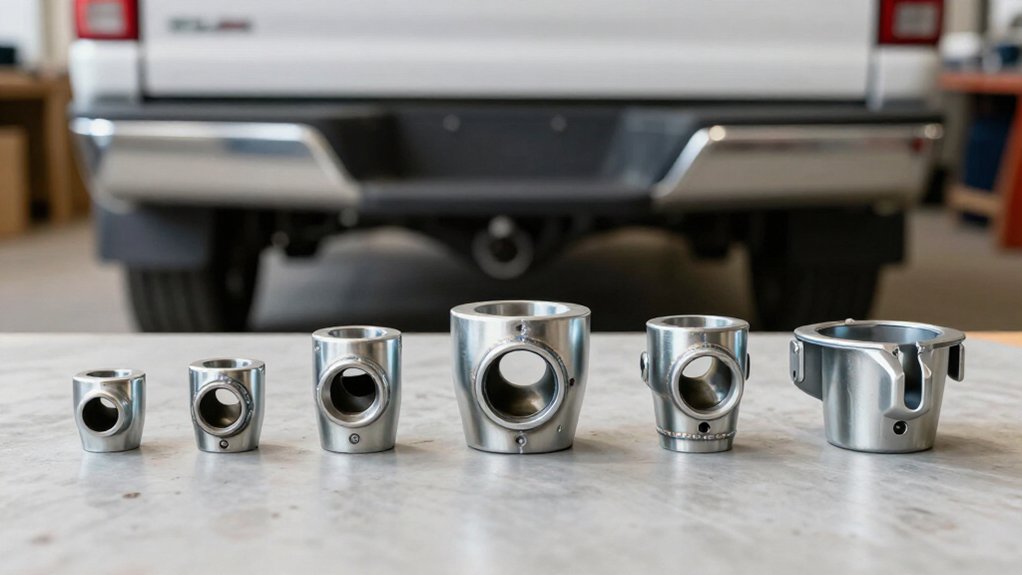
Choose the hitch by matching its class, receiver, and ratings to your vehicle and fully loaded trailer.
Class I/II usually use 1¼-inch receivers; Class III/IV use 2-inch, and Class V uses 2½-inch.
Limits range from 2,000/200 pounds GTW/TW for Class I to 10,000/1,000 for Class IV; verify Class V specifications.
Keep loaded GTW and tongue weight within the lowest vehicle, hitch, or component limit.
Match pins and hardware, and confirm fit before towing; more details follow.
Receiver Size Compatibility
Before selecting a ball mount or accessory, confirm that its shank matches the receiver opening: Class I and II hitches typically use 1¼-inch receivers, Class III and IV use 2-inch receivers, and Class V systems may use 2- or 2½-inch receivers. Measure the inside width of the square opening; common sizes include 1¼, 2, 2½, and 3 inches. Match the shank and hitch pin to the opening: Class I/II commonly use ½-inch pins, while Class III/IV and most higher-capacity hitches use ⅝-inch pins.
Confirm the pin passes through holes and locks. Match the ball and shank to the trailer coupler, too, and verify the assembly’s rating meets the required load. A loose fit isn’t proof of compatibility. Don’t tow until every connection seats correctly and secures firmly.
Class Ratings Overview
Once the receiver and shank match, use the hitch class to compare load limits. Hitch classes standardize maximum trailer capacity through GTW and tongue weight (TW) ratings; treat each as a ceiling, not a target. Check both figures on the hitch and vehicle before towing.
| Class | Receiver | Maximum ratings |
|---|---|---|
| I–II | 1-1/4 in | I: 2,000/200 lb; II: 3,500/350 lb GTW/TW |
| III–IV | 2 in | III: 8,000/800 lb; IV: 10,000/1,000 lb GTW/TW |
Class V typically uses a 2-1/2-inch receiver and supports about 16,000–20,000 lb GTW and 2,700 lb TW; XD and CD variants differ. Select a class only when your vehicle’s rating permits it. The lowest applicable component limit governs, so don’t assume a higher-class hitch increases your vehicle’s capacity.
Verify manufacturer specifications and installation requirements.
Gross Trailer Weight (GTW)
Gross trailer weight (GTW) is the total weight of a fully loaded trailer, and each hitch class sets a maximum GTW rating. Check the trailer’s loaded weight, including cargo, against the rating before you tow; an empty-trailer figure won’t tell you the required GTW.
Class I hitches typically support up to 2,000 lb GTW for yard trailers; Class II models reach 3,500 lb for utility trailers or light campers. Class III ratings commonly top out at 8,000 lb, and Class IV at 10,000 lb. Heavy-duty Class V hitches often carry ratings around 16,000-20,000 lb.
Those figures don’t permit exceeding a component’s capacity: your GTW limit is the lowest rating among the hitch, vehicle, trailer, and ball-mount components. Check labels and vehicle towing limits before towing.
Tongue Weight Ratings
Tongue weight (TW) is the downward force your trailer’s coupler applies to the hitch, and you must stay within the hitch’s rated limit. Class ratings range from 200 lb for Class I to 2,700 lb for Class V; estimate TW at about 10–15% of loaded trailer weight, then check both the hitch limit and your vehicle’s payload capacity. Measure TW safely with suitable equipment before towing.
Tongue Weight Basics
Often, tongue weight (TW), the downward force a trailer’s coupler applies to the hitch, runs about 10–15% of the trailer’s gross weight (GTW).
You can use this percentage as a reference, but tongue weight depends on how you load the trailer. Keep cargo secured and distributed; a poorly balanced load can affect handling and stability. Measure TW with a scale rather than relying on appearance.
Hitch classes differ in rated TW capacity. A Class I hitch is rated up to 200 lb; Class III, up to 800 lb, or 1,000 lb with weight distribution. Class IV may be rated up to 1,000 lb weight carrying or 1,400 lb weight distributing. Class V ratings can reach 2,700 lb. Check hitch and trailer specifications before towing.
Understanding Tongue Weight Limits
When you choose a hitch, check its tongue weight (TW) rating—not just its gross trailer weight rating.
Tongue weight is the downward force your trailer coupler applies to the hitch. You must keep that load within the hitch’s TW limit; meeting its gross trailer weight rating alone doesn’t ensure compatibility.
As a planning estimate, tongue weight typically equals about 10–15% of the trailer’s gross weight. Consequently, as your loaded trailer’s weight rises, its tongue load usually rises too. Calculate expected TW using the trailer’s loaded weight, then compare it with the hitch’s rating.
Don’t exceed either the hitch’s TW limit or the vehicle’s limits. If your setup uses a weight-distribution system, follow the ratings and instructions specified for that configuration, and verify compliance.
Class-Specific Tongue Ratings
Although hitch classes are often compared by gross trailer weight, each also sets a maximum tongue weight—the downward force the trailer applies to the hitch.
Class I hitches allow up to 200 lb of tongue weight, so you should reserve them for very light trailers or accessories. Class II ratings reach 350 lb; use a compatible Class II ball mount and keep the application within that limit. Class III hitches permit up to 800 lb, while Class IV ratings rise to 1,000 lb. Class V hitches can reach about 2,000 lb, though exact XD/CD ratings vary by setup.
Treat these figures as hitch maximums, not guarantees of capacity for every towing combination. Check the hitch label and manufacturer’s specifications before selecting or loading equipment.
Tongue Weight and Payload
Tongue weight (TW) is the downward force a trailer applies at the hitch ball, and it must stay within both the hitch’s rating and your vehicle’s payload limit. Hitch ratings cap both gross trailer weight (GTW) and TW; meeting the GTW limit doesn’t excuse exceeding the TW limit. Typical TW is about 10% to 15% of GTW, so a 10,000-pound trailer may place 1,000 to 1,500 pounds on the hitch. Compare that load with the hitch’s published TW rating: Class I allows up to 200 pounds, Class II 350, Class III 800, Class IV 1,000, and Class V 2,700.
A rating is a ceiling, not a target. TW also counts against your vehicle’s payload because it transfers trailer load to the vehicle. Your usable trailer load therefore depends on remaining payload as well as hitch capacity. Exceeding either limit can overload the hitch, stress rear suspension, and impair handling; lower-rated classes leave less safety margin.
Checking Tongue Weight Safely
To check tongue weight safely, place a tongue-weight scale beneath the trailer coupler or on the trailer tongue and measure the trailer in its loaded condition. Tongue weight (TW) is the downward force your coupler applies to the hitch. Compare your measured value with the manufacturer’s maximum TW rating for that exact hitch; receiver class alone may not establish the limit.
As a planning estimate, multiply expected gross trailer weight (GTW) by 0.10 to 0.15 to estimate TW, but don’t substitute this calculation for measurement. Incorrect TW can overload the hitch even when GTW appears acceptable. If TW exceeds the limit, don’t try to compensate with a different ball mount or drawbar length.
Instead, move cargo or repack items to correct load distribution, then remeasure. If you can’t bring TW within rating, use a higher-rated hitch. Measure with the trailer loaded as you’ll tow it, and compare ratings on the same basis.
Verify Vehicle Towing Capacity
Before choosing a hitch class, check your owner’s manual or door-jamb label for your vehicle’s maximum towing capacity, also called tow rating or gross trailer weight (GTW). That limit may be lower than the hitch’s class rating, so the lower rating controls. Confirm your vehicle can safely tow the trailer’s loaded GTW before selecting a Class I–V receiver.
A Class III hitch rated for 8,000 pounds, for example, can’t raise a vehicle’s lower tow limit; Class V ratings of 16,000–20,000 pounds don’t change that ceiling.
Check TW against vehicle and hitch limits. Class I allows up to 200 pounds; Class II, 350; and Classes III/IV allow 800–1,000. If unsure, use a hitch selector for your exact year, make, and model.
Account for Trailer Braking Requirements
When matching a trailer to a hitch, confirm its brakes are rated and working for the trailer’s loaded weight—not merely the hitch class. Check brake capacity against the trailer’s actual GVWR or GTW, and don’t assume a higher hitch rating supplies adequate stopping power.
Class IV hitches, often rated up to 10,000 pounds GTW, and Class V, up to about 20,000, serve heavier loads that may require stronger braking systems. High tongue weight increases braking loads at the hitch and tow vehicle, so size braking capacity for the loaded combination.
Match wiring and brake controller settings to electric or surge brakes; consult the trailer’s manual for specifications. Never exceed hitch GTW or TW limits: brakes can’t prevent structural overload even when they stop.
Matching Hitches to Trailer Types
Match the hitch class to your trailer’s loaded weight and tongue weight, then verify that the vehicle and hitch meet those limits. Class I’s 1-1/4-inch receiver handles up to 2,000 pounds GTW and 200 pounds TW. Use it for yard trailers, bike racks, or cargo carriers. Class II’s same-size receiver rates to 3,500 pounds GTW and 350 pounds TW; consider it for teardrop campers and small utility trailers.
For small boats, pop-up campers, or ATVs, Class III offers a 2-inch receiver rated to 8,000 pounds GTW and 800 pounds TW. Class IV supports 10,000 pounds GTW and 1,000 pounds TW for larger boats and full-size campers. Class V suits livestock trailers, large boats, or oversized toy haulers. Check its receiver and rating: 16,000-20,000 pounds GTW and up to 2,700 pounds TW.
Prevent Receiver Hitch Rattle
A correctly rated hitch can still rattle if its components don’t fit securely. Match the receiver, mount, pin, and coupler carefully; looseness can create noise and unwanted movement while towing.
- Use the correct receiver tube size: 1-1/4 inches for Class I/II, 2 inches for Class III/IV, and 2-1/2 inches for Class V.
- Match the pin diameter to the hitch class: Class I/II typically use 1/2-inch pins; Class III/IV typically use 5/8-inch pins.
- Seat the ball mount fully, then install the pin and clip completely to limit lateral play.
Confirm the hitch ball matches the coupler, commonly 2 or 2-5/16 inches. If movement remains, use a tightener rated for your receiver size and pin type; it can reduce play but can’t correct damaged equipment. Inspect before towing.
Inspect Hitch Pin Hole
Inspect the hitch pin hole before towing; damage, deformation, or debris can prevent the correct-size pin from seating and locking fully. Treat this opening as the retention point: it keeps your ball mount or other receiver accessory from sliding out during use. Check the hole and surrounding metal in good light, and clear any obstruction before inserting the pin.
Match the pin to your hitch class; a pin that’s too small or too large may not secure the connection as intended. Confirm the pin passes fully through aligned holes and its lock engages.
- Class I and II commonly use a 1/2-inch pin.
- Class III, IV, and V commonly use a 5/8-inch pin.
- Replace worn pins or hardware before towing.
Don’t tow if fit’s uncertain.
Conclusion
Before you tow, verify your vehicle’s towing capacity and stay within the lowest GTW and tongue weight rating among your vehicle, hitch, and trailer. Match the receiver size and hitch class to your trailer, and account for braking requirements.
Secure the hitch pin, then inspect its hole and retainers for wear or damage. If you hear receiver rattle, address it before travel with a compatible anti-rattle device. Don’t exceed ratings; recheck connections before each trip.